Foreign Buying Lifts Kospi Back Above 8,000; Volatility to Persist Next Week
Summary
- Foreign investors returned after 35 days, sending the Kospi Index and Kosdaq Index up 4.63% and 3.22%, respectively, and restoring the 8,000 Kospi and 1,000 Kosdaq thresholds.
- Foreigners were net buyers of about 2 trillion won led by the two semiconductor giants, Samsung Electronics and SK Hynix, as well as Kospi 200 futures, reversing a prolonged selling streak.
- Securities firms say extreme volatility may continue because of SpaceX's listing, US rate increases, and the June FOMC, but still favor a buy in tranches on dips strategy.
Forecast Trend Report by Period


Foreign investors return after 35 days
Buy 2 trillion won of shares led by chip heavyweights
Kospi touches 8,400; Kosdaq regains 1,000
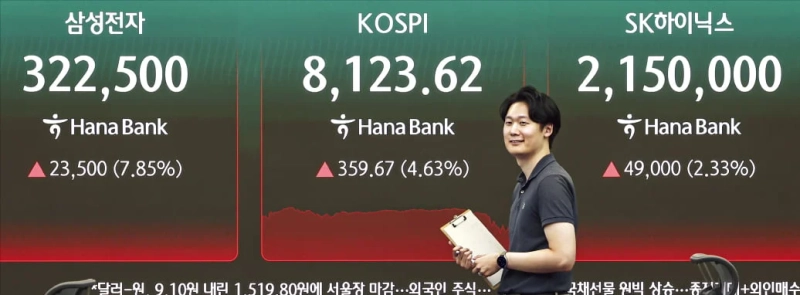
South Korean stocks ended the week with a sharp rebound on June 12 after opening with a Black Monday-style selloff in both the benchmark Kospi and the tech-heavy Kosdaq. Growing expectations of a ceasefire between the US and Iran drew foreign investors back to the local market for the first time in 35 days.
The Kospi closed up 4.63% at 8,123.62. The index surged from the open and briefly climbed above 8,400 before late profit-taking trimmed gains. A buy-side sidecar, a temporary curb on program buy orders, was triggered in the morning for the 13th time this year.
Samsung Electronics rose 7.86%, SK Hynix gained 2.33% and SK Square climbed 10.59%, leading the advance among large-cap stocks. Construction shares expected to benefit from reconstruction projects also gained, along with semiconductor materials, parts and equipment makers. The Kosdaq rose 3.22% to 1,029.05, bringing the Kospi back above 8,000 and the Kosdaq back above 1,000 after both broke those levels on Monday.
The standout development was the return of foreign investors. Foreigners, who had been net sellers on the main board for 24 straight sessions since May 7, bought 2 trillion won of stocks on June 12, according to the Korea Exchange. They were net buyers not only of cash equities, including the two biggest chipmakers, but also of Kospi 200 futures. Securities firms say volatility may continue as variables such as SpaceX's listing and further US rate increases remain in play, though their medium- to long-term outlook for the market remains intact.
Asian equities also advanced on June 12, with Japan's Nikkei 225 rising 2.81%, Hong Kong's Hang Seng Index gaining 1.55% and China's Shanghai Composite adding 1.12%.
Market reacts more to ceasefire hopes than inflation; 19 of top 20 stocks by market value rise
Severe volatility seen through the June FOMC; staggered buying favored over selling into dips
A circuit breaker was triggered on Monday after the Kospi and Kosdaq tumbled together. The Kospi then rebounded to 8,096.93 on Tuesday, fell to 7,730.82 on Wednesday, swung dozens of times between 7,300 and 7,800 on Thursday, and ended Friday higher after breaking above 8,400 intraday.
That was the pattern for South Korea's stock market over the past week. The Kospi repeatedly swung between the 7,300 range and the 8,400 range, while the Kosdaq followed a similar path. Circuit breakers and buy- or sell-side sidecars, which curb trading during sharp futures-driven volatility, were triggered nine times this week across the main board and the Kosdaq market. The market ended June 12 on growing ceasefire hopes, but concerns remain that extreme volatility will continue next week.
Foreigners buy Samsung Electronics and SK Hynix again
South Korean stocks were buffeted throughout the week by tensions between the US and Iran, the possibility of additional Federal Reserve rate increases and concerns that semiconductor shares had peaked, according to the securities industry. Even Nvidia CEO Jensen Huang's visit to South Korea on June 8 failed to stop both the Kospi's 8,000 threshold and the Kosdaq's 1,000 level from breaking, as worries over a peak in chip earnings intensified after Broadcom's results. After that, fears of a broader Middle East war alternated with hopes for a ceasefire, leaving the market whipsawed.
But after US President Donald Trump said on June 11 that a ceasefire agreement was near, the Kospi and Kosdaq rose 4.63% and 3.22%, respectively, on June 12. Lee Kyung-min, an analyst at Daishin Securities, said the market was paying more attention to easing Middle East risks than to inflation pressure, even after US producer prices for May rose 6.5% from a year earlier, the fastest pace in three and a half years. On the main board, 19 of the top 20 stocks by market capitalization finished higher. Samsung Electro-Mechanics was the lone decliner, falling 5.04%.
Foreign investors also turned buyers again. They posted net sales every day from May 7 through June 11, according to the Korea Exchange. Net selling over that stretch totaled 74 trillion won. Even including trades on Nextrade, they sold large amounts of stock almost every day except on May 26, when they bought a net 104.5 billion won, and May 27, when they bought 4.5 billion won. The selling reflected portfolio rebalancing after domestic semiconductor shares surged in a short period.
On June 12, however, foreign investors bought about 2 trillion won of main-board stocks in regular trading. SK Hynix topped net purchases at 1.288 trillion won, followed by Samsung Electronics at 882.9 billion won. Retail investors sold 4.32 trillion won, while institutions bought a net 2.3772 trillion won. Lee said the reversal in a prolonged stretch of foreign selling was helping improve investor sentiment.
Buy in tranches on dips rather than sell
Friday's rally ended in cheers, but forecasts for another week of violent swings are building. Samsung Electronics and SK Hynix account for 51% of the main board's market capitalization, leaving the broader market vulnerable even to modest debate over whether chip stocks have peaked.
That sensitivity was on display again later in the day. After foreign media reported that a global bank was restricting hedge fund leverage tied to Samsung Electronics and SK Hynix because of concerns over a potential plunge following their sharp gains, both stocks pared advances after hitting intraday highs of 330,000 won and 1.29 million won, respectively. The Kospi, which had risen as much as 9% intraday, also finished with a gain in the 4% range. SpaceX's listing, seen as a global liquidity magnet, and the timing of future US rate increases remain additional variables.
Still, securities firms say the medium- to long-term bullish outlook remains intact. Han Ji-young, an analyst at Kiwoom Securities, said the market could face renewed volatility through next week's Federal Open Market Committee meeting, but investors would be better off buying in tranches on pullbacks than raising cash after selling.
Lee Sun-a, Korea Economic Daily reporter suna@hankyung.com

Korea Economic Daily
hankyung@bloomingbit.ioThe Korea Economic Daily Global is a digital media where latest news on Korean companies, industries, and financial markets.