Iran Says Talks Revert to Two-Week-Old Draft; Trump May Unfreeze $24 Billion
Forecast Trend Report by Period


End in Sight for U.S.-Iran War as 14-Point MOU Nears
Deal Would Promise Initial Release of $12 Billion
Oil Tumbles on Hopes Strait of Hormuz Will Reopen
Iran Denies Any Final Agreement on Details
The U.S. and Iran may sign a peace memorandum in Geneva on June 14 that includes a ceasefire, 106 days after the war began. President Donald Trump said a signing could come this weekend, on June 13 or June 14, and a senior Iranian official also indicated the odds of a deal were high. Oil prices tumbled on expectations that ships held up around the Strait of Hormuz could soon resume transit.
Bloomberg reported on June 11, citing Group of Seven officials, that a senior Iranian official said overnight talks had a high chance of producing an agreement between Washington and Tehran. Geneva is emerging as the most likely venue for a signing ceremony. Trump is due to attend the G7 leaders' summit in Evian-les-Bains, France, from June 15 to June 17. That has raised the possibility that any accord could be timed around the summit, given the resort town's proximity to Geneva.
Iran's Mehr News Agency, citing a source tied to Tehran's negotiating team, disclosed details of the proposed memorandum on June 12. The draft contains 14 provisions, including a full lifting of the U.S. maritime blockade within 30 days, a suspension of sanctions on oil and related products, and guaranteed Iranian access to financial assets. It also includes a U.S. commitment to release $12 billion in frozen Iranian funds before the start of a 60-day negotiation period and another $12 billion during the talks.
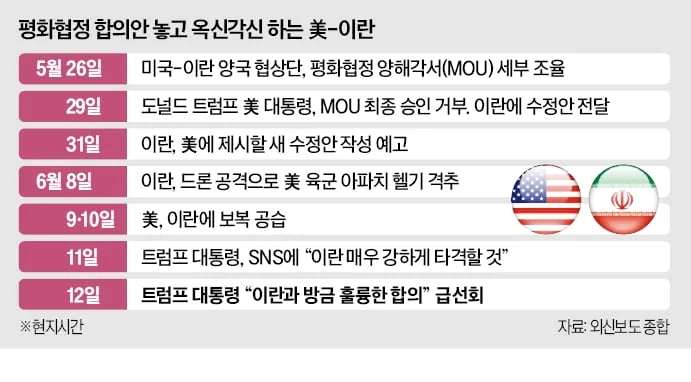
As recently as a day earlier, Trump had threatened to strike Iran's Kharg Island and take control of Iranian oil resources. The mood shifted after he posted on social media that he was calling off the attack roughly three hours before the planned bombing and said a deal was close.
Iran's Fars News Agency gave a more detailed account of the negotiations. Two weeks ago, the two sides had effectively reached the final stage of an agreement, but talks were halted after Trump demanded the addition of several details. On June 10, however, Qatar stepped in as a mediator and the U.S. withdrew its demand for extra clauses, returning the process to the version agreed two weeks earlier with no new provisions added.
The negotiations have not been finalized. Fars denied reports of a June 14 signing ceremony in Geneva, saying Iran's internal review and decision-making process had not yet been completed. It said it fully denied those reports. Still, the draft agreed two weeks ago reflects terms Tehran had been seeking from Washington, which may support a favorable internal review.
Trump said on June 11 that the core of any agreement was Iran's commitment not to possess nuclear weapons. Still, the most plausible scenario is that the two sides first sign a broad accord and leave detailed plans, including the removal of enriched uranium, for follow-up negotiations.
International oil prices fell sharply on news that a ceasefire deal could be near. On the New York Mercantile Exchange, West Texas Intermediate for July delivery dropped to $83.37 a barrel at about 4 a.m. on June 12. Brent for August delivery, which settled at $90.38 the previous day, fell to $85.97.
Lee Sang-eun, Washington correspondent, Hankyung.com, selee@hankyung.com

Korea Economic Daily
hankyung@bloomingbit.ioThe Korea Economic Daily Global is a digital media where latest news on Korean companies, industries, and financial markets.