BOK Governor Warns Samsung Bonuses Could Stoke Korea Inflation
Forecast Trend Report by Period


High inflation may persist well after war ends
Oil shock could spread to other goods
IT-sector bonuses may fuel demand-side price pressure
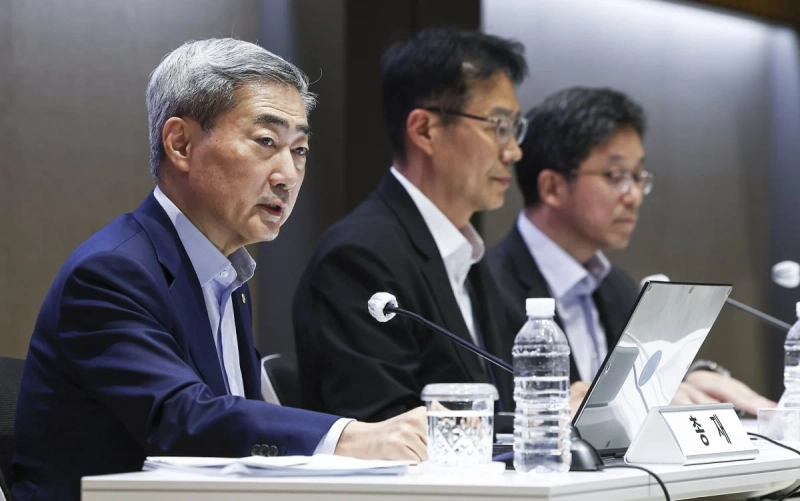
Bank of Korea Governor Shin Hyun-song said consumer inflation is set to remain elevated for a prolonged period even if the war in the Middle East ends, as high oil prices continue to ripple through the economy. He said the jump in crude prices could spread beyond energy to other goods, and that hefty performance bonuses paid by semiconductor companies could add to demand-side inflation pressure. At the same time, he pushed back indirectly against market speculation over a “big step,” or a 50-basis-point increase in the benchmark interest rate at a single meeting.
At a June 17 briefing at the Bank of Korea on its inflation-targeting framework, Shin said it would take a long time for energy supply chains to return to prewar conditions and for global oil prices to stabilize. As a result, consumer inflation will remain high for a considerable period, he added.
In a report released the same day, the Bank of Korea forecast consumer inflation at about 3% in the second half of this year and core inflation in the mid-to-upper 2% range. Shin said the accumulated impact of high oil prices could spread from energy to other categories with a lag. The BOK’s analysis of cases since 2000 in which an oil-price shock lasted more than three months found that a 10% increase in crude prices lifted core inflation by more than 0.1 percentage point about five months later.
A similar pattern appeared during the Russia-Ukraine war that began in February 2022. Global oil prices climbed to $118 a barrel in June 2022 before turning lower, but the contribution to inflation from items excluding petroleum products widened instead. The correlation between global oil prices and price gains in industrial goods, electricity, gas and water, and services excluding dining out peaked after a lag of about 14 to 18 months. That suggests the oil shock spread to other prices after roughly a year and a half. Shin said the recent weakness of the won is also amplifying the rise in oil prices. The BOK is watching for second-round inflation effects and pressure on inflation expectations.
Shin also singled out large performance bonuses at semiconductor companies as a new source of inflation pressure. The central bank now judges that wages and demand are exerting a stronger upward pull on prices than it did at its monetary policy meeting in May, he said.
According to the BOK, an increase in the share of companies paying bonuses in the top 10% of the industry lifts consumer inflation by 0.05 percentage point five months later. In the first quarter, IT-sector bonuses accounted for 1.3 percentage points of the 3.4% increase in nominal wages. That placed them in the top 3% of the wage distribution for 2012-2025.
The BOK said the contribution of bonuses in the IT sector will probably reach an unusual level early next year, exceeding the top 1% of historical observations. It said bigger payouts at semiconductor companies could fuel wage-hike demands in other industries and add to demand-side inflation pressure.
Still, Shin distanced himself from market talk of a big-step rate increase. Such speculation surfaced when markets were under strain, with government bond yields and the won-dollar exchange rate rising sharply, he said. The central bank will set monetary policy based on the economy’s underlying trend rather than react to every move in financial markets. Sim Sung-mi, Korea Economic Daily reporter, smshim@hankyung.com

Korea Economic Daily
hankyung@bloomingbit.ioThe Korea Economic Daily Global is a digital media where latest news on Korean companies, industries, and financial markets.