PiCK
US to Waive Iran Oil Sanctions After June 19 Ceasefire Signing, Raising Prospect of Brent in $60s
Summary
- The US said it would immediately waive sanctions on Iranian crude and end all economic sanctions after a 60-day negotiating period.
- As Iranian crude returns to the global market, Brent crude and WTI each tumbled more than 5%, sending international oil prices to their lowest level in three months.
- Goldman Sachs lowered its Brent forecast and said large-scale investment through a reconstruction fund could boost Iran’s oil production, adding to downward pressure on prices.
Forecast Trend Report by Period


Iranian oil set to return as crude prices slide
US to grant immediate sanctions relief after June 19 ceasefire signing
Brent drops back into the $70s

The US has decided to immediately waive sanctions on Iranian crude when a planned 60-day ceasefire memorandum of understanding is signed on June 19. The move points to a medium- to long-term increase in global oil supply, and crude prices have already fallen sharply.
Bloomberg and other media outlets reported on June 16 that the US had promised to effectively lift sanctions on Iranian oil as soon as the agreement is formally signed. Washington would then end all economic sanctions on Iran under a timetable for a final agreement to be set during the 60-day ceasefire period. Sanctions on the financial, insurance and shipping services needed for oil exports are also set to be waived during that period. The US and its Western allies have enforced tough sanctions on Iranian oil exports since 2012.
Trump administration officials had previously said sanctions would be eased in stages if Iran carried out nuclear-related commitments such as diluting and disposing of enriched uranium. The draft MOU made public, however, takes the opposite approach: sanctions relief first, compliance later. That means Iran could return to the global oil market before fulfilling pledges such as disposing of enriched uranium.
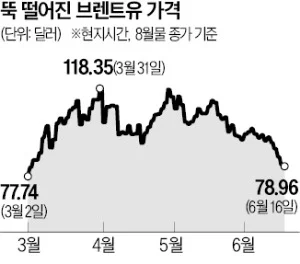
The prospect sent international crude prices lower on June 16, pushing them to their lowest level in more than three months. Brent crude futures for August delivery settled at $78.96 a barrel on ICE Futures Europe, down 5.1% from the previous session. West Texas Intermediate futures for July delivery settled at $76.05 a barrel on the New York Mercantile Exchange, a 5.8% decline.
Oil from the holder of the world’s third-largest reserves may return to market, fueling hopes for a sharper price drop as Strait traffic resumes
Economic sanctions to end during 60-day talks, including banking, shipping and insurance services
A draft of the 60-day ceasefire memorandum electronically signed by the Trump administration and Iran on June 14 includes broad economic incentives for Tehran. It marks a sharp reversal by a US administration that had once threatened to wipe out Iran’s civilization.
Sanctions to be lifted immediately
Under the 14 provisions disclosed by Bloomberg on June 16, the US promised to end all economic sanctions on Iran according to the schedule for a final agreement after the 60-day negotiation period. Trump administration officials had previously said sanctions relief would be offered as an incentive for Iran to carry out nuclear-program commitments, including the dilution and disposal of enriched uranium.
But the draft MOU shows the US agreed to effectively lift sanctions on Iranian oil exports as soon as the signing takes place. The document states that the US Treasury Department would issue waivers covering Iranian crude, petrochemical products and derivatives, as well as all related services including banking, insurance and shipping, from immediately after the MOU is signed until the day sanctions are formally lifted. If that language stands, Iran would reenter the global oil market before carrying out promises such as disposing of enriched uranium.
The US and other Western countries have imposed various sanctions on Iran since the 1979 Islamic Revolution. Restrictions on Iranian oil exports intensified in 2012. Since then, Iranian crude has effectively become a discounted product, exported only through sanctions-evasion measures such as illegally changing its country of origin in third countries. Most shipments moved through Southeast Asia before reaching buyers including China and India. Prices were also lower.
Sanctions were temporarily lifted in 2016 under the Joint Comprehensive Plan of Action reached during Barack Obama’s administration, and countries including South Korea imported substantial volumes of Iranian crude during that period. But sanctions were reimposed in 2018.
Linked to reconstruction fund
If Iranian crude becomes fully tradable in the international market starting June 19, it would have a significant effect on the global oil supply-demand balance. Traffic through the Strait of Hormuz is still expected to take time to normalize, but the removal of sanctions on Iranian crude could speed the decline in oil prices.
There are also growing expectations that shipping through the strait could resume sooner than anticipated. CNBC reported that Goldman Sachs lowered its Brent forecast for the fourth quarter to $80 a barrel from $90, citing a faster-than-expected recovery in oil exports from the region. It also cut its 2027 forecast to $75 from $80.
Large-scale investment through a reconstruction fund could also significantly increase Iranian oil production over the longer term. Iran’s annual crude output is estimated at 20.8 billion barrels. Before the war, it produced about 4.5 million barrels a day, ranking sixth in the world. Export volumes after domestic consumption stood at 1.66 million barrels a day at the end of last year.
The US plans to attract private-sector investment from allies including South Korea, Japan and Europe as it builds the reconstruction fund. That could make it harder for Washington to reimpose economic sanctions on Iran even after the 60-day ceasefire period ends. It also leaves the US with limited leverage if Iran is slow to dispose of nuclear material and take other agreed steps.
Another variable is growing bipartisan pressure in Congress to formally debate the agreement. Semafor reported that Senator Bill Cassidy, a Republican from Louisiana, said a US-Iran nuclear accord should be ratified by a two-thirds vote in the Senate.
Lee Sang-eun, Washington correspondent, Korea Economic Daily, selee@hankyung.com

Korea Economic Daily
hankyung@bloomingbit.ioThe Korea Economic Daily Global is a digital media where latest news on Korean companies, industries, and financial markets.