Kospi Tops 9,000 as Stocks Brush Off Hawkish Fed Shift
Summary
- The Fed kept its benchmark interest rate unchanged and adopted a more hawkish tone in its statement and dot plot, but the impact on South Korea’s Kospi is expected to be limited.
- Analysts said continued capital expenditure (CAPEX), the credit cycle, and upward revisions to corporate earnings estimates mean companies’ investment activity and stock prices are instead becoming variables that shape interest rates.
- Unless there is a sustained and steep tightening cycle, the Kospi is set to keep outperforming the S&P 500 and the Kosdaq, while the hurdle for a rate hike remains high and the case for a rate cut is still intact.
Forecast Trend Report by Period


“Stock-market weakness during rate-hike cycles belongs to an earlier era of weak demand”
“In a capex and credit cycle, stock prices can instead help shape interest rates”
New Federal Reserve Chair Kevin Warsh used his first Federal Open Market Committee meeting to underscore the central bank’s commitment to price stability, making clear the Fed’s hawkish turn. Analysts said the shift is unlikely to have much impact on South Korea’s stock market.
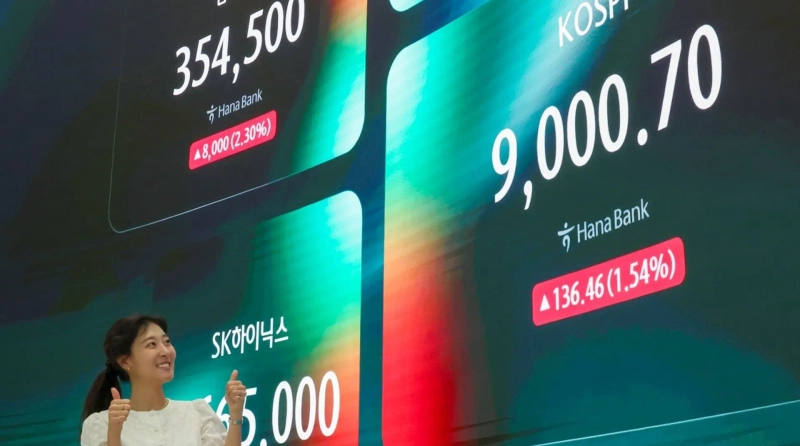
The Kospi rose above 9,000 intraday on June 18, extending its record rally. Concerns had mounted that the benchmark would come under pressure after US stocks fell on the FOMC’s hawkish tone, but the index instead gained more than 1%.
The Fed said early June 18 it would keep its benchmark rate unchanged at 3.50% to 3.75%. The decision was unanimous, with 12 votes in favor and none opposed, in contrast to the April meeting, when four members dissented.
The clearest change in the FOMC statement was the removal of prior policy guidance. Earlier decisions to hold rates had been framed in a way that preserved the possibility of cuts, but this statement dropped the phrase “easing bias.”
The Fed also removed the phrase “additional adjustments,” which had remained in the March and April statements. Markets took that as a sign the central bank had withdrawn its earlier signal that rate cuts were still on the table.
Instead, the Fed said inflation still exceeds the committee’s 2% target and in part reflects supply shocks that lifted prices in some sectors, including energy. “The Committee will deliver price stability,” it said.
The dot plot also turned more hawkish. Of the 18 officials who submitted rate projections released on June 18, nine expected at least one rate hike this year. Eight projected no change, and only one forecast a cut. That was a sharp shift from March, when almost no officials anticipated a hike this year.
The median year-end policy rate rose to 3.8% from 3.4% in March, reflecting the possibility of one increase before year-end. That has led markets to raise their assessment of the odds of a rate hike this year.
Even so, many analysts see limited fallout for South Korean equities.
Kim Sung-hwan, an analyst at Shinhan Securities, said the old pattern no longer holds. In the past, demand improved only when rates fell, which meant interest rates dictated the direction of the stock market. That is no longer the case, he said, adding that Big Tech companies do not ramp up capital expenditure simply because rates are low and then drive up intermediate-goods prices.
When capital expenditure and credit rise together in the same cycle, the causal relationship flips, Kim said. Corporate investment activity and stock prices then become variables that help determine interest rates.
Hur Jae-hwan, an analyst at Eugene Investment & Securities, said expectations for upward revisions to earnings estimates for US and South Korean companies remain intact despite concerns over higher rates. That means data-center investment and earnings expectations for related companies remain valid even if rates rise.
The stronger concerns over tightening become, the less likely market leadership is to shift away from existing winners where capital-expenditure demand is clear, Hur said. Unless markets enter a sustained and steep tightening phase, he expects the Kospi to continue outperforming the S&P 500 and to maintain an edge over the Kosdaq.
Some analysts also argue that despite the statement’s hawkish tilt, the bar for an actual rate hike remains high, leaving the possibility of cuts intact.
Hur Jin-wook, an analyst at Samsung Securities, said he still expects two additional rate cuts, in December 2026 and March 2027, even though the risk of a Fed hike has risen. He cited rapidly falling oil prices and the fading effects of tariffs and higher energy prices, which he said increase the chances that inflation will cool.
Most officials calling for a rate hike this year are likely to be hawkish regional Fed bank presidents, he said. A majority of this year’s voting members, including Fed leadership, still appear to support holding rates steady. If inflation slows more gradually, the start of rate cuts could be delayed until next year, but the hurdle for a rate hike remains high, he added.
Noh Jeong-dong, Hankyung.com reporter dong2@hankyung.com

Korea Economic Daily
hankyung@bloomingbit.ioThe Korea Economic Daily Global is a digital media where latest news on Korean companies, industries, and financial markets.