PiCK
South Korea Weighs Moving Crypto Exchange Shareholder Reviews to Digital Asset Law
Summary
- A plan is being pushed to move controlling-shareholder eligibility reviews for virtual-asset exchanges under the anti-money laundering law to the Digital Asset Basic Act.
- Naver’s fine for violating the Fair Trade Act could become grounds for disqualification as Dunamu’s controlling shareholder under the revised anti-money laundering law, making the stock swap a risk factor.
- Legal analysts said the Naver-Dunamu merger could still face a controlling-shareholder eligibility dispute even if the review is transferred to the digital asset law.
Forecast Trend Report by Period


Could the Naver-Dunamu Deal Face a New Hurdle?
AML Law Seen Reaching Limits in Exchange Oversight
Debate Grows Over Legal Consistency
South Korea Moves Toward Sector-Specific Rules Like Those for Banks
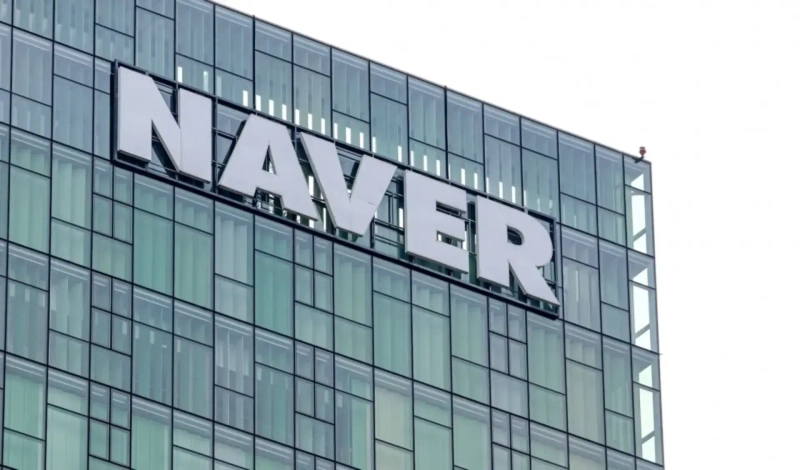
South Korea is pushing to move eligibility reviews for controlling shareholders of virtual-asset exchanges out of the Act on Reporting and Use of Certain Financial Transaction Information, the country’s anti-money laundering law, and into the proposed Digital Asset Basic Act. The move reflects a broader push to unify market-entry rules under a sector-specific law, as is done for banks and insurers.
The issue has drawn renewed attention after a stock swap between Naver Corp. and Dunamu Inc. put controlling-shareholder eligibility at the center of the deal. It has also fueled debate over whether an anti-money laundering law should be used to assess an exchange’s ownership and governance structure.
AML Law as a Stopgap
According to the National Assembly and the government on June 18, the Financial Services Commission is reviewing a plan to reorganize exchange entry regulations under a separate industry-law framework as discussions on the Digital Asset Basic Act proceed. The plan would cover controlling-shareholder reviews, approvals for ownership changes and ongoing eligibility checks.
At present, exchange registration and ownership-related change filings are governed by the anti-money laundering law. So far, authorities have mainly considered disqualifying factors such as criminal records of chief executives and other executives when deciding whether to accept a registration filing. But revisions to the law will expand the review to controlling shareholders starting Aug. 20.
Under the revised law, a registration, change or renewal filing may be rejected if a controlling shareholder has been fined or received a heavier penalty for violating the Fair Trade Act or the Act on the Aggravated Punishment of Specific Economic Crimes.
That is why controlling-shareholder eligibility has emerged as a major risk in the Naver-Dunamu stock swap. Naver was fined last year for violating the Fair Trade Act over allegations that, while receiving real estate listing information, it prevented partner companies from providing the same data to competitors.
If Naver Financial Co., a major shareholder of Naver, comes to hold Dunamu as a wholly owned subsidiary, Naver’s Fair Trade Act violation could be treated as grounds for disqualifying a controlling shareholder under the revised law. In that case, a change filing related to Dunamu’s controlling shareholder could be rejected. The two companies therefore plan to hold an extraordinary shareholders’ meeting on Aug. 18, just before the revised law takes effect, to complete the stock swap.
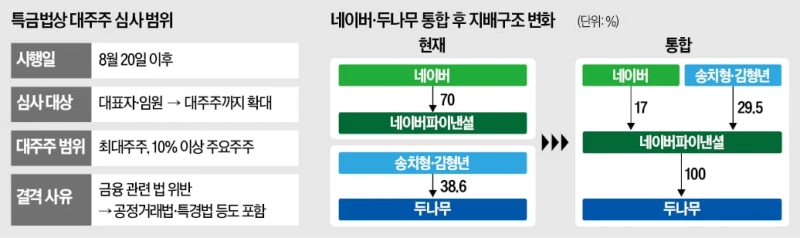
Will It Affect the Naver-Dunamu Combination?
The anti-money laundering law came to include controlling-shareholder reviews for virtual-asset exchanges because no separate industry law existed. Even so, critics argue that using an anti-money laundering statute to judge an exchange’s ownership and governance structure does not fit the broader legal framework, even if a regulatory gap existed. The issue was also raised during deliberations on the 2024 amendment to the law.
A review report by the National Assembly’s Political Affairs Committee said entry regulations aimed at protecting users and improving market soundness should, where possible, be set out in the Virtual Asset User Protection Act. At the time, however, lawmakers concluded that the anti-money laundering law had to be amended first, taking into account the renewal filing schedule for existing operators.
Legal analysts say moving the controlling-shareholder review to the digital asset law would not necessarily end the dispute over Naver and Dunamu’s shareholder eligibility. Naver’s record of violating the Fair Trade Act would likely remain subject to review under a sector-specific law as well. Still, critics say it is hard to avoid questions about legal consistency when a rule that could determine whether a corporate M&A deal proceeds contains structural gaps.
“There is a need, even now, to clearly separate the roles of entry regulation and anti-money laundering regulation,” a legal industry official said.
Cho Mi-hyun, Korea Economic Daily reporter mwise@hankyung.com

Korea Economic Daily
hankyung@bloomingbit.ioThe Korea Economic Daily Global is a digital media where latest news on Korean companies, industries, and financial markets.