US Bank Stocks Hit 15-Year Intraday Highs as IPO Revival Fuels Rally
Summary
- US financial stocks, especially the KBW Bank ETF and large bank shares including JPMorgan and BofA, hit intraday record highs for the first time in 15 years.
- Expectations for better earnings are rising as large IPOs drive a surge in fee income and banks use AI to cut costs.
- Institutional buying is flowing in as the projected P/E ratio of the XLF ETF, which holds large banks, is about 30% cheaper than the S&P 500.
Forecast Trend Report by Period


Big IPOs Drive Surge in Fee Income
Buying Flows Shift Into Financials
KBW Bank ETF, JPMorgan and BofA
Large-Cap Names Set Intraday Records
"About 30% Cheaper Than the S&P 500"
Financials Emerge as Alternative to Soaring AI Stocks
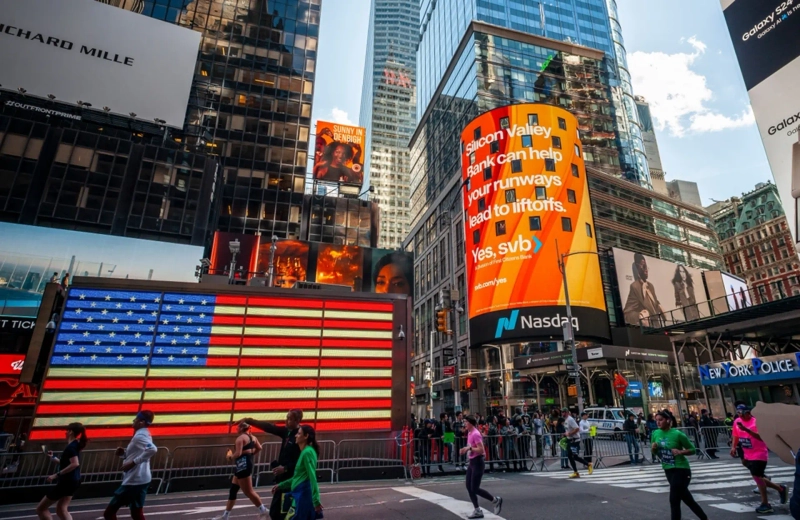
US financial stocks hit 15-year intraday highs in New York trading on June 17, drawing renewed investor attention after being overshadowed by the artificial intelligence boom. A revival in capital markets driven by large initial public offerings, along with still-cheap bank valuations, is helping fuel the move.
Bank ETF Hits Intraday Record
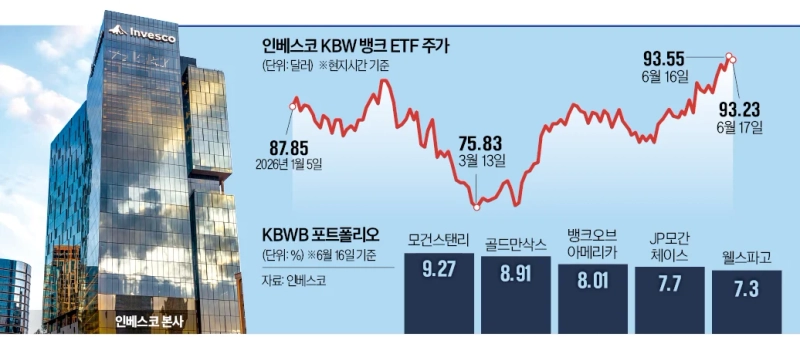
The Invesco KBW Bank ETF, which holds major US bank stocks and trades on the Nasdaq, rose 3.06% over the past five trading sessions. It ended June 17 down 0.34% at $93.23, after climbing as high as $95.05 during the session. That marked the fund's highest intraday level since its 2011 listing.
Large bank stocks also reached intraday highs. JPMorgan Chase rose as much as 2% to $337.77, while Bank of America gained 2% to $57.98. Major investment banks including Goldman Sachs and Morgan Stanley also moved higher. The shares later reversed course after Kevin Warsh began his first press conference as Federal Reserve chair, heightening caution over monetary-policy uncertainty.
On Wall Street, attention is shifting to large financial stocks after the sharp run-up in technology shares. In earlier cycles, big banks often stumbled briefly at the start of rate-hiking phases or during macroeconomic shocks. Once they adjusted to the new environment, however, they tended to resume climbing in a step-by-step pattern.
JPMorgan Chase illustrates that trend. Its shares rose as high as $171 in 2021, when interest rates were held at 0.00% to 0.25% during the pandemic response. The stock then fell to around $101 the following year as the Fed's aggressive tightening cycle rattled markets. Investors were factoring in a jump in short-term funding costs after the central bank delivered four straight 75-basis-point hikes from June through November, lifting the benchmark rate to 4.25% to 4.50%.
JPMorgan rebounded after weathering the regional banking turmoil triggered by Silicon Valley Bank's collapse in 2023. As regional lenders faced fears of a chain of failures, customers shifted deposits to the biggest banks. The stock then held in a relatively firm range of about $130 to $170.
This year, the shares rebounded again after the latest bout of turmoil passed. JPMorgan touched a record $334 in January, then slid to around $282 in February as conflict in the Middle East and an oil shock weighed on sentiment. It quickly recovered as the chances of a ceasefire improved, and this month returned to around $333, near its prior peak.
Revived Capital Markets Spark Fee Windfall
Brokerages are also focusing on a recent surge in fee income. As the IPO market regains momentum, large banks are collecting sharply higher fees. SpaceX's $75 billion fundraising is a leading example, generating as much as $500 million in fees for underwriters.
Josh Brown, chief executive officer of Ritholtz Wealth Management, said large banks are no longer simply financial firms dependent on net interest margins. They have become fee-based businesses and are benefiting from the recovery in IPO activity.
Another factor is a business-model overhaul that combines finance with new technology rather than relying solely on lending income. Financial firms are moving aggressively to apply AI to core operations, including borrower credit assessments and insurance risk analysis, to cut operating costs and widen profit margins.
Still-cheap valuations relative to earnings expectations are also attracting institutional investors. Barron's said the Financial Select Sector SPDR Fund, which trades under the ticker XLF and holds major US banks, is valued at less than 15 times projected earnings over the next 12 months. That compares with about 21 times for the S&P 500, making it roughly 30% cheaper.
Park Ju-yeon, Hankyung.com reporter grumpy_cat@hankyung.com

Korea Economic Daily
hankyung@bloomingbit.ioThe Korea Economic Daily Global is a digital media where latest news on Korean companies, industries, and financial markets.