Kospi Tops 9,000 for First Time as Samsung, SK Hynix Earnings Rally Overcomes Fed Tightening Fears
Forecast Trend Report by Period


Kospi 9,000, powered by semiconductors
Up 115% this year
Earnings optimism builds for Samsung and SK Hynix
Bullish calls see 10,000 before year-end
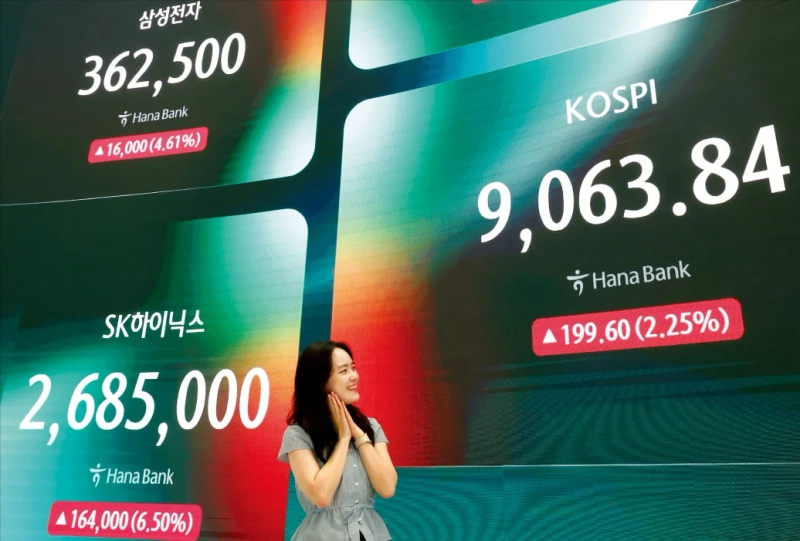
South Korea’s Kospi index closed above 9,000 for the first time, shrugging off a drop in US stocks triggered by fresh Federal Reserve tightening signals. Rising earnings expectations for chipmakers and the government’s push to boost valuations through commercial law revisions are fueling views that the so-called Korea discount is starting to fade.
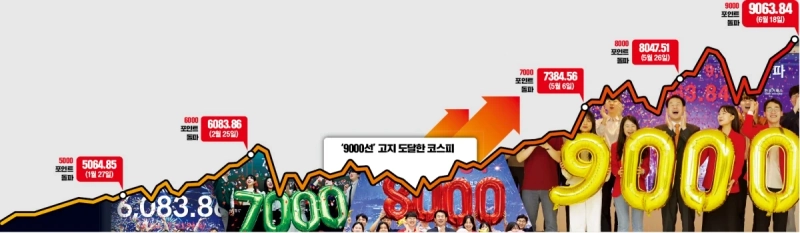
The Kospi rose 2.25% to 9,063.84 on June 18. It has advanced for six straight sessions since June 11. After closing at 8,047.51 on May 26 to top 8,000, the benchmark took just 23 days to break through 9,000.
The index came under pressure at the open. Overnight, Fed Chair Kevin Warsh signaled after the Federal Open Market Committee’s regular meeting that interest rates could still rise this year. US equities fell across the board, with the Nasdaq down 1.34% and the S&P 500 lower by 1.21%.
The Kospi then reversed course as a ceasefire agreement in the Middle East revived risk appetite. Another surge in semiconductor shares, the main driver of the benchmark’s rally, gave the index the momentum to clear 9,000.
SK Hynix rose 6.51% to close at 2.685 million won on June 18 after touching a record 2.7 million won intraday. Samsung Electronics gained 4.62% to 362,500 won. Samsung also returned to the global top 10 by market capitalization, overtaking Meta Platforms and Tesla.
With the latest gain, the Kospi is up 115.08% from the end of last year. The rally reflects repeated upward revisions to profit forecasts for semiconductor companies including Samsung and SK Hynix, along with a valuation boost tied to the government’s commercial law revisions.
An analysis by the Korea Economic Daily showed that the 12-month forward price-to-earnings ratio for Kospi-listed companies excluding Samsung Electronics and SK Hynix from January through May had already surpassed Hong Kong’s Hang Seng Index on a full-year basis and the UK’s FTSE 100 as of May. If the forward multiples of Samsung and SK Hynix, still relatively low because earnings estimates have surged, catch up with the rest of the market, the Kospi could move well beyond 10,000.
Chip-led Kospi makes new history 23 days after topping 8,000
Daishin Securities says 11,500 is possible
The global macro backdrop was not favorable. The Bank of Japan raised its policy rate to 1% on June 16, the highest level in 31 years. The Fed and the Bank of Korea also strongly signaled that rate hikes remain possible this year.
Even so, the Kospi extended its rally because earnings momentum at semiconductor companies proved strong enough to overpower tightening worries. Sharp increases in price targets for US memory maker Micron Technology also added to optimism for the industry.
Only chip-related shares surged
On June 18, just 102 stocks on the Kospi advanced, including Samsung Electronics and SK Hynix. While the index climbed 2.25%, as many as 771 stocks fell, underscoring the extreme concentration of gains in semiconductor-related names.
Samsung Electronics and SK Hynix, up 4.62% and 6.51%, respectively, led the push above 9,000. Samsung Life Insurance, which rose 4.92%, and SK Square, up 6.52%, posted similar gains as investors focused on the value of their stakes in the two chipmakers.
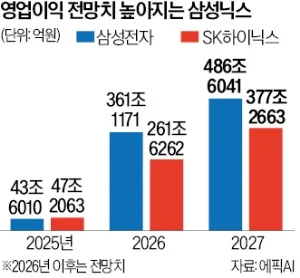
The concentration in Samsung and SK Hynix reflects steadily rising profit estimates for both companies. According to AI-based investment information service EpicAI, Samsung Electronics is forecast to post operating profit of 361.1171 trillion won this year and 486.6041 trillion won next year. Those consensus estimates are up 4.36% and 9.89%, respectively, from a month earlier. SK Hynix’s operating profit outlook was also revised higher, to 261.6262 trillion won this year, up 3.07% from a month ago, and 377.2663 trillion won next year, up 8.12%.
According to CompaniesMarketCap, Samsung Electronics’ dollar-denominated market capitalization stood at $1.562 trillion on June 18, putting it back in the global top 10 ahead of Tesla at $1.488 trillion and Meta Platforms at $1.44 trillion.
SK Hynix drew further support from news that it had supplied samples of its seventh-generation high-bandwidth memory, or HBM4E, and was pursuing a US listing of American depositary receipts. The company also signaled a shareholder return plan of as much as 100 trillion won aimed at preventing erosion of shareholder value, helping drive a larger gain in the stock. Beyond the two giants, gains spread across the broader chip ecosystem, including Samsung Electro-Mechanics, up 8.27%, and LG Innotek, up 2.80%, both of which make semiconductor substrates and related components.
Foreign investors were net buyers of 1.4286 trillion won, helping lift the Kospi above 9,000. Samsung Electronics accounted for the largest share of those purchases at 689 billion won.
Most other stocks fell. Among the 30 biggest companies by market capitalization, 21 declined, including Hyundai Motor, down 2.75%, LG Energy Solution, down 3.85%, and HD Hyundai Heavy Industries, down 3.25%.
Micron price target also raised
The strength in chip shares was evident in the US as well, even as the broader market fell. Micron rose 2.20% overnight to close at $1,043.19 while the Nasdaq dropped 1.34%. Deutsche Bank raised its price target on Micron to $1,500 from $1,000, citing the likelihood that earnings forecasts will rise further as memory prices strengthen.
The upbeat outlook for semiconductors is reinforcing expectations of further gains in the Kospi. Analysts see earnings growth led by chipmakers as the force that could carry the index to 10,000. Daishin Securities raised its 2026 target for the Kospi to 11,500 from 8,800, citing upward revisions to earnings estimates for semiconductor companies.
“The domestic stock market is in a classic earnings-and-policy cycle,” Lee Kyung-min, an analyst at Daishin Securities, said. The upside for the Kospi should remain open until 12-month forward earnings per share begin to turn down, he added.
Kang Jin-gyu and Bae Seong-su, Korea Economic Daily reporters, josep@hankyung.com

Korea Economic Daily
hankyung@bloomingbit.ioThe Korea Economic Daily Global is a digital media where latest news on Korean companies, industries, and financial markets.