Warsh Drops Guidance, Skips His Dot as Fed Signals Higher Rates; Markets Fear More Volatility
Summary
- The Fed said it held its benchmark rate at 3.50% to 3.75% while signaling a move to 3.8% by year-end.
- Warsh scaled back the use of forward guidance and the dot plot, indicating that the Fed’s policy path may become less predictable.
- Markets are concerned that reduced communication and the possible scrapping of the dot plot could increase future market volatility and policy uncertainty.
Forecast Trend Report by Period


Warsh’s First FOMC Delivers a Hawkish Hold in 132 Words
Fed Strongly Signals a Rate Increase This Year
No Dots, Shorter Statement
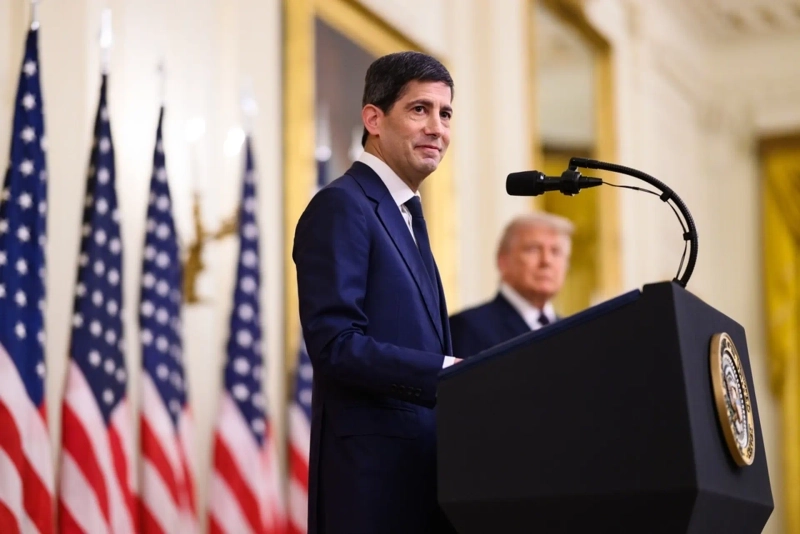
Federal Reserve Chair Kevin Warsh presided over his first regular Federal Open Market Committee meeting on June 17. In the statement and at his press conference, he signaled that rates could rise, easing concerns that he would be swayed by President Donald Trump’s calls for cuts. At the same time, he kept his language restrained to limit the market impact.
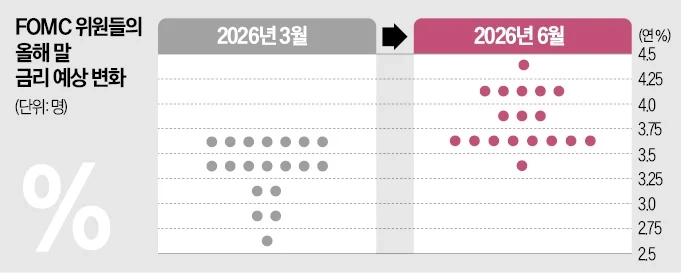
The Fed left its benchmark interest rate unchanged at 3.50% to 3.75%. In the Summary of Economic Projections, it sharply raised this year’s inflation outlook and moved up the projected rate path.
Fed officials put the appropriate policy rate at 3.8% at the end of this year. They raised the 2027 year-end projection to 3.6% from 3.1%, and the 2028 projection to 3.4% from 3.1%. In its statement, the FOMC said inflation remains above its 2% target and reflects the effects of supply shocks that pushed up prices in some sectors, including energy. It also stressed its commitment to restoring price stability.
Barclays said Warsh’s policy statement was much shorter, in the style of Alan Greenspan. The bank said the Fed chair characterized inflation as elevated and showed a strong commitment to price stability. Still, markets appeared to view his hawkish turn as manageable because he cited temporary energy-price gains as a key driver of inflation.
Warsh’s first FOMC statement ran to just 132 words. That was down sharply from 345 words at the Fed’s April meeting under Jerome Powell. The change reflected Warsh’s view that excessive Fed explanation of the macro policy path can lead to policy mistakes, and that messaging should be kept as restrained as possible.
At His First FOMC, Warsh Says Fed Messaging Distorts Markets
Broader Changes to Communication Framework May Come by Year-End
Warsh was unequivocal after chairing his first FOMC meeting on June 17: He does not want markets trying to read the Fed’s every signal. He effectively discarded forward guidance, long seen as a key tool for gauging the Fed’s view on the economy and rates. He also declined to submit a dot to the rate-path chart, which offers clues on specific policy levels. The move underscores his intention to focus the Fed on setting rates based on incoming economic data. Some on Wall Street, however, fear that reduced visibility into the Fed’s policy direction could amplify market swings.
No Advance Signal on the Policy Path
The FOMC statement was cut to less than half the length seen under Powell. Speaking just after its release, Warsh said the statement was “shorter and simpler” than before and included only the facts as policymakers saw them, with outdated phrasing removed.
On the removal of forward guidance, he said it was not appropriate in the current policy environment. Forward guidance is the tool the Fed uses to shape market expectations by offering advance hints on the future path of rates. It became one of the central bank’s signature tools after the global financial crisis and during the Covid-19 pandemic.
Warsh made clear he would rather describe current economic conditions and policy judgments as they stand than pre-commit to a future path. “Our north star is to conduct monetary policy properly,” he said. “The statement should convey facts.”
Dot Plot Turns More Hawkish, but ...
The Fed left rates unchanged at 3.50% to 3.75% at this meeting, but the dot plot shifted in a more hawkish direction. The median projection for the end of this year rose to 3.8% from 3.4% in March. The inflation forecast for this year was also revised up sharply to 3.6%.
But Warsh did not submit his own dot, making it harder to infer his policy leanings. He said the dot plot does not help in carrying out policy. He also said the Fed would review its broader communications framework by the end of this year, including press conferences, the dot plot, meeting procedures, and the minutes and transcripts. That has fueled speculation that the dot plot itself could disappear.
Warsh spent considerable time explaining his case against the dot plot. “Every dot plot is written in pencil with an eraser,” he said. Officials know the world can change very quickly even when they submit those projections. He added that they did not see themselves as bound by those forecasts six weeks later, or even six days later. If conditions change, the outlook can change as well.
Will Uncertainty Rise?
Some investors worry that uncertainty could increase if statements remain concise and the dot plot also disappears. That concern surfaced at the press briefing, where Warsh was asked whether changes to Fed communications could heighten market volatility.
Warsh said financial markets become less efficient if they are fixated on guessing how the Fed will react to any given data point. That is because market prices themselves, the most important source of information for rate policy, become contaminated by Fed messaging. In his view, Fed signaling can distort markets and weaken the effectiveness of monetary policy.
He also stressed that the Fed’s top priority is to achieve price stability, the mandate given by Congress.
That appeared to reflect sensitivity to concerns that Trump could influence interest-rate policy. Trump was reported to have responded briefly to the Fed’s decision to hold rates steady on June 17, saying, “That’s fine. It doesn’t matter.”
Park Shin-young, New York correspondent, Hankyung.com, nyusos@hankyung.com

Korea Economic Daily
hankyung@bloomingbit.ioThe Korea Economic Daily Global is a digital media where latest news on Korean companies, industries, and financial markets.