Exclusive: Iran Requires War-Risk Insurance for Hormuz Transit, Laying Groundwork for Future Fees
Summary
- Iran said ships transiting the Strait of Hormuz must carry PGSA-approved hull war voyage insurance.
- The Iranian government is currently covering the insurance premium, while putting in place a system that could later impose fees.
- The policy covers losses in the Strait of Hormuz from capture, seizure and mines, but is automatically canceled if war breaks out among major powers.
Forecast Trend Report by Period


Iran has begun requiring all vessels passing through the Strait of Hormuz to carry insurance approved by its government, putting in place a system that could later be used to impose transit-related charges. For now, no fee is being collected.
The Persian Gulf Strait Authority, or PGSA, said it began accepting vessel applications on June 18, when a memorandum of understanding on ending hostilities between the US and Iran took effect.
Under general and special passage terms posted on the PGSA website, ships seeking to transit the strait must hold a valid navigation permit issued by the authority. They also must carry PGSA-approved "HULL WAR VOYAGE INSURANCE."
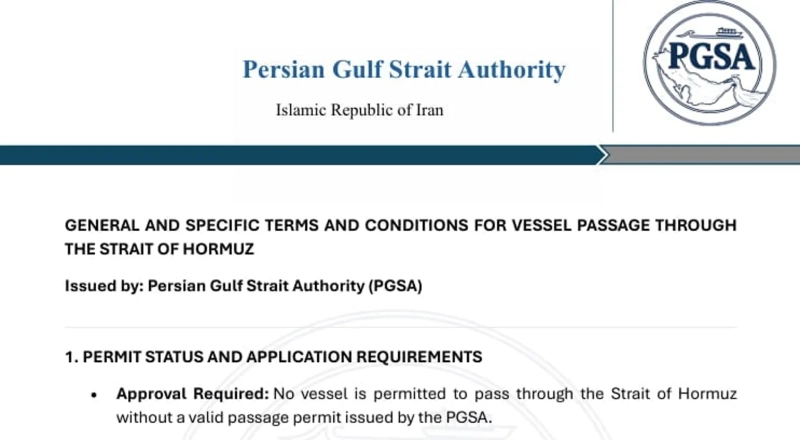
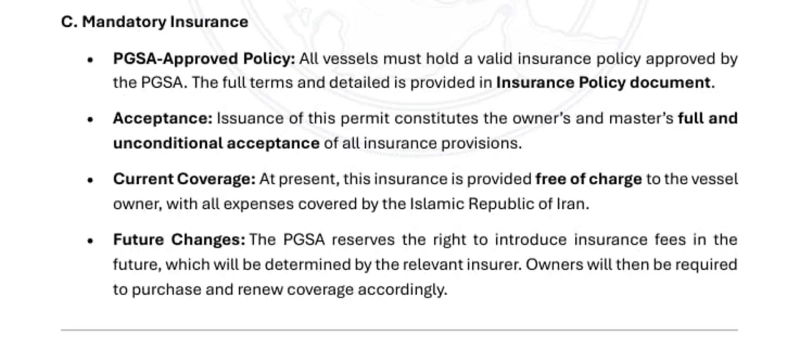
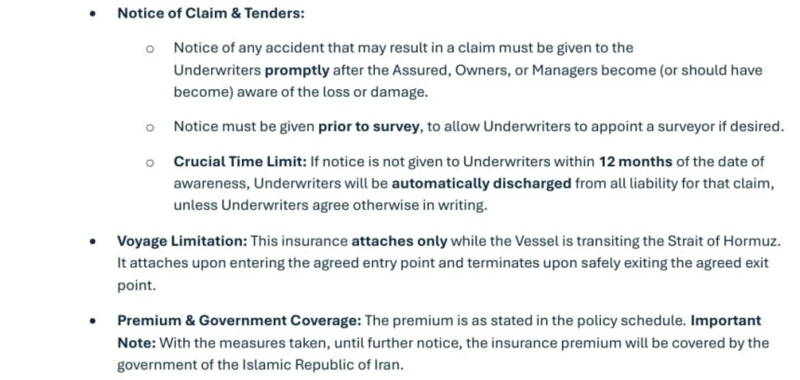
The insurance arrangement gives Iran a mechanism to control traffic through the strait and potentially levy related fees later. In the published terms, the Iranian government said "the premium is specified in the insurance policy" and that "under the measures taken, the premium shall be borne by the Iranian government until further notice." That means premiums may be charged later but are temporarily waived. The move is interpreted as part of the MOU between the Trump administration and Iran allowing free passage through the strait for 60 days.
Iran said the policy is intended to keep ships in the region from being drawn into war. The document describes the coverage as protecting against vessel loss or damage arising from "capture, seizure, arrest, restraint, detainment and mines," with mine coverage limited to mines laid on routes specifically designated by the PGSA.
The terms say coverage does not apply in the event of war among the major powers -- the UK, US, France, Russia and China. The policy would also terminate automatically if such a war breaks out. Losses caused by drifting mines outside PGSA-designated routes are also excluded.
The insurance applies only to the Strait of Hormuz transit segment. The document says coverage begins when a vessel enters the agreed entry point and ends when it safely clears the agreed exit point.
The PGSA said ships may pass through the strait only on designated routes near Larak Island. Deviating from those routes or using alternative passages is "strictly prohibited" and would be treated as a violation. Shipowners and captains bear full responsibility for any losses, fines and accidents resulting from such violations.
The standard response time for passage applications is 48 hours, according to the PGSA. Captains will receive final coordination details and precise route information via VHF or online communication by 24 hours before scheduled departure.

Lee Sang-eun, Washington correspondent, Hankyung, selee@hankyung.com

Korea Economic Daily
hankyung@bloomingbit.ioThe Korea Economic Daily Global is a digital media where latest news on Korean companies, industries, and financial markets.