Retail Stock-Buying on Credit Surges as KOSPI Nears 9,000; Secured Loans Approach $29 Billion
Summary
- Amid the stock-market rally, borrowing to invest through deposit-backed loans and insurance policy loans continues to rise.
- Outstanding overdraft loans and unsecured credit loans at the five major banks are still climbing despite tighter rules.
- The government lowered its household loan growth target and tightened regulations, but loan demand in the market remains strong.
Forecast Trend Report by Period


Borrowing to Buy Stocks Heats Up as KOSPI Nears 9,000
Deposit- and Insurance-Backed Loans Near 40 Trillion Won
South Korean retail investors are still borrowing to buy stocks despite tighter lending curbs. As the market rally continues, more investors are turning to loans backed by bank deposits and insurance policies to raise short-term funds.
Outstanding deposit-backed loans at the five major banks — KB Kookmin, Shinhan, Hana, Woori and NH NongHyup — stood at 6.6415 trillion won ($4.8 billion) as of June 18, according to the financial industry on June 19. That was up 341.3 billion won ($247 million) from the start of this year. The balance has kept rising since surpassing 6 trillion won in July 2025. At the current pace, deposit-backed loans will top 7 trillion won ($5.1 billion) for the first time this year.
Insurance policy loans, which allow borrowers to use policy surrender values as collateral, also jumped. Outstanding policy loans at South Korea's three biggest life insurers — Samsung Life, Kyobo Life and Hanwha Life — reached 32.4224 trillion won ($23.5 billion) at the end of May, up 479.3 billion won ($347 million) from a month earlier. The balance has risen by 970.5 billion won ($703 million) over the first five months of this year.
Borrowing for Stock Investment Persists Despite Curbs; Deposit- and Insurance-Backed Loans Also Rise
Investors Pile Into Deposit-Backed Loans at 3% to 4% Rates; Unused Overdraft Credit Still Totals 53 Trillion Won
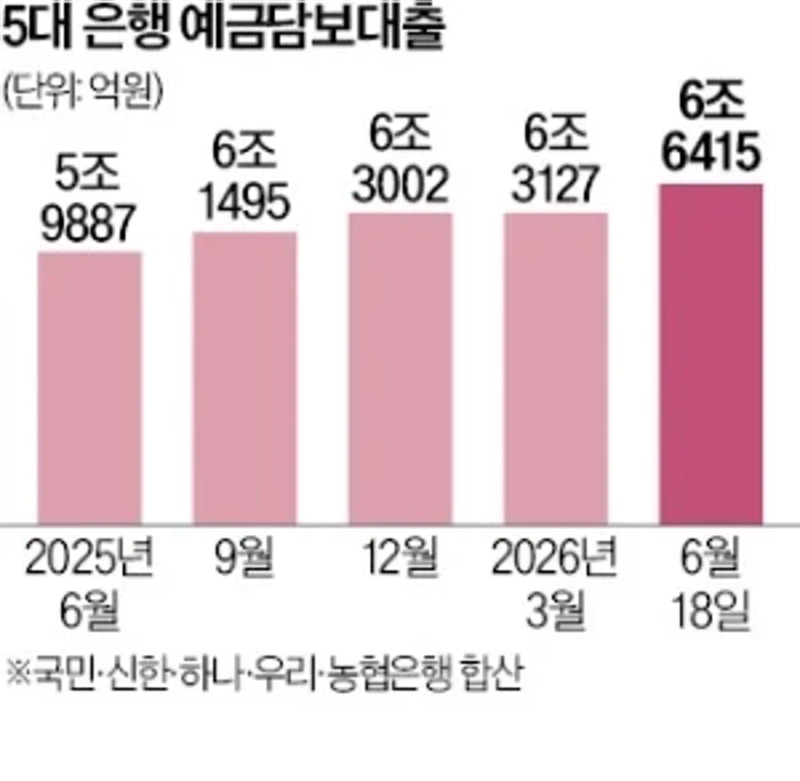
For borrowers without top-tier credit, deposit-backed and policy loans can provide cheaper short-term funding than overdraft credit lines, which often carry annual rates above 5%. That has helped fuel borrowing to invest in stocks.
Deposit-backed loans and policy loans have largely remained outside the latest restrictions. South Korea's financial authorities moved to slow household debt growth by having banks trim limits on unsecured credit loans and overdraft accounts. But loans secured by deposits or insurance contracts are harder to curb because they are backed by clear collateral. Authorities reduced the ceiling on policy loans in April to 70% of surrender value from 80%, yet balances have continued to climb. At Samsung Life, Kyobo Life and Hanwha Life, outstanding policy loans stood at 32.4224 trillion won ($23.5 billion) at the end of May, up 479.3 billion won ($347 million) from the previous month.
Overdraft lending has not fallen either, even after some banks began cutting limits more broadly from June 8. Outstanding overdraft loans at the five major banks totaled 42.9477 trillion won ($31.1 billion) as of June 18. The balance was little changed from a week earlier even after KB Kookmin Bank and Hana Bank capped all personal unsecured loans at 100 million won ($72,000), raising the threshold for new borrowers. Instead, the utilization rate on overdraft credit lines rose to 44.5%.
Bank unsecured lending has continued to increase. Outstanding unsecured credit loans at the five major banks stood at 108.3339 trillion won ($78.5 billion) on June 18, up 1.8186 trillion won ($1.32 billion) so far this month. That accounted for more than half of the 3.1168 trillion won ($2.26 billion) increase in overall household lending. The five banks still had 53.6322 trillion won ($38.9 billion) in unused overdraft credit available.
One executive at a commercial bank said lenders cannot cut the limits on overdraft accounts that have already been agreed. Depending on stock-market sentiment, credit lending may rise further, the executive added. The bank is checking daily lending volumes to avoid exceeding this year's loan-growth target.
The government set this year's household loan growth target at 1.5%, down 0.3 percentage point from last year's 1.8% target. It asked the five major banks to keep household loan growth to 800 billion won to 900 billion won ($580 million to $652 million). It also told mutual finance institutions, including Saemaul Geumgo, not to increase household lending from last year.
Kim Jin-seong and Kim Su-hyeon, Hankyung.com reporters, jskim1028@hankyung.com

Korea Economic Daily
hankyung@bloomingbit.ioThe Korea Economic Daily Global is a digital media where latest news on Korean companies, industries, and financial markets.