PiCK
The Era of ‘Kind Mr. Fed’ Is Over: What Kevin Warsh’s Message Really Means
Summary
- Goldman Sachs said the era of easy money defined by low inflation and low rates is over, and that markets have entered a postmodern cycle.
- Warsh, the Fed chair, said markets should scale back expectations for a Fed put and price assets based on economic data.
- Goldman Sachs said it recommends portfolios centered on four themes: AI hardware, power and energy, defense, and infrastructure.
Forecast Trend Report by Period


The age of easy money is ending
Warsh signals the end of the ‘Fed put’
Goldman says the golden era of low rates and low inflation is over
From cheap money to more demanding capital
Money is flowing to AI, power, defense and infrastructure

Anyone watching markets lately can see that the investment environment investors had grown used to is changing fast. Since the 1980s, low interest rates, globalization and central banks willing to step in during crises helped lift almost every major asset class over time, from growth stocks to bonds and real estate.
Wall Street increasingly believes that era is fading. That does not mean liquidity is disappearing. As the U.S.-China rivalry over AI leadership intensifies, geopolitical fragmentation reshapes energy security, and countries pursue industrial self-reliance, governments are still set to spend more. Investment in AI, infrastructure, defense and energy also stands to keep rising. What is ending is the era of easy money, when cheap capital lifted assets broadly and indiscriminately.
Warsh’s message to markets: You’re on your own
The clearest symbol of that shift this week was the debut of Kevin Warsh as chair of the Federal Reserve. Half of Federal Open Market Committee members projected a rate increase this year. At his press conference, Warsh repeated the phrase “price stability” 12 times. It was a stark contrast with his predecessor, Jerome Powell, who often used press conferences to steady markets after a hawkish statement or dot plot unsettled investors. Jeffrey Gundlach, chief executive officer of DoubleLine Capital, said Warsh was not the “easy money” chair that markets had been hoping for.
But Warsh’s real message was not simply about higher rates. In past remarks and again at this press conference, he gave little basis for classifying him as a conventional hawk. His earlier prescription was to shrink the Fed’s balance sheet to address the root causes of inflation and then lower rates.
This time, he made hawkish remarks such as saying financial conditions are not tight outside the housing market and that the Fed will achieve its 2% inflation target. At the same time, he said current inflation data cannot be fully trusted because collection methods are outdated, and that the dot plot is something that can always be erased. Taken together, the remarks offered little clue as to whether he is hawkish or dovish, or whether the next move will be a hike, a hold or a cut. As Warsh put it, he would refrain from offering his personal outlook on the direction of monetary policy.
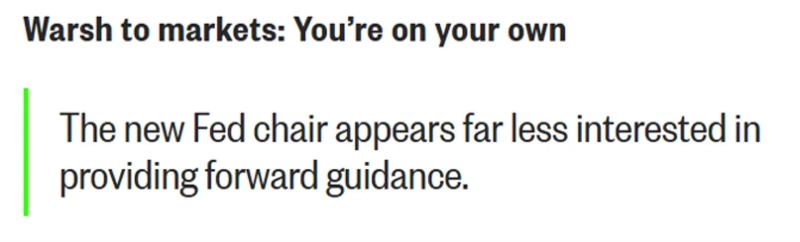
Instead, he was driving at something else. Markets should react to economic data itself, not to how the Fed may respond to that data. In other words, investors should stop focusing primarily on what Fed officials might say or whether the central bank will cut or raise rates, and start pricing assets based on the data itself. Michael Kramer, founder of Mott Capital, said Warsh had effectively told markets: “You’re on your own.”
Since quantitative easing began, investors have grown accustomed to the so-called Fed put. The idea is that if stocks come under heavy pressure, the Fed will step in with hints of rate cuts or fresh liquidity to support markets. In most cases, that expectation has been rewarded. Warsh now appears determined to break that link and remove the safety net. The old model, in which markets leaned heavily on the central bank and the central bank tried to reassure them, should give way to one in which markets price economic data directly.
That is why Warsh said he would overhaul data collection, communication and the Fed’s inflation framework. If the goal is to force markets to stand on their own rather than look constantly to the Fed, investors need more credible data, better measurement of AI’s effects on productivity and employment, and less communication from the central bank.
No one knows whether those reforms will succeed. The U.S. government needs to issue more debt, while the Fed says it wants to shrink its balance sheet. That raises questions about whether a central bank constrained by fiscal realities can carry out that plan as intended. The key point, though, is that the Fed chair has made clear there will no longer be a central bank eager to soothe markets and flood the system with money.
A structural shift in the investment paradigm
Goldman Sachs has framed the end of easy money as part of a broader shift in the investment paradigm. The bank says the golden era of low inflation, low rates and globalization is over, and that markets are entering what it calls a “postmodern cycle.”
From the 1980s onward, falling inflation, accelerating globalization, deregulation and tax cuts reduced costs and boosted corporate profits. Low rates also kept pushing valuations higher. After the 2008 financial crisis, quantitative easing and zero interest rates helped usher in the dominance of U.S. Big Tech and growth stocks. In a world defined by weak growth and low inflation, American platform companies delivered some of the most predictable high growth. Ultra-low rates pushed their valuations even higher.
Now the backdrop has changed. Since the Covid-19 pandemic, the inflation shock has pushed real rates higher and government debt has surged. Globalization has retreated under tariffs and regionalization, driving up corporate costs and consumer prices. Geopolitical tensions are spurring more spending on defense, energy security and supply-chain restructuring. The biggest shift is the AI revolution. It is creating unprecedented demand for capital spending on physical infrastructure such as data centers, semiconductors, power grids and networks. That change is also reshaping industrial structures and leadership in equity markets.
If governments and companies are going to spend more on capital investment, they will need more capital. That is one reason the cost of capital, inflation and interest rates continue to rise. For companies to justify elevated valuations now, a growth narrative alone is no longer enough. They need to prove actual earnings growth and cash flow, while continuing to raise expectations for future performance. That helps explain why sectors tied to AI infrastructure, manufacturing, defense and energy have remained market leaders.
In the end, the demise of easy money means capital will move more selectively and with stricter discipline. Goldman Sachs recommends building portfolios around four core themes: AI hardware, power and energy, defense, and infrastructure.
In the video, we took a closer look at Chair Warsh’s message, what it means that excess liquidity has turned negative for the first time since 2021, and Goldman Sachs’ postmodern cycle. We also outlined the key questions investors should ask when valuing assets under the new paradigm.
Bin Nan-sae, New York correspondent, Hankyung.com binthere@hankyung.com

Korea Economic Daily
hankyung@bloomingbit.ioThe Korea Economic Daily Global is a digital media where latest news on Korean companies, industries, and financial markets.