PiCK
More Than 200 Korean Penny Stocks Face Delisting Risk Under Tougher July Rules
Summary
- The exchange said that from July, companies will be subject to delisting if they meet even one of the following conditions: penny-stock status with a share price below 1,000 won, market capitalization below 20 billion won, full capital impairment, or 10 disclosure penalty points.
- It said 219 penny stocks trading below 1,000 won on South Korea’s stock market are nearing the implementation of the delisting rules, heightening investment warnings around related companies.
- Listed companies are successively disclosing reverse stock splits and capital reductions to maintain their listings, and the exchange said the number of Kosdaq companies subject to delisting could rise to around 150 this year.
Forecast Trend Report by Period


Exchange to sharply tighten listing maintenance requirements from July
219 stocks priced below 1,000 won face delisting risk
148 on Kosdaq, 42 on Kospi, accounting for 7.6% of all listings
Companies turn to reverse stock splits and capital reductions to stay listed
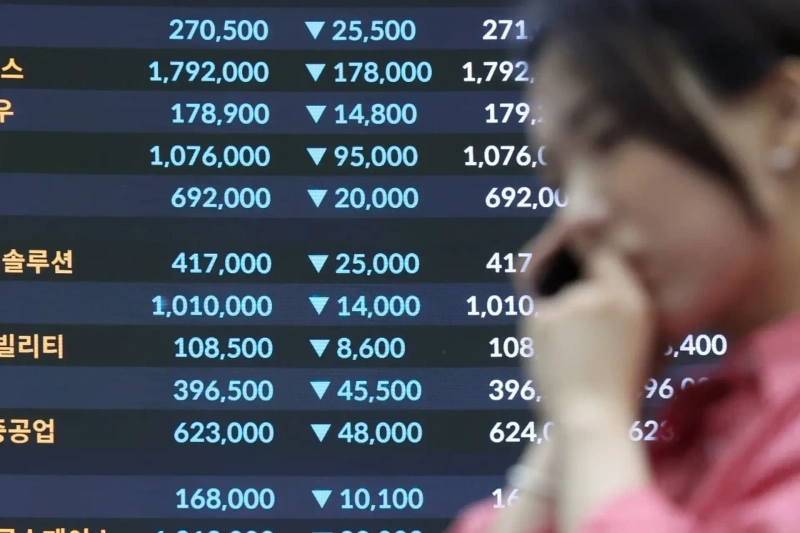
More than 200 companies listed on South Korea’s stock market could face expulsion as new delisting rules for so-called penny stocks trading below 1,000 won take effect next month. Starting in July, a listed company whose shares remain below 1,000 won for 30 consecutive trading days will be designated a watch-list issue. It will then be delisted if it fails to keep the stock at or above 1,000 won for 45 consecutive days during the following 90-day period. Companies are rolling out measures such as reverse stock splits to maintain their listings, heightening investor caution around the names.
As of June 19, 219 companies listed on the Kospi, Kosdaq and Konex markets were trading below 1,000 won, according to the Korea Exchange. That represented 7.6% of the country’s 2,877 listed companies. Of the total, 148 were on Kosdaq, 42 on Kospi and 29 on Konex.
The combined market value of those penny stocks was 5.5075 trillion won on Kosdaq and 2.4413 trillion won on Kospi. Including Konex-listed firms, the total topped 8 trillion won.
The Korea Exchange earlier unveiled a reform plan to swiftly and strictly remove troubled companies, saying it would significantly tighten listing maintenance standards and accelerate delistings, including for penny stocks. From July, companies will become subject to delisting if they meet any one of four conditions: a market capitalization below 20 billion won, a share price below 1,000 won, full capital impairment on a half-year basis, or cumulative disclosure penalty points of 10 over the past year, with immediate action for serious and intentional violations. Companies whose share price remains below face value even after a reverse stock split will also be included. The move reflects concern that thinly traded stocks can be exploited for price manipulation.
Companies at risk of delisting are moving quickly to meet the requirements. One notable trend is a surge in reverse stock splits aimed at lifting share prices. From February, when discussions over delisting penny stocks began, through June 19, 219 companies disclosed reverse stock split plans, according to filings on the Financial Supervisory Service’s electronic disclosure system. That was up 24-fold from nine a year earlier. The number increased to 43 from one on Kospi and to 176 from eight on Kosdaq.
There is another sign of efforts to escape penny-stock status: disclosures of capital reduction decisions. For example, if a company with a face value of 500 won per share, a share price of 500 won and capital of 50 billion won carries out a 10-for-1 capital reduction without compensation, its capital would shrink while its face value and share price would rise tenfold to 5,000 won, removing the penny-stock label. According to the Financial Supervisory Service, 118 companies disclosed capital reductions from February through June 19, more than double the 47 a year earlier.
Industry participants expect the list of delisting candidates to expand sharply from the fourth quarter. Given the time needed for watch-list designation and for companies to satisfy the minimum share-price requirement, some stocks could begin delisting procedures as early as the fourth quarter. That has fueled projections that this year’s number of delistings could reach a record high. The exchange expects the number of Kosdaq companies subject to delisting this year to rise to around 150, in a range of 100 to 220. According to the exchange, the busiest year on record for delistings was 2000 during the dot-com bubble, when 127 stocks were removed.
Shareholders in companies facing possible expulsion are growing increasingly anxious. One investor in a penny stock listed on the Kospi wrote on an online stock forum that the shares were “moving in reverse during a major bull run.” Another retail investor said they had invested for more than three years before ultimately cutting losses, describing the emotional strain.
Oh Jung-min, Hankyung.com reporter blooming@hankyung.com

Korea Economic Daily
hankyung@bloomingbit.ioThe Korea Economic Daily Global is a digital media where latest news on Korean companies, industries, and financial markets.