PiCK
South Korea Ruling Party Says It Will Speed Up Digital Asset Framework Law in Second Half
Forecast Trend Report by Period


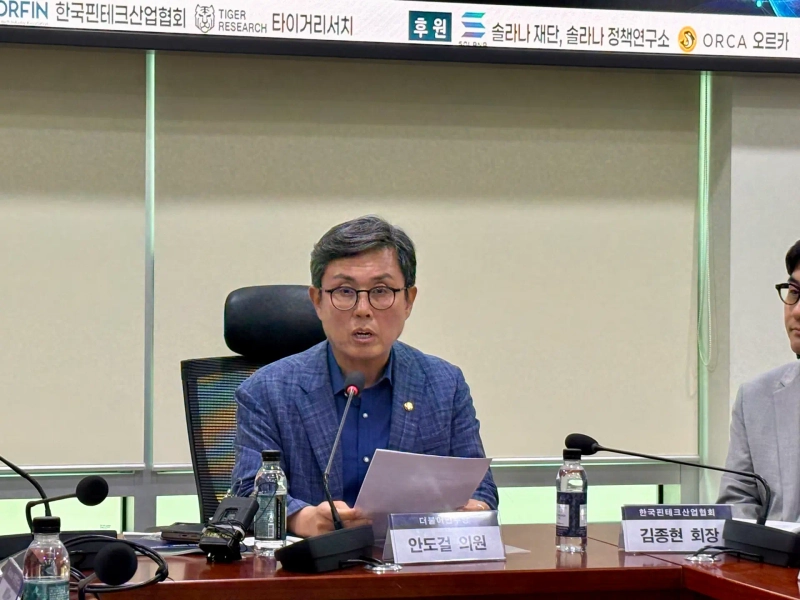
Ahn Do-geol, who previously served as secretary of the Democratic Party’s digital asset task force, said the party will step up efforts in the second half of this year to enact a framework law for digital assets. Industry participants are also increasingly calling on South Korea to ease rules that separate financial services from virtual assets.
Ahn made the remarks on June 22 at a seminar at the National Assembly Members’ Office Building in Seoul’s Yeouido district titled “Global Trends in Digital Asset Institutionalization and South Korea’s Legislative Direction.” The digital asset framework law has moved beyond the discussion stage and should now proceed to enactment, he said, adding that the National Assembly would accelerate the work in the second half.
The Democratic Party proposed the bill last year, but it has repeatedly stalled in the National Assembly. Industry participants say it is effectively impossible to foster the digital asset sector without a basic law in place. The purpose of institutionalization is clear, Ahn said: whether digital assets will be left unattended or developed into trusted financial infrastructure within the regulated system.
He also pledged to push follow-up legal changes, including revisions to the Electronic Financial Transactions Act. He said he would work to lay the legislative groundwork for digital assets to develop into financial infrastructure used in the real economy.
Lee Kang-il, another Democratic Party lawmaker, also backed the push. In opening remarks at the seminar, Lee said institutionalizing digital assets goes beyond creating new regulations and is fundamentally about building trust. Digital asset innovation cannot be sustainable if it ends with speculative gains or market disruption, he said. Standards must also be established to improve market transparency and clearly define responsibility when risks arise.

Calls Grow to Scrap Finance-Crypto Separation Rules
Participants at the seminar also argued that South Korea should relax restrictions separating financial companies from virtual-asset businesses if blockchain technology is to transform finance. Lee Yong-jae, head of the digital asset industry division at Mirae Asset Securities, said the current separation principle should be abolished and that overseas markets are moving instead toward convergence between finance and virtual assets.
Removing the rule would allow large financial groups to begin full-scale collaboration with Web3 and digital-asset startups, he said. He added that the principle should be scrapped to support broader growth in the industry.
Lee also called for looser rules on tokenized securities, or STOs. There is no need to limit the types of securities that can be tokenized, he said, adding that the aim is to improve on areas where the market is already strong by tokenizing standardized securities such as stocks. South Korea should also build tokenized-securities processes suited to domestic conditions, drawing on overseas examples involving bonds and money-market funds, he said.

Solana Policy Institute Says US Clarity Act Debate May Pick Up Next Month
The Solana Policy Institute, a Solana-based think tank, said at the seminar that debate over the US crypto market structure bill known as the Clarity Act could gather pace next month. Miller Whitehouse-Levine, the group’s chief executive officer, said the US Senate could begin a fuller review of the bill toward the end of July.
Most major legislation needs 60 votes to pass the Senate, he said. That leaves the timeline uncertain, and debate could continue into next year.
Whitehouse-Levine also discussed the GENIUS Act, the US stablecoin law enacted last year. He said the legislation created the first federal regulatory framework for dollar-based stablecoins in the US. Congress set the basic framework, and regulators are now drafting detailed rules.
The US is building digital-asset regulation on two tracks — the stablecoin law and the Clarity Act, he said. Both reflect a shift away from a case-by-case enforcement approach toward a system based on clear rules.

JOON HYOUNG LEE
gilson@bloomingbit.ioCrypto Journalist based in Seoul