Krafton to Invest About $36 Million in HyperAccel as It Expands AI Push
Summary
- Krafton will strengthen its AI chip value chain by investing about $36 million as a strategic investor in the Series B round of South Korean AI semiconductor startup HyperAccel.
- Based on its buildout of a GPU cluster and experiments with AI characters and AI agents, Krafton has concluded that inference costs are a core competitive factor for game companies and is seeking to lower AI inference costs through LPU technology.
- Krafton is pushing into physical AI, robotics and defense, and industry officials say the company is evolving into a broader technology company that also controls AI hardware infrastructure.
Forecast Trend Report by Period


About $36 million investment in AI chip startup
Strategic stake in HyperAccel
Move bolsters AI chip value chain
Expansion reaches physical AI, robotics and defense
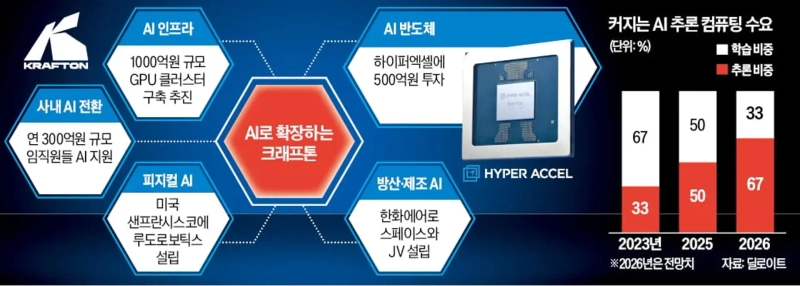
Krafton Inc., which has been ramping up its push into physical artificial intelligence, is making a major investment in an AI semiconductor startup. It is rare for a game company to invest directly in a chipmaker. The move adds to Krafton’s push to secure assets spanning AI models, including its Raan model, to inference semiconductors, underscoring its broader shift from a game developer toward an AI company.
◇ About $36 million into HyperAccel
Krafton will participate as a strategic investor in the ongoing Series B round for South Korean AI semiconductor startup HyperAccel, according to investment banking industry sources on June 22. The company is set to invest about 50 billion won ($36 million), accounting for roughly one-third of HyperAccel’s total fundraising target of 150 billion won ($108 million).
HyperAccel is a fabless AI semiconductor startup founded in 2023 by KAIST professor Kim Joo-young. It develops language processing units, or LPUs, for large language model inference. The company is working jointly with Naver Cloud and LG Electronics and plans to target shared infrastructure as well as on-device AI markets for home appliances and robots. After raising 55 billion won ($39.6 million) in a Series A round at the end of 2024, HyperAccel is seeking a large follow-on investment 18 months later. It was valued at more than 200 billion won ($144 million) at the time.
A large investment by a game company in an AI chipmaker is unusual. After declaring an “AI First” strategy last year, Krafton built a GPU cluster worth 100 billion won ($72 million) and has been testing AI characters capable of real-time interaction and customized content generation. Through that work, the company is understood to have concluded that AI could sharply increase costs in the gaming industry.
Unlike simple, repetitive non-playable characters, AI agents that interact with users in real time require enormous computing infrastructure. Demand for inference rises exponentially as AI is used more widely in development tasks such as code generation, image creation and quality checks. “Showing AI characters as a technology demo and providing them as a commercial service to millions of users are completely different issues,” a gaming industry official said. “Ultimately, technology that lowers inference costs will become a game company’s competitive edge.”
HyperAccel’s LPU is viewed as one way to lower those costs. Nvidia Corp.’s chips, which dominate the global AI infrastructure market, cost tens of thousands of dollars apiece and remain in short supply. HyperAccel’s alternative is optimized for LLM inference rather than general-purpose GPU computing. It also uses low-power DRAM, or LPDDR, instead of hard-to-secure high-bandwidth memory, reducing both price and power consumption. That helps explain why Krafton made a strategic investment in HyperAccel even as it continues to work with Nvidia and the broader global AI ecosystem. Over time, the investment could reduce its dependence on GPUs while giving it greater control over costs.
◇ Edge in physical AI, too
Krafton is already gaining traction in physical AI. Built around the hit game PUBG: Battlegrounds, the company has infrastructure that allows physical AI systems to conduct physical learning in a virtual world. That was part of the backdrop for Hanwha Aerospace Co.’s proposal in March to establish a joint venture with Krafton to jointly develop physical AI.
Semiconductors are becoming increasingly important in physical AI as well, where unmanned systems and manufacturing equipment must recognize their surroundings and make decisions on site in real time. Low-power, low-latency chips that can run inference quickly while reducing heat and electricity use are becoming essential. Krafton’s investment in HyperAccel is therefore also tied to its physical AI ambitions.
Krafton established Ludo Robotics in San Francisco last year and began developing the “brain” for humanoid robots. The effort aims to extend AI technology used to control virtual characters in games into robot intelligence in the real world.
ADVERTISEMENT
Industry officials say Krafton is evolving into a broader technology company with control over AI hardware infrastructure as well. “Even in the global market, it is rare for a game company to vertically integrate its value chain into hardware areas such as AI chips,” an IT industry official said. “It appears to be a company that understands AI, sets a long-term strategy and executes it step by step.”
Ahn Jung-hoon/Choi Da-eun, Korea Economic Daily reporters ajh6321@hankyung.com

Korea Economic Daily
hankyung@bloomingbit.ioThe Korea Economic Daily Global is a digital media where latest news on Korean companies, industries, and financial markets.