Hashed Open Research Says South Korea Is Suited to Become a Digital-Asset Hub in the AI Agent Era
Summary
- Hashed Open Research said South Korea has the conditions to emerge as a digital-asset hub in the era of AI agents.
- Researcher Esther Kim said stablecoins, RWA, and STO should be seen not simply as financial products, but as core infrastructure linking the AI-agent economy and 24-hour capital markets.
- She emphasized that for South Korea to become a digital-asset hub, it needs to design digital-asset policy at the level of national strategy and build a digital-asset strategy that attracts talent and capital.
Forecast Trend Report by Period


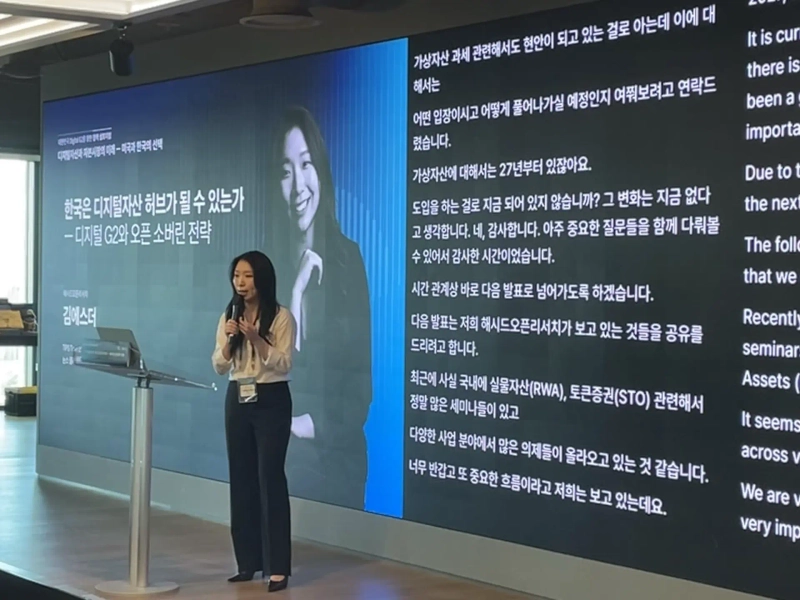
Hashed Open Research, or HOR, said South Korea has the foundations to emerge as a digital-asset hub in the age of artificial intelligence. It said stablecoins, real-world asset tokenization, or RWA, and security token offerings, or STOs, should be viewed not simply as financial products but as core infrastructure connecting the AI-agent economy, 24-hour capital markets, and the country’s strengths in manufacturing and content.
Esther Kim, a researcher at HOR, made the remarks at a June 23 presentation at Hashed Lounge in Seoul’s Gangnam district. The event was titled “Policy Symposium for Korea’s Digital G2 Ambition: The Future of Digital Assets and Capital Markets — Choices for the US and South Korea.”
Kim called the recent increase in domestic discussions on RWA and STOs a positive development. But she said the debate has tended to remain focused on individual products. The digital-asset ecosystem is also tied to questions of national vision and sovereignty. As AI reshapes how people understand the world, she said, the issue has become a broader national challenge.
In the digital era, capital, talent and companies do not stay confined to a single territory. Countries are expanding from entities that own value to entities that are chosen, Kim said. South Korea, she added, should position itself not only as a country that protects value, but as a platform chosen by talent and capital.
Kim cited Singapore and the United Arab Emirates as examples of digital-asset hubs. She said Singapore became a hub chosen by capital through long-term policy consistency and a predictable jurisdiction. The UAE, meanwhile, has pursued sovereign wealth funds, AI infrastructure and digital-asset strategies as it prepares for the post-oil era.
She said South Korea also has the conditions needed to attract talent and capital in the AI era. Those strengths include one of the world’s highest internet penetration rates, strong digital literacy, competitiveness in manufacturing and content, and a robust gaming culture.
“South Korea is one of the countries that can most naturally adapt to an environment where AI agents become the main actors in economic activity,” Kim said. Because Korean society is already familiar with digital services, online transactions and a game-based digital economy, it can also quickly accept an environment in which AI agents conduct transactions and payments.
Kim singled out the gaming industry as an important foundation. South Korea is a leading global gaming market and the country that created esports, she said. Games already function as digital economic ecosystems where ownership, trading and character-based activity are routine. In that sense, the AI-agent economy — where characters and agents, rather than humans, carry out part of economic activity — overlaps with an area South Korea has already learned to navigate culturally.
She also said South Korea’s manufacturing strength could be tied to a digital-asset strategy. Digital-asset infrastructure combined with the country’s industrial base in memory semiconductors, automobiles and shipbuilding could become a new growth engine.
“On-chain digital assets can move value created in AI, content and consumer markets across borders around the clock,” Kim said. “Stablecoins, RWA and STOs should be seen not as individual products, but as the foundation South Korea needs to attract talent and capital in the AI era.”
Kim said digital-asset policy should be designed not simply as regulatory reform, but as national strategy. For South Korea to become a digital-asset hub, it needs competitiveness in policy direction, speed, trust and vision, she said. Any digital-asset strategy should begin with a vision for what kind of country South Korea wants to be chosen as.

Minseung Kang
minriver@bloomingbit.ioBlockchain journalist | Writer of Trade Now & Altcoin Now, must-read content for investors.