South Korea Digital-Asset Rules Must Shift to Market Design From Issuers, Experts Say
Summary
- Participants said digital-asset legislation should expand beyond the question of who can issue won-denominated stablecoins to include payment use cases and market design.
- Lee Yeo-jin said the next three years will be a key window for the digital transformation of Korean finance and that rules for won-denominated stablecoins, RWA, and STO should be designed to function in live markets.
- Experts from South Korea and abroad said RWA and tokenized securities should not be confined to private blockchains and that regulators should create conditions to test products similar to those available overseas through public-blockchain adoption and regulatory sandboxes.
Forecast Trend Report by Period


South Korea’s digital-asset legislation needs to move beyond debate over who can issue won-denominated stablecoins and address how they will be used for payments and how the market will be structured, participants at a policy symposium said. They argued that won stablecoins, real-world asset tokenization and tokenized securities should be designed to function in live markets rather than remain confined within the framework of traditional finance.
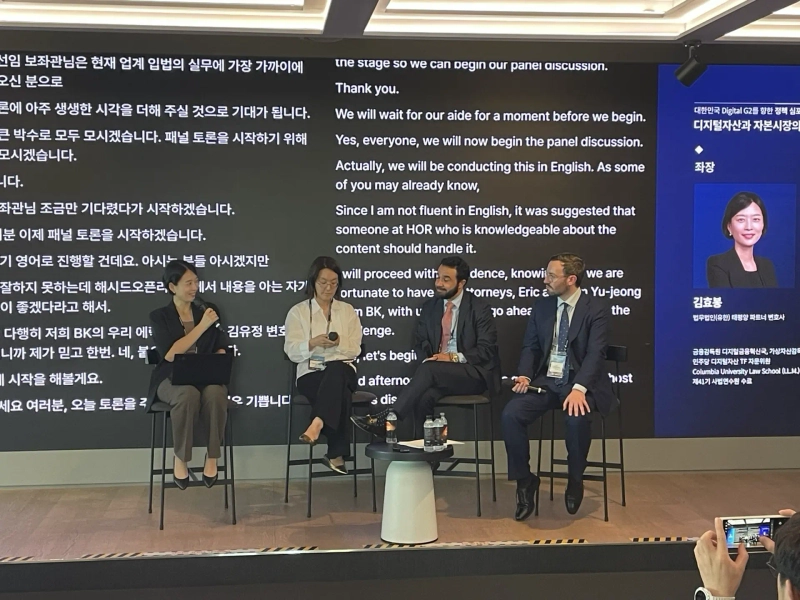
At a panel discussion held June 23 at Hashed Lounge in Seoul’s Gangnam district, speakers said digital-asset regulation should not stop at questions of issuer identity or legal form. Policymakers also need to weigh payment use cases, whether to allow public blockchains and whether the products can circulate globally. The event was titled “Policy Symposium Toward Korea as a Digital G2: The Future of Digital Assets and Capital Markets — Choices for the U.S. and Korea.”
Lee Yeo-jin, a senior secretary at the National Assembly’s Political Affairs Committee, said discussion of South Korea’s proposed Digital Asset Basic Act should be approached in the context of building a new financial-market structure rather than through the exchange-centered regulatory lens of traditional finance. Much of the government’s proposal was sorted out in the first half of the year, Lee said, but major issues remain, including how stablecoins would be used, exchange governance, and the relationship between real-world assets and tokenized securities.
“The next three years will be a critical period for Korean finance to get on board with digital transformation,” Lee said. “If a won stablecoin appears only in 2029, the country may already have missed an important opportunity.”
On won-denominated stablecoins, Lee said the debate should not remain focused solely on issuers. Policymakers need to design practical use cases at the same time, including payment networks, distribution structures and user touchpoints.
Lee also called for a broader approach to real-world assets and tokenized securities. South Korean financial authorities have tended to handle real-world assets within the tokenized-securities framework under the Capital Markets Act, he said, but added that discussion cannot be postponed indefinitely while waiting for a perfect system.
He said regulators should open areas that are already feasible and then refine the framework through regulatory sandboxes or follow-up legislation. That would create conditions for testing in South Korea products similar to digital-asset offerings already seen overseas.
On the tokenized-securities regime, Lee pointed to the limits of a closed structure. “A structure that assumes private chains and participation by a small number of institutional nodes is just repeating the blueprint of 20th-century finance,” he said. “We need to step back and redefine the bigger picture of what functions RWA and STO are meant to serve in the real market.”
Overseas experts said policymakers should also examine frameworks built on public blockchains. Miller Whitehouse-Levine, chief executive officer of the Solana Policy Institute, said using private blockchains would not be fundamentally different from existing exchange systems. He added that concerns over the confidentiality of trading information could be addressed through technical tools such as confidential token extensions.
Chris Montagnano, chief legal officer at Orca, said tokenized securities could also trade on public-blockchain infrastructure if issuers manage investor eligibility checks and disclosure obligations. Protocols such as Orca are not the entities making regulatory judgments, he said, but instead serve as infrastructure supporting transactions between verified wallets.
The panel also included Kim Hyo-bong, a partner at Bae, Kim & Lee LLC, alongside Whitehouse-Levine, Montagnano and Lee.

Minseung Kang
minriver@bloomingbit.ioBlockchain journalist | Writer of Trade Now & Altcoin Now, must-read content for investors.