War, Foreign Selling, Strong Dollar: Drivers Change, but Won Stays Stuck Above 1,500
Summary
- The won-dollar exchange rate has failed to fall below 1,500 won, and the high exchange-rate trend is becoming entrenched.
- Authorities expect SK Hynix’s ADR issuance to help expand dollar supply and block upward pressure on the exchange rate if about 40 trillion won flows back into South Korea.
- If SK Hynix’s ADR wins a higher valuation in the U.S. market and more companies follow with ADR issuance, exchange-rate volatility tied to foreign selling pressure could ease, though there are concerns about a long-term negative impact on the domestic stock market.
Forecast Trend Report by Period


Can SK Hynix ADRs Help Ease Currency Pressure?
High won-dollar rate has persisted since early last year
It was expected to fall after the war ended
But it surged again on prospects of U.S. rate hikes
Authorities pin hopes on Hynix ADRs
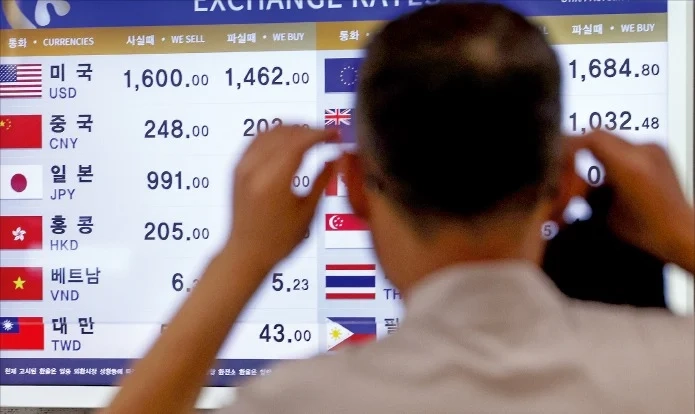
The won has shown little sign of strengthening against the dollar. Until recently, foreign investors’ net selling of local stocks was cited as the main driver of the elevated won-dollar exchange rate. Now broad dollar strength has emerged as the latest explanation for the won’s weakness. Against that backdrop, South Korea’s foreign-exchange authorities are looking to SK Hynix Inc.’s American depositary receipt, or ADR, issuance as a new card to help stabilize the exchange rate.
Exchange Rate Fails to Break Below 1,500 Won
In Seoul trading on June 23, the won closed the daytime session at 1,539.1 per dollar as of 3:30 p.m., 2.1 won weaker than the previous session. It rose as high as 1,542 won shortly after the open, moving above the 1,540-won level intraday for the first time in 15 days since June 8. With the exchange rate unable to fall below 1,500 won, criticism is growing that only the explanation for the pressure keeps changing while the high-rate trend remains firmly in place.
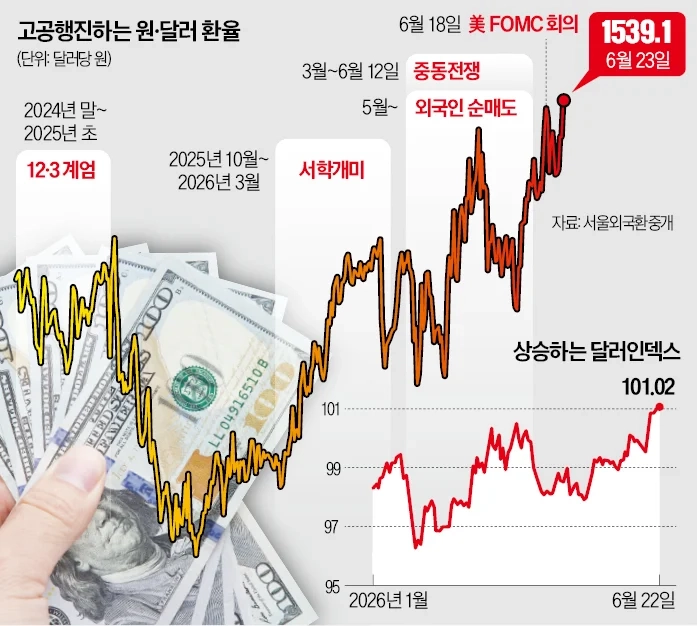
In early 2025, the won weakened to 1,476 per dollar in the aftermath of emergency martial law. From October 2025, South Korean retail investors buying overseas stocks emerged as a new source of pressure on the currency. As authorities scrambled to roll out alternatives such as return investment accounts in the domestic market and a new framework for the National Pension Service, war broke out in the Middle East in late February 2026. The exchange rate climbed to a new level and moved back above 1,500 won. Then, from early May, foreign investors dumped stocks for portfolio rebalancing, rapidly converting won into dollars as they exited the market and pushing the exchange rate as high as 1,560 won.
Since last week, the latest force driving the exchange rate higher has been the global dollar rally. Predictions that the won would strengthen by about 100 won once a substantive agreement to end the war was reached have missed the mark. One foreign-exchange dealer at a bank said the prospect of an end to the war was no longer being reflected in the market. As the Federal Reserve shifted back toward a rate-hike stance, the dollar index rose above 101 for the first time since May 2025.
Authorities Look to ADRs
The options available to South Korea’s foreign-exchange authorities are limited. With returns generated from managing foreign-exchange reserves needing to be remitted for investment in the U.S., officials are in no position to aggressively draw down reserves to defend the currency.
A new option attracting the authorities’ attention is SK Hynix’s ADR issuance. ADRs are securities issued to allow foreign companies’ shares to trade on U.S. stock exchanges. If about 40 trillion won ($28.9 billion) raised through the issuance is brought back for domestic investment, it could initially help increase dollar supply in the foreign-exchange market.
What officials are counting on most is that even if foreign investors sell the ADRs, that would not trigger demand to convert won into dollars. That could help block short-term upward pressure on the exchange rate.
ADRs often trade at a premium to the underlying shares, making them popular with overseas investors. At Taiwan Semiconductor Manufacturing Co., about 20% of total market capitalization is represented by ADRs. From 2020 to 2023, the average ADR price traded 2.58% above the Taiwan-listed shares. South Korean authorities believe TSMC’s ADRs served as a buffer against foreign capital outflows. Since the start of this year, the won has fallen 6.46% against the dollar, while the Taiwan dollar has slipped just 0.95%.
If SK Hynix, which trades at about 24 times earnings, wins a U.S. valuation closer to Micron Technology Inc., which trades at about 57 times earnings, other companies could rush to issue ADRs as well. If SK Hynix raises the ADR share of its market capitalization beyond 2.5%, foreign investors could convert more of their existing holdings of locally listed shares into ADRs. If more companies issue ADRs, the market may be able to avoid the kind of exchange-rate swings now driven by foreign selling of domestic stocks, even when overseas investors sell ADRs.
Still, some worry that overly active ADR issuance could hurt South Korea’s domestic stock market over the longer term. The head of research at a securities firm said ADRs could become another problem during periods when foreign capital is scarce in the local equity market, much as single-stock leveraged products approved to keep South Korean retail investors from moving abroad in search of leverage produced side effects of their own.
Sung-mi Shim / Young-hyo Jung / Jung-min Nam

Korea Economic Daily
hankyung@bloomingbit.ioThe Korea Economic Daily Global is a digital media where latest news on Korean companies, industries, and financial markets.