Altus CEO Says Korean Finance Needs 3-5 Year Blockchain Roadmap to Build In-House Capabilities
Summary
- Lee Hyung-yeon said Korean financial institutions need a 3-5 year long-term roadmap to build blockchain capabilities in-house.
- He said Korean financial institutions adopting blockchain should prioritize global connectivity, digital assets and custody capabilities over efficiency alone.
- Altus said the real-world asset (RWA) market could provide growth momentum for Korean financial institutions and that they should adopt blockchain at a manageable level.
Forecast Trend Report by Period


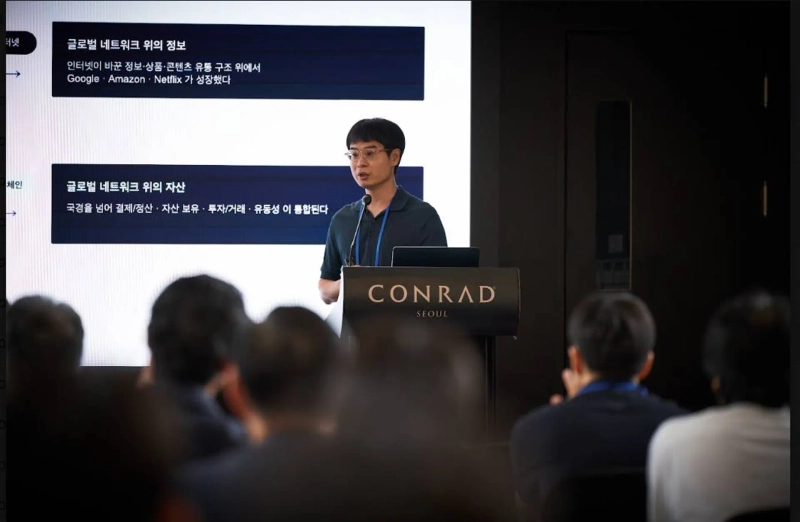
Lee Hyung-yeon, chief executive officer of South Korean blockchain company Altus, formerly known as B-Harvest, said on June 25 that domestic financial institutions need a long-term roadmap to build blockchain capabilities in-house.
Speaking at the "Tokenization 2026 for Financial Institutions" seminar at the Conrad Seoul in Yeouido on June 25, Lee said one to two years is not enough to develop the capabilities needed for a blockchain business. He argued that Korean financial institutions need a three- to five-year medium- to long-term roadmap to secure in-house blockchain expertise.
The seminar was co-hosted by Altus, global blockchain infrastructure company Blockdaemon and Zenith, a project based on Canton Network. Speakers included Lee, Alex Kim, Blockdaemon's head of global business development, and Heslin Kim, Zenith's chief business officer.
Lee presented on the theme "Designing Future Financial Infrastructure In-House." He said financial borders could break down faster than expected, much as YouTube and Netflix quickly erased borders in content distribution. If regulation is supportive, overseas digital-asset companies could enter South Korea and threaten local financial institutions.
Lee said Korean institutions should seek blockchain's value in connectivity rather than efficiency. Unlike the US, where older financial infrastructure has left more inefficiencies, South Korea's financial system was built relatively recently. As a result, blockchain adoption alone may not produce a large efficiency gain.
He compared the difference between US and Korean financial infrastructure to the gap in road conditions between an old city and a newly built one. The area Korean financial institutions should focus on, he said, is blockchain's global connectivity. South Korea's blockchain-based financial infrastructure has strong potential to connect with global markets, and preparing for that connectivity will be a key task for domestic institutions.
South Korea Could Become a Global Core Player
Lee said the need for digital assets ultimately also comes down to connectivity. Because Korea's financial infrastructure is already highly efficient, the case for adopting digital assets such as stablecoins and security tokens may not seem intuitive at first. Digital assets do not create entirely new assets but operate existing assets in a different form, increasing the likelihood that assets can move across borders more easily.
He said Korean institutions could establish themselves as core players in global markets through blockchain. Domestic institutions have so far remained relatively peripheral to global financial infrastructure participation. But because blockchain infrastructure is now being built, moving faster could give them a chance to stand at the center of a new global market.
Lee also said internal capabilities will be critical. In the digital-asset era, custody capabilities could become a core competitive strength for financial institutions. Safely holding money is a fundamental function of financial institutions, and custody will play that role in the digital-asset era, making related capabilities essential.
Financial Institutions Should Watch the RWA Market
Kim Se-heon, a lead at Altus, said blockchain transition should not be viewed simply as a risk factor. Presenting on "Using Canton Network for Institutional Digital Asset Platforms" at the seminar, Kim said institutions need a strategy that accepts blockchain at a manageable level while improving risk-adjusted returns.
He identified real-world assets, or RWAs, as a market Korean institutions should watch. Boston Consulting Group has projected that the RWA market could grow to $19 trillion by 2033.
Altus said that outlook helps explain why global financial institutions have recently begun stepping up investment in RWA infrastructure. Payment, custody and settlement services tied to real-world assets will ultimately need to be handled by financial institutions, Kim said. The RWA segment offers business opportunities well suited to financial institutions and could provide growth momentum.
Kim said the spread of blockchain technology is also changing the nature of competition. In the past, banks and securities firms mainly competed with peers in their own industries. Now fintech platforms are taking the lead in retail finance. Korean institutions should prepare to adopt blockchain in part to brace for the possible entry of overseas fintech companies such as Robinhood and Revolut into the domestic market.
Separately, Altus recently formalized its business identity as a "blockchain foundry" to target demand from Korean institutions looking to adopt blockchain. The company plans to use the know-how it has built over the past eight years to become a digital-asset infrastructure partner for financial institutions.

JOON HYOUNG LEE
gilson@bloomingbit.ioCrypto Journalist based in Seoul