Hyundai Motor, KAI Target 2034 Commercial Launch of AAM Aircraft
Summary
- Hyundai Motor Group and Korea Aerospace Industries Ltd., or KAI, are targeting commercialization in 2034 through joint development of an AAM, UAM, and dual-use civilian and military platform.
- The two companies plan to redesign the aircraft shape from scratch, finalize a joint design by 2027, and apply for type certification (TC) with US and South Korean authorities in 2028.
- Hyundai Motor Group will combine its electrified powertrain and global business capabilities with KAI’s aircraft systems development and a control and communications network based on low-Earth-orbit communications satellites to pursue an eVTOL-based AAM business.
Forecast Trend Report by Period


Joint development of future air mobility
KAI shifts from solo development
Aircraft shape and development concept to be redesigned from scratch
Companies discuss joint venture after signing pact
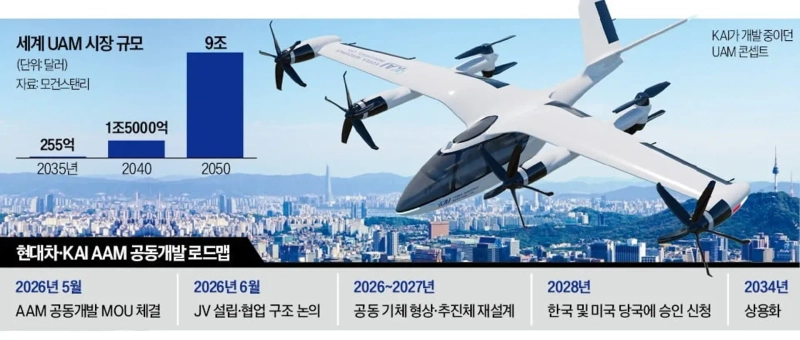
Hyundai Motor Group and Korea Aerospace Industries Ltd., or KAI, are reviving South Korea’s advanced air mobility, or AAM, project through a joint development effort, according to industry officials. The business had made little progress for some time, but the two companies have now drawn up a roadmap targeting commercialization in 2034. Their partnership could also help speed development of a Korean urban air mobility, or UAM, platform.
Redesigning the aircraft from scratch
Hyundai Motor Group and KAI are discussing a plan to develop an AAM aircraft and secure certification from the US Federal Aviation Administration and South Korea’s Ministry of Land, Infrastructure and Transport by 2034, industry officials said on June 25. The project would expand beyond urban passenger transport into a dual-use civilian and military platform for cargo transport, emergency medical transfers to island areas, and military resupply and reconnaissance.
The companies signed a memorandum of understanding in May to jointly develop AAM and have since discussed broader cooperation, including the possible establishment of a joint venture, people familiar with the matter said. AAM is a broader concept than conventional UAM, encompassing urban passenger transport as well as cargo services and military operations.
KAI changed its in-house AAM aircraft design seven times from 2023 and repeatedly conducted flight tests, wind tunnel tests and computational fluid dynamics analysis, but failed to achieve the performance it wanted. After agreeing to work with Hyundai Motor Group, the companies decided to scrap the existing design and start over with the aircraft shape, according to people familiar with the matter. Under the plan, they aim to finalize a joint aircraft design by 2027 and apply for type certification, or TC, with US and South Korean authorities around 2028. The goal is commercialization in 2034 after a certification process that typically takes about six years.
That schedule is two to three years later than KAI’s previous target of 2031 to 2032 when it was developing the project on its own. Redesigning the aircraft shape alone is expected to take about a year, forcing the company to push back the commercialization timeline.
Hyundai Motor to supply powertrain, KAI the airframe
The partnership is meant to address the limits both companies encountered in their separate development efforts. KAI faced rising pressure after four failed attempts to pass a preliminary feasibility review for a state AAM research and development program. Developing a single aircraft type requires about 800 billion won ($579 million), making solo development difficult.
Hyundai Motor Group also pursued the business independently through Supernal, its US AAM unit, but delays in development and certification led to restructuring and job cuts. Speculation had grown that Hyundai might withdraw from the AAM business.
Having learned from those setbacks, the companies chose to collaborate. They plan to combine Hyundai Motor Group’s electrified powertrain technology and global business capabilities with KAI’s expertise in aircraft systems development and its experience in flight testing and certification. KAI is also reviewing a plan to use low-Earth-orbit communications satellites it is developing with the Ministry of Science and ICT and the Electronics and Telecommunications Research Institute for AAM control and communications networks.
The aircraft will use an electrified powertrain, making it an eVTOL-based AAM platform.
"A shift from separate development by domestic companies to a joint development system should improve the chances of success for K-UAM," an industry official said. "This collaboration could become an important turning point for South Korea’s AAM industry."
Song Jun-young and Shin Jeong-eun, Korea Economic Daily reporters, ssong@hankyung.com

Korea Economic Daily
hankyung@bloomingbit.ioThe Korea Economic Daily Global is a digital media where latest news on Korean companies, industries, and financial markets.