US Says AI Models Need Pre-Approval, Slowing OpenAI’s GPT-5.6 Rollout
Summary
- The US government said advanced AI models such as GPT-5.6 will require government approval before release, effectively shifting the system to a permit regime.
- The move expands US AI export controls to include access rights to AI models, exposing companies and public institutions that rely on big tech models to policy-change risk.
- South Korea is building Korean AI models through the government’s Independent AI Foundation Model Project, making the pace of domestic investment and development more important as the country tries to reduce AI dependence.
Forecast Trend Report by Period


OpenAI CEO Sam Altman discloses talks with US officials
Washington acted before the model’s release
OpenAI follows Anthropic
Government gets first access to models
Partner selection must be discussed with Washington
The Trump administration has moved to restrict access to OpenAI’s next artificial intelligence model, widening a tougher stance that had already hit Anthropic. In Anthropic’s case, the government intervened after release. This time, it stepped in before the model reached the market. The move is being interpreted as a clear signal that Washington wants to control access to advanced AI models. It is also adding momentum to calls in South Korea for domestically developed AI models to protect the country’s AI sovereignty.
AI model launches are shifting to a permit system
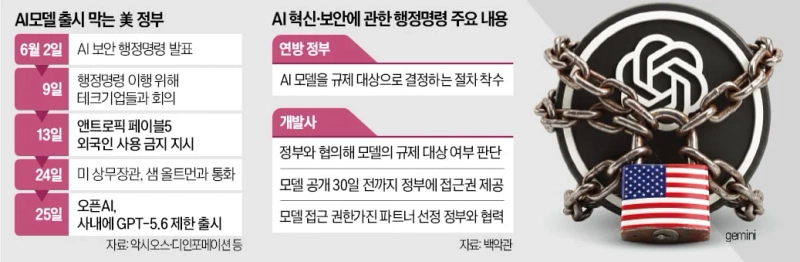
The Information reported on June 25 that OpenAI Chief Executive Officer Sam Altman told employees in an internal memo that the company plans to make GPT-5.6 available only to a limited group of partners at first. During that pre-release period, the US government will review customers and approve access on a case-by-case basis.
Altman visited Washington earlier this month and gave an advance demonstration of GPT-5.6 to the Office of the National Cyber Director and the Office of Science and Technology Policy, the report said. Plans for a phased rollout of GPT-5.6 were also set at that time. US Commerce Secretary Howard Lutnick called Altman on June 24 and told him not to release the model without approval from other agencies. Altman told staff he had informed the government that such an approach was not desirable over the long term. He added that OpenAI would work with US officials and industry participants to create a more sustainable framework for future product releases.
The White House on June 2 issued an executive order on advanced AI innovation and security, laying the groundwork for tighter control of AI models. The order says the government must, within 30 days, establish procedures to designate AI systems as “protected frontier models.” It also says AI developers must provide the government access to models 30 days before public release and consult with officials when selecting priority-access partners. In effect, AI model launches have shifted toward a permit system.
South Korea faces pressure to reduce AI dependence
As US export controls expand beyond semiconductors to access rights for AI models, calls are growing for South Korea to reduce its dependence on foreign AI. Concerns that companies and public institutions relying on big tech models could be shaken at any time by shifts in US policy are now becoming reality.
The Ministry of Science and ICT is pushing ahead with its Independent AI Foundation Model Project. The program aims to build a Korean AI model with performance exceeding 95% of the latest global systems, using 50,000 graphics processing units and a budget of about $145 million. Four teams — LG AI Research, SK Telecom, Upstage and Motif Technologies — are competing in the second round of development, with the second evaluation due in August.
South Korea remains in a better position than many other countries. According to AI Index 2026, published in April by Stanford University’s Institute for Human-Centered Artificial Intelligence, South Korea ranked third globally with eight “notable AI models,” behind the US with 50 and China with 30. The gap with the top two is wide, but South Korea’s total far exceeds the single model cited for countries in the next group, including Canada, France and the UK. The list included four models from LG AI Research, including EXAONE 4.0 and K-EXAONE, as well as an Upstage model. As recently as 2024, no South Korean model had appeared on the list. Many in the industry view that as the result of concentrated domestic investment centered on the Independent AI Foundation Model Project.
As the US government’s attempts to control AI are expected to continue, calls are growing to speed up selection under the project. A South Korean AI industry official said the current process would not produce a final selection until the first half of next year. Meanwhile, US and Chinese companies including Anthropic, OpenAI and Zhipu AI are releasing new models almost every week and targeting South Korea’s enterprise market.
Kim In-yeop, Silicon Valley correspondent / Lee Young-ae, reporter inside@hankyung.com

Korea Economic Daily
hankyung@bloomingbit.ioThe Korea Economic Daily Global is a digital media where latest news on Korean companies, industries, and financial markets.