Lee Unveils $7.2 Billion Fund to Foster Five ‘Korean Palantirs’ by 2030
Summary
- The government said it will foster five Korean Palantir-style companies in the security innovation sector with valuations above 1 trillion won and create 50 companies with more than 100 billion won in revenue.
- It said it will create a 10 trillion won fund over the next five years to focus support on security innovators in AI, aerospace, drones, robotics and quantum technology, as well as defense unicorns.
- The government said it will help security companies such as MakinaRocks, Robotis and Uconsystem grow through a rapid procurement system, opening national satellite imagery, and R&D funding and equity investment.
Forecast Trend Report by Period


Lee chairs meeting on future security innovators
Targets five firms worth more than $720 million by 2030
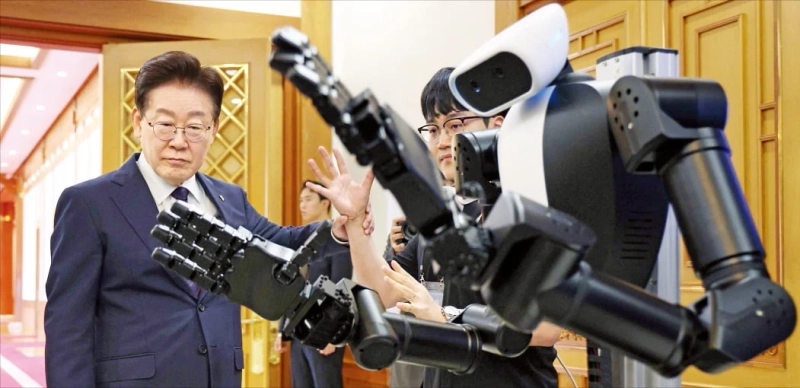
South Korea said it aims to foster five companies in the emerging security sector with valuations above 1 trillion won ($720 million) by 2030, part of a push to create domestic versions of Palantir.
The Ministry of SMEs and Startups, the Ministry of National Defense and other agencies presented the plan at a strategy meeting chaired by President Lee Jae-myung at the Blue House on June 26. The government will establish a technology-focused asset manager modeled on In-Q-Tel, the venture capital firm backed by the US Central Intelligence Agency, and invest as much as 10 trillion won ($7.2 billion) over the next five years in innovative security companies. It is also targeting 50 companies with annual revenue of more than 100 billion won ($72 million).
Lee said his government would spare no effort to help South Korean innovators stand out in the new security market, citing US companies Palantir and Anduril as examples of global security innovators. He said advanced civilian technologies including semiconductors, drones, robots, satellites and networks have become decisive to national security. Technological superiority is now a security advantage, he added.
The term refers to security capabilities built on defense artificial intelligence and advanced sensors rather than traditional conventional military strength. Palantir, which drew attention during the wars in Ukraine and the Middle East, is considered one of the best-known companies in the field. The company is valued at 480 trillion won, or about $346 billion. Germany and France, key North Atlantic Treaty Organization members, have declared plans to develop their own defense AI industries, highlighting the growing importance of such technologies to military capability.
Government widens funding, military technology access in push for defense unicorns
MakinaRocks, Robotis and others in focus
Lee has emphasized security innovation companies because advanced technologies such as AI, aerospace, drones, robotics, cybersecurity and quantum communications are expected to shape future battlefields. He has set a goal of nurturing a Korean version of Palantir or SpaceX while strengthening both national security and exports.
‘K-defense is skewed toward big-company hardware’
Lee said at the June 26 meeting that South Korea’s defense industry has made a remarkable leap but now faces new challenges. The sector remains concentrated in hardware weapons systems made by large companies, while the procurement structure is slow and rigid. That makes fostering security innovators at the national level especially important, he said.
Support for the sector does not mean excluding large companies, Lee said. Still, venture companies and startups have an edge in speed and agility and can take the lead on this new stage. He added that South Korea should build innovative companies capable of competing with Palantir, valued at 480 trillion won, and Germany’s Helsing, valued at 26 trillion won.
Companies attending the meeting that were classified as security innovators included MakinaRocks in physical AI, Robotis in robotics, Uconsystem in drones, Persona AI in AI solutions, ICTK and Norma in quantum technology, and Nara Space Technology in satellites.
Lee first used the term security innovation companies at a Cabinet meeting on May 26. The shift suggests he wants to move beyond the traditional framework of the defense industry and foster new growth sectors. To support startups, the government plans to create a fund of as much as 10 trillion won over the next five years. It also plans to build a rapid procurement system that would cut the time needed to deploy advanced weapons systems to less than a year from the current seven to 10 years. National satellite imagery and observation data will also be opened to the private sector.
‘We may soon need a supplementary budget’
Lee responded to proposals from security companies at the meeting and immediately instructed Cabinet members and aides to act. After Jeon Tae-gyun, chief executive officer of satellite-imagery analysis company SIA, said there was a shortage of graphics processing units, Lee ordered officials to speed up purchases of Nvidia GPUs. He added that GPUs would be needed on an ever larger scale and said the government may soon need a supplementary budget because additional fiscal resources appear to be emerging. The remarks were interpreted as hinting at a second extra budget this year, as a semiconductor boom could generate higher-than-expected tax revenue. A Blue House official said no decision had been made on a supplementary budget and described Lee’s comments as a general remark on the need to expand investment to raise growth potential.
Cho Moon-soo, chairman of Hankuk Carbon, pointed to a problem in which companies lose business ties once they grow from small firms into mid-sized ones and no longer qualify for benefits. Lee said the government did not intend to disadvantage mid-sized companies and indicated officials were reviewing a gradual reduction in support for smaller firms.
Lee also instructed officials to devise a plan under which the government would lend research-and-development funds to innovative companies and, if their technology development succeeds, jointly own the intellectual property and take an equity stake. After Pablo Air Chairman Kim Young-joon called for a large security special zone, Lee ordered officials to identify unused islands or other sites where land, sea and air security capabilities could be tested. He said applying humanoid robots in the military raises ethical questions but is nevertheless one of the areas the country needs to prioritize.
Kim Hyoung-kyu
▶ Security innovation project
A government-wide industrial strategy aimed at responding not to traditional or conventional military threats, but to new forms of national security threats using advanced technologies such as artificial intelligence, aerospace and drones.

Korea Economic Daily
hankyung@bloomingbit.ioThe Korea Economic Daily Global is a digital media where latest news on Korean companies, industries, and financial markets.