Korean Stocks Reel as SK Hynix’s Wild Swings Spark Panic Near 3 Million Won
Forecast Trend Report by Period


Roller-Coaster Kospi: Is SK Hynix Driving the Turmoil?
VKOSPI Tops 90
Sidecars Triggered 29 Times This Year, Surpassing 2008 Crisis Level
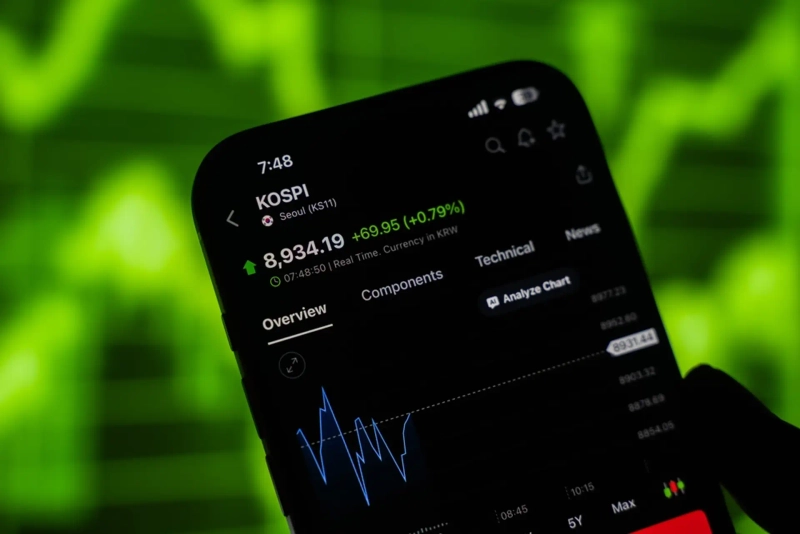
South Korea’s stock market has been gripped by fears of extreme volatility. The shock from “Black Tuesday” on June 23, when the benchmark Kospi plunged nearly 10% in a single session, had barely faded before “Black Friday” hit three days later, pushing the market deeper into panic. It was the first time circuit breakers, which temporarily halt trading in all stocks, were triggered twice in the same week.
The Korea Exchange said a circuit breaker was triggered on the Kospi at 12:10 p.m. on June 26. The measure suspends trading for 20 minutes when the index remains down at least 8% from the previous trading day for one minute.
The Kospi opened down more than 1% on June 26, but losses accelerated as selling pressure intensified in semiconductor heavyweights including Samsung Electronics and SK Hynix. A sell-side sidecar, which temporarily suspends program sell orders, was triggered at about 11:12 a.m. The market failed to regain its footing, and the index at one point fell back to the 8,100 level.
The June 26 halt marked the fifth circuit breaker on the Kospi this year. Five of the 11 circuit breakers ever triggered in the market have now occurred in 2026. Most notably, another circuit breaker was set off just three days after June 23, when the index tumbled more than 910 points. It was the first time since the launch of South Korea’s stock market that circuit breakers were triggered twice in a single week.
Market participants say relentless selling in large-cap semiconductor stocks made this the most destructive week in the history of the Korean stock market. The number of sidecars triggered on the Kospi this year has reached 29, already well above the 26 recorded during the 2008 global financial crisis, underscoring the severity of the turmoil.
Volatility in SK Hynix, South Korea’s flagship artificial intelligence memory stock, has been especially intense. On June 26, the stock fell more than 10% intraday to 2.6 million won. That was a sharp reversal from the previous day, when it jumped as much as 15.78% to 2.988 million won, putting the symbolic 3 million won level within reach.
The dominant view in the market is that SK Hynix fell because the stock had risen too far, too fast. This year, the gap between SK Hynix’s share price and its 20-day moving average had generally moved between minus one standard deviation and plus two standard deviations. But when the company regained the title of the market’s most valuable stock, it rose for eight straight trading sessions and the gap widened to plus two standard deviations.
When a stock rises sharply in a short period, the chances of profit-taking increase. SK Hynix had mostly traded within a relatively normal range around its average price over the previous 20 sessions this year. But during its eight-session rally to the top of the market-cap rankings, the stock climbed much faster than usual.
That distance is captured by a metric known as price disparity, which shows how far the current share price stands above or below its recent average. At the time, the reading rose to plus two standard deviations, beyond its typical trading range. In the market, that was taken as a sign the short-term rally had become overheated. Profit-taking then emerged, pulling the stock back toward its average trend line.
The Kospi 200 Volatility Index, or VKOSPI, often referred to as South Korea’s fear gauge, has also surged to extreme levels. The index climbed as high as 97.78 intraday after Black Tuesday, setting a record, and remained above 93 on June 26. A reading above 90 suggests investors have effectively given up trying to predict near-term stock moves and have fallen into severe panic.
Han Ji-young, an analyst at Kiwoom Securities, said semiconductors had been the only sector leading the Kospi’s sharp rebound over the previous two days. On June 26, profit-taking hit those outperforming chip stocks, while passive flows tied to semiconductor names also reversed, triggering selling pressure across most sectors.
Kang Kyung-ju, Hankyung.com reporter qurasoha@hankyung.com

Korea Economic Daily
hankyung@bloomingbit.ioThe Korea Economic Daily Global is a digital media where latest news on Korean companies, industries, and financial markets.