Binance’s 150x KOSPI-Linked Bets Stoke Volatility Debate
Summary
- The world’s largest cryptocurrency exchange, Binance, has listed leveraged derivatives tied to the Kospi, fueling controversy.
- The products apply up to 50x leverage to the KORU ETF and to major South Korean stocks, meaning gains or losses can widen to as much as 150%.
- Concerns have been raised that the products could increase volatility in South Korea’s stock market and that users of overseas cryptocurrency exchanges may struggle to obtain oversight or compensation from domestic regulators in cases such as forced liquidation or exchange accidents.
Forecast Trend Report by Period


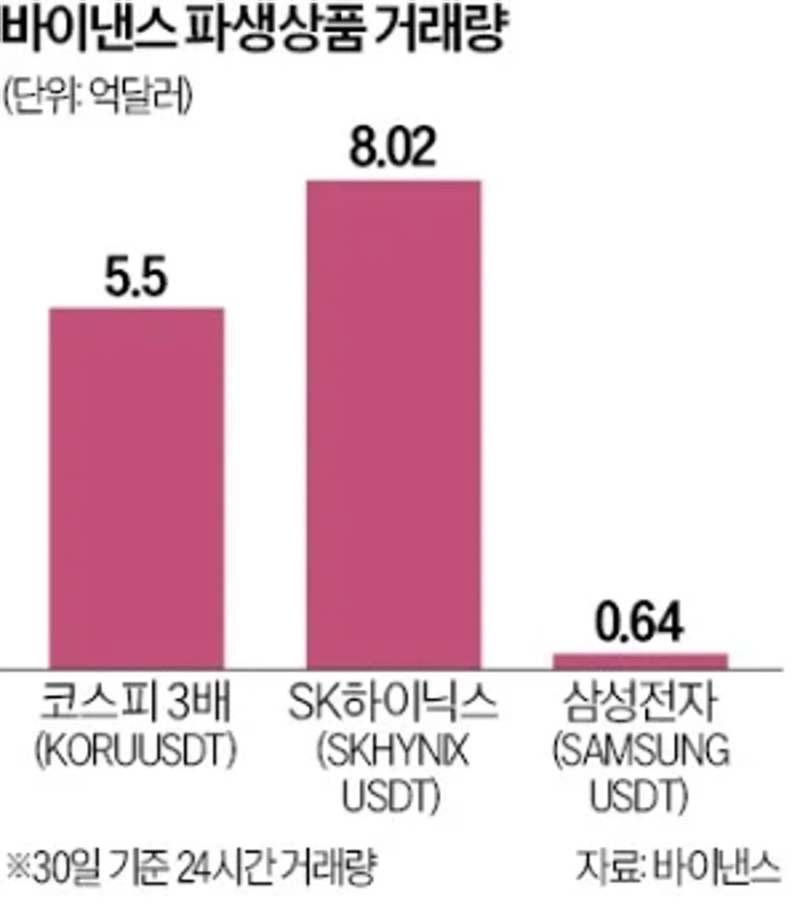
Binance, the world’s largest cryptocurrency exchange, is drawing scrutiny after listing derivatives that allow traders to make leveraged bets of as much as 150 times on moves in the Kospi index. Concern is also rising as similar products tied to major South Korean stocks including Samsung Electronics Co., SK Hynix Inc. and Hyundai Motor Co. are trading, though questions remain over the products’ actual structure and their impact on the market.
Binance said cumulative trading volume in KORUUSDT, listed on June 22, reached $1.36 billion as of June 30. The product is based on KORU, a US-listed leveraged exchange-traded fund tied to the Kospi. KORU is designed to deliver three times the daily return of a Kospi-related index. Binance also listed a product based on KORU’s price that offers leverage of up to 50 times. Products that allow traders to apply as much as 50 times leverage to price moves in major South Korean stocks including SK Hynix and Samsung Electronics are also available.
The products are leveraged instruments settled in Tether’s dollar-pegged stablecoin USDT. Put simply, if the Kospi moves 1%, KORU would move 3%. With 50 times leverage applied, an investor’s profit or loss could swell to as much as 150% of margin. Margin deposits and profit-and-loss settlement are conducted in USDT.
Some market participants have raised so-called wag-the-dog concerns that such derivatives could heighten volatility in South Korea’s stock market. Still, many view the impact as limited because the products do not involve buying or selling the underlying shares. Instead, they are bets on price direction, meaning orders do not flow directly into the domestic equity market. “Usually, the exchange matches bullish and bearish bets on its internal book and only calculates gains and losses, so it would be difficult to move the actual market,” Kim Min-seung, head of research at Korbit, said. He added that prices formed on overseas crypto exchanges could still influence investor sentiment in South Korea’s stock market the following day.
While trading volume has reached into the billions of dollars, that does not mean an equivalent amount of money has flowed overseas. Trading volume is the sum of all buy and sell transactions. For example, if an investor posts about $720 in margin and uses 50 times leverage, that person can trade roughly $36,000 of exposure at a time. If the position is bought and sold 10 times in a day, total trading volume would amount to about $360,000. In South Korea, investing in leveraged products comes with high barriers including mandatory investor education, but overseas cryptocurrency exchanges impose few such restrictions. That means if forced liquidation, pricing errors or exchange failures occur, investors cannot receive direct supervision or compensation from South Korean financial authorities.
Cho Mi-hyun, Korea Economic Daily reporter mwise@hankyung.com

Korea Economic Daily
hankyung@bloomingbit.ioThe Korea Economic Daily Global is a digital media where latest news on Korean companies, industries, and financial markets.