Won Tests 1,550 Despite $36 Billion Defense, With 1,600 Risk in View
Summary
- The won-dollar exchange rate moved above 1,550, with some in the market even discussing a rise to 1,600, heightening concern that the won is entering a structurally elevated exchange-rate regime.
- Authorities have net sold about 50 trillion won, or roughly $36 billion, of dollars over the past six months, but have still failed to reverse won weakness and the broader rise in the exchange rate.
- Views on the second-half exchange rate are sharply divided between the possibility of a break above 1,600 won and hopes that incoming dollar inflows will ease pressure.
Forecast Trend Report by Period


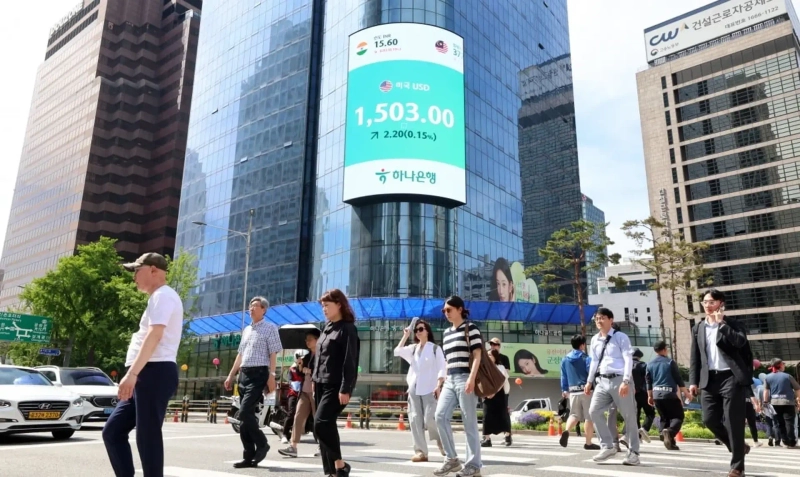
The won weakened past 1,550 per dollar in intraday trading, climbing to its highest level since the global financial crisis. South Korea’s foreign-exchange authorities supplied about 50 trillion won, or roughly $36 billion, to the market over the past six months, but that has not been enough to counter broad dollar strength and pressure on the Korean currency. Some market participants now argue the won has entered a structurally weak phase. A move beyond 1,600 per dollar is also being discussed.
In Seoul trading on June 30, the won closed the daytime session at 1,549.4 per dollar, 4.2 won weaker than the previous session. It was the highest daytime closing level since March 6, 2009, when it ended at 1,550.0 during the global financial crisis.
The won opened at 1,543.1 per dollar, 2.1 won stronger than the previous close, but turned higher early in the session. It later moved around the 1,550 level before ending the day. The currency traded above 1,550 during daytime hours for the first time in 16 sessions since June 8.
Market participants say the recent moves look markedly different from typical trading patterns. Since closing the daytime session at 1,511.1 per dollar on June 15, the won has weakened in all but two sessions. The exchange rate has risen nearly 40 won in about two weeks, fueling concern that the move into the 1,500s is no longer a temporary shock and could prove prolonged.
Bank of Korea data show the average daytime closing rate in the first half of 2026 was 1,484.56 per dollar, based on the 3:30 p.m. close. The second-quarter average was 1,501.64. On a half-year basis, that was the highest since the first half of 1998, when the average was 1,494.80. On a quarterly basis, it was the highest since the first quarter of 1998, when it averaged 1,596.88.
The biggest problem is that dollar strength is reinforcing won weakness. Pressure on the US currency increased as the prospect of further Federal Reserve rate hikes returned to the forefront. Buying flowed into New York overnight after the US and Iran agreed to halt attacks, but that did little to reverse the broader rise in the won-dollar rate. The dollar index, which tracks the greenback against six major currencies, traded above 101 during the session.
A weaker yen also added pressure on the won. The yen traded in the 162 range against the dollar during the session, its weakest level since December 1986, shortly after the Plaza Accord. Japan’s government stepped up verbal intervention, but the yen’s slide showed little sign of easing. Because the won tends to move in tandem with the yen, the Japanese currency’s decline appears to have added to downward pressure on the Korean currency.
The problem for policymakers is that the exchange rate has remained difficult to contain despite large-scale intervention. According to the Bank of Korea’s release on June 30 detailing foreign-exchange market stabilization measures for the first quarter of 2026, the authorities’ net foreign-exchange transactions totaled negative $13.628 billion. That was equivalent to about 19.1 trillion won, or roughly $13.8 billion.
A negative net transaction figure means the authorities were net sellers of dollars in the market. When the won drops rapidly and the won-dollar exchange rate surges, officials supply dollars from reserves to slow the pace of the move. The first-quarter intervention was the fourth-largest net dollar sale on record. In the previous quarter, the fourth quarter of 2025, net dollar sales reached negative $22.467 billion, the largest quarterly total on record. Combined, the authorities sold a net $36.095 billion over the two quarters. In won terms, that amounts to roughly 50 trillion won deployed over six months to defend the currency.
Even so, the exchange rate is once again testing the 1,550 level. The authorities have slowed the pace of the rise by supplying dollars, but they have not reversed the direction of the move. Since the second half of 2025, demand for dollars in the domestic foreign-exchange market has increased as overseas investment by Korean residents expanded, foreign funds flowed out and companies stepped up efforts to secure dollars.
The average won-dollar rate in the fourth quarter of 2025 was 1,451.96, up 65.83 won from 1,386.13 in the previous quarter. The dollar was not strengthening in a one-sided way at the time, but stronger domestic demand for dollars deepened pressure on the won. That burden had not fully disappeared in the first quarter of 2026.
If expectations for further won weakness persist, companies and investors may become more aggressive in buying dollars. That, in turn, would add further upward pressure on the exchange rate. The authorities’ decision to conduct more than $10 billion in net dollar sales can also be seen as an effort to curb those expectations.
Views on the second half are sharply divided. Some market participants now discuss the possibility of the won moving beyond 1,600 per dollar. If worries about additional Fed tightening intensify and dollar strength persists, pressure on the won could increase further. A prolonged period of elevated exchange rates would raise import prices and companies’ cost burdens, with delayed effects on consumer inflation.
Others expect supply-demand imbalances to ease somewhat in the second half. Foreign investors’ rebalancing demand around quarter-end and half-year-end may subside, while a large inflow of dollars tied to SK Hynix’s American depositary receipt listing is expected to provide an additional source of supply.
“Whenever the exchange rate falls, real demand emerges from buyers trying to secure dollars, making it difficult to create conditions favorable to the won,” Min Kyung-won, an economist at Woori Bank, said. He added that foreign investors’ continued moves to reduce their weighting in domestic equities are also a concern.
Kang Kyung-ju, Hankyung.com reporter qurasoha@hankyung.com

Korea Economic Daily
hankyung@bloomingbit.ioThe Korea Economic Daily Global is a digital media where latest news on Korean companies, industries, and financial markets.