PiCK
Open Standard to Launch OUSD Stablecoin This Year With 140 Partners, Challenging Tether and Circle
Summary
- The global stablecoin project 'OUSD' is set to launch later this year with more than 140 companies including Visa, Google, BlackRock and Coinbase, challenging a market long led by Tether (USDT) and Circle (USDC).
- OUSD said South Korean companies including Samsung Electronics, Shinhan Financial Group, domestic card issuers and internet banks have joined its model, which shares reserve income with partners and waives issuance and redemption fees.
- The report said Circle shares fell 18% after news of the OUSD launch, while potential conflict with domestic regulation, the possible launch of a won-based stablecoin and future interoperability remain key sources of uncertainty for investors.
Forecast Trend Report by Period


More than 140 companies, including Visa, Google and BlackRock, join project
South Korean companies including Samsung and Shinhan also sign on
KakaoBank says it has expressed interest in serving as a distribution partner
Potential conflict with domestic regulation remains a key variable
Open Standard, a global project backed by more than 140 financial and technology companies including Samsung Electronics and Shinhan Financial Group, plans to launch its own stablecoin, OUSD, later this year. It is the largest alliance project to emerge since the US enacted the GENIUS Act, its stablecoin law. The group is challenging a market long dominated by Tether's USDT and Circle's USDC with a new model that shares reserve income with partners.
The global stablecoin market is currently worth about $312.3 billion. Tether and USDC have market capitalizations of $184.7 billion and $73.9 billion, respectively, accounting for about 83% of the market. The arrival of the OUSD alliance, backed by global payment networks and deep capital, is drawing industry attention over whether it can disrupt the long-standing duopoly.
Open Standard, a global digital-currency alliance, on July 1 disclosed plans to issue OUSD later this year and released a list of more than 140 partners. Participants include global payments companies such as Visa and Mastercard, as well as major financial firms including BlackRock and BNY. Big Tech companies such as Google and Shopify also joined, along with major crypto firms including Coinbase. Shopify plans to support OUSD as a payment option for merchants on its platform.
OUSD's biggest differentiator is its revenue-sharing model. Tether and Circle typically invest customer reserves in safe assets such as US Treasuries and keep most of the resulting income. OUSD said it will share reserve income with partners after deducting operating costs. It will also waive issuance and redemption fees entirely, lowering barriers to institutional participation.
Its operating structure also emphasizes independence. Open Standard, the operator of OUSD, will be established as an independent corporation that complies with the GENIUS Act. Its board will also be made up of participating companies. Ecosystem management and major decisions will center on the collective interests of partners rather than any single company. Jack Abrams, interim chief executive of Bridge, Stripe's stablecoin unit, will lead the launch later this year as Open Standard's first interim CEO.
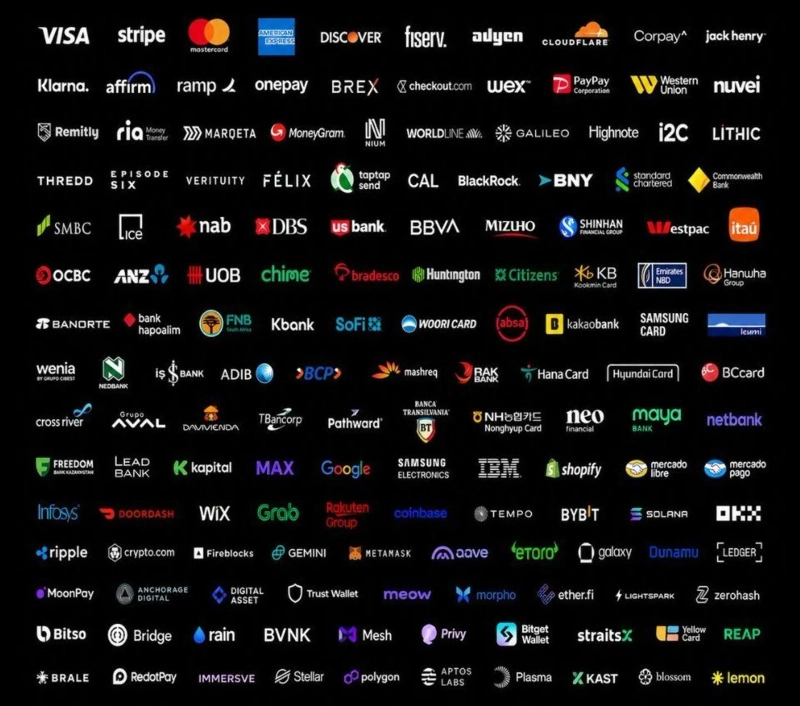
The participation of South Korean companies also stands out. Shinhan Financial Group is among the partners, along with major card issuers including KB Kookmin Card, Hyundai Card, Samsung Card, Hana Card, Woori Card, BC Card and NH NongHyup Card. Internet-only banks KakaoBank and K Bank are also on the list. Samsung Electronics and Hanwha Group joined from industry, while Dunamu, the operator of Upbit, signed on from the crypto sector. It is unusual for so many major South Korean financial institutions and conglomerates to join a global stablecoin alliance at once.
Their objectives differ by sector. Banks are reviewing whether OUSD could eventually be distributed in South Korea and linked to financial services. KakaoBank has already told Open Standard it wants to participate as a domestic distribution institution. A KakaoBank official told Bloomingbit on July 1 that the bank had conveyed its intention to join as an OUSD distribution partner, but that nothing has been finalized regarding specific business plans or service adoption.
Card companies are also considering using OUSD for cross-border payments or settlement infrastructure. The role of crypto firms is expected to be more limited. A Dunamu official told Bloomingbit that Upbit is not participating in the issuance of the stablecoin and has only expressed interest in joining the future expansion of the Open Standard ecosystem.
Samsung's participation has drawn particular attention. With Samsung Electronics and Samsung Card included among OUSD partners, industry participants have raised the possibility that OUSD could eventually be linked to digital financial services such as Samsung Wallet and Samsung Pay. A Samsung Card official told Bloomingbit that Mastercard and Visa had asked domestic card companies whether they were interested in joining OUSD, and the company responded that it was interested. No further detailed discussions have taken place.
Hyundai Card also confirmed that it joined as part of an early technology review. A Hyundai Card official said participation in Open Standard was intended to help the company respond to a changing environment and take part in related discussions.
Circle shares, meanwhile, plunged on the news. The biggest blow was that Coinbase, a longtime partner and Circle's largest distribution channel, joined the OUSD alliance as one of its key backers. Coinbase and Circle are due to renew their existing revenue-sharing agreement in August. With a new alternative now in hand, Coinbase's negotiating leverage with Circle has increased sharply. On July 1, the day news of the OUSD alliance broke, Circle shares fell 18% as investors priced in the rise of a new competitor and the risk of market-share erosion.
OUSD still faces substantial hurdles. Meta's Libra project failed to overcome regulatory barriers, and Paxos's USDG, launched in 2024 with a similar partnership model, has remained limited to distribution of about $3 billion.
Potential conflict with South Korean regulation is another variable. Kim Nam-woong, chief executive of Populous, said OUSD is also likely to follow the structure used by existing dollar stablecoins, with US Treasuries serving as reserve assets. That differs from the direction of South Korea's proposed stablecoin legislation, which would require reserves to be held entirely in won.
"It may be possible to provide services to overseas users through foreign subsidiaries, but there would be considerable regulatory constraints on full-scale use in South Korea," Kim told Bloomingbit. "It will also be important how the Bank of Korea and other regulators view the participation of domestic financial institutions in a global stablecoin alliance."
He added that it remains to be seen whether a won-based stablecoin will be launched separately in the future alongside the dollar-based OUSD, and whether an interoperable structure can be established. Unless reserve-asset rules and broader institutional uncertainty are resolved, domestic companies will need considerable time before applying it to actual services, he said.

Doohyun Hwang
cow5361@bloomingbit.ioKEEP CALM AND HODL🍀