Samsung, Shinhan Join 140-Company Global Dollar Stablecoin Alliance Led by Visa, Mastercard
Summary
- Dollar stablecoin OUSD, backed by Visa, Mastercard, BlackRock and Google, is set for an October launch, challenging a market long dominated by Tether (USDT) and Circle (USDC).
- OUSD will eliminate minting and redemption fees and distribute interest income from reserve assets to consortium members, creating a model in which participant revenue rises as usage grows.
- Thirteen South Korean companies, including Samsung Electronics, Shinhan Financial Group, KB Kookmin Card and Dunamu, joined the consortium to secure an early foothold as the global payments order shifts and competition in stablecoin distribution intensifies.
Forecast Trend Report by Period


140 companies back global dollar stablecoin alliance
Visa, Mastercard and Coinbase lead push
BlackRock and Google add heft
OUSD to eliminate minting and redemption fees
Revenue-sharing model targets payment networks
Samsung Electronics Co. and Shinhan Financial Group are among 13 South Korean companies that have joined a global dollar stablecoin alliance formed by payment companies and financial firms including Visa and Mastercard. The move marks a push by traditional finance into a stablecoin market long dominated by crypto-native issuers such as Tether and Circle. It also signals that competition for control of global dollar payment rails is entering a new phase.
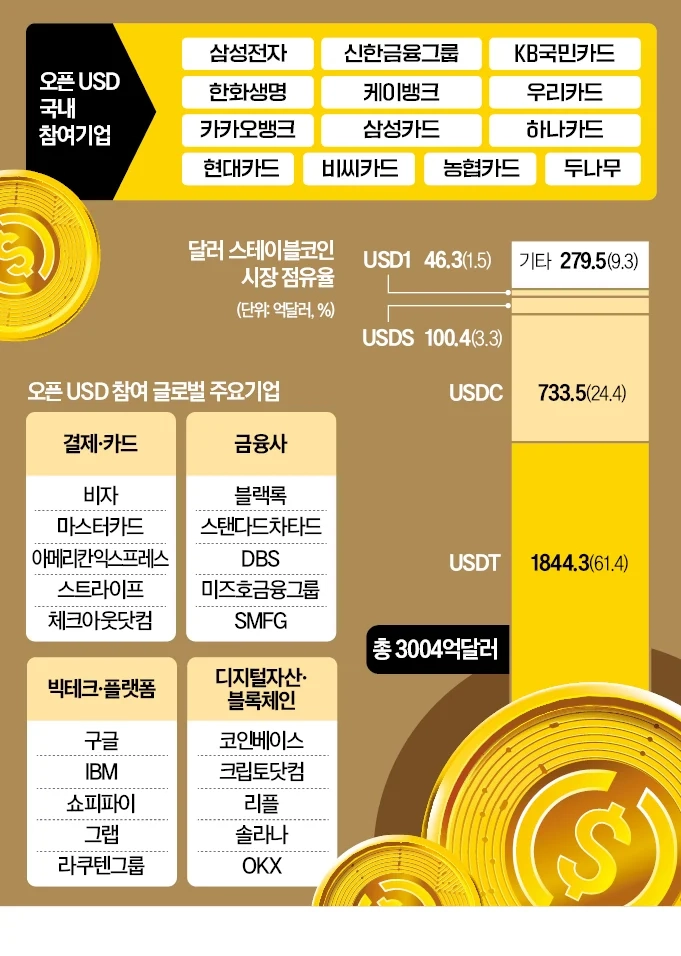
OpenStandard, a consortium whose members include Visa, Mastercard, BlackRock and Google, plans to launch the dollar-pegged stablecoin OpenUSD, or OUSD, as early as October, according to financial industry officials and foreign media reports cited on July 1. About 140 companies have joined the group, spanning payment firms, financial institutions, big tech companies and crypto businesses.
The South Korean participants include Samsung Electronics, Shinhan Financial Group, KB Kookmin Card and Dunamu. A senior Shinhan Financial official described OUSD as dollar stablecoin infrastructure effectively built jointly by traditional financial institutions. Shinhan joined the consortium so it can respond to changes in the global payments order once related legislation is in place in South Korea, the official added.
OUSD is designed to maintain a one-to-one peg with the US dollar. Unlike Tether's USDT and Circle's USDC, it will not charge minting or redemption fees. It will also share income generated from reserve assets with consortium members. The strategy is to challenge a dollar stablecoin market that Tether and Circle have largely controlled by building a shared infrastructure.
Markets reacted quickly. Circle shares plunged more than 17% the previous day after news of the planned OUSD launch. Investors are betting that OUSD, backed by globally established payment networks, could quickly threaten existing stablecoins. Kim Min-seung, head of research at Korbit, said the battle for stablecoin leadership will shift from issuance to distribution through payment rails and platforms.
Traditional finance's counterattack as OpenUSD emerges to challenge Tether and Circle
Visa, Mastercard and Coinbase lead, with BlackRock and Google joining
Tether and Circle have long held an entrenched position in the global stablecoin market. USDT, issued by Tether, and Circle's USDC account for nearly 90% of the market. Later entrants have repeatedly launched their own dollar coins, but most have failed to gain traction. In the stablecoin business, distribution matters more than issuance. That makes it difficult to dislodge incumbents with links across exchanges, wallets, payment networks and bank accounts.
Can Tether and Circle's dominance be broken?
That is why OpenUSD, led by Visa, Mastercard, Stripe and Coinbase, is drawing attention. OUSD is not simply another dollar stablecoin. It more closely resembles a shared settlement network built on existing financial and payment infrastructure. Visa and Mastercard, which dominate global card networks, are at the table with Stripe, a leader in online payments, and Coinbase, a global crypto exchange. They are joined by traditional financial firms and big tech companies including BlackRock, Standard Chartered, Google and IBM.
Kim said new entrants struggle to scale issuance unless they can secure merchants and payment endpoints that will accept their coin. OUSD addresses that weakness from the outset by bringing in about 140 participating companies.
Another feature that sets OUSD apart is its profit model. Tether and Circle rely heavily on interest income from reserve assets, investing customer dollars in US Treasuries and cash-like instruments. As issuance grows, reserves increase. In periods of higher interest rates, that income rises as well.
OUSD is offering a different structure. It will eliminate minting and redemption fees and distribute income from reserve assets among consortium members. As OUSD usage rises, the revenue shared with participants could grow as well. The idea is to expand the ecosystem by distributing profits that incumbent issuers have largely kept for themselves to payment-network and platform participants.
The market view is that OUSD could change the basis of stablecoin competition. Until now, the central question has been who can issue the most trusted stablecoin. Going forward, competitiveness may depend more on how tightly issuers connect merchants, settlement networks and platforms.
Korean companies also race to secure an early foothold
South Korean companies are joining for the same reason. Samsung Electronics already has global payment touchpoints through Samsung Wallet. Shinhan Financial Group is looking for business opportunities tied to changes in overseas payment and settlement networks through its banking and card units. The participation of domestic card companies including KB Kookmin Card reflects the same logic. If OUSD is integrated with card networks, payments could still be made like ordinary card transactions while back-end settlement is handled in dollar stablecoins.
K Bank and KakaoBank may also have room to expand into digital-asset payment and remittance services through their mobile-based financial platforms. Dunamu, which operates crypto trading, wallets and won deposit-and-withdrawal infrastructure, is particularly exposed to changes in stablecoin distribution. Hanwha Life is also watching stablecoin-based settlement infrastructure from the perspective of overseas asset management and global financial services expansion.
Still, OUSD-based services are unlikely to begin immediately in South Korea. The country first needs a Digital Asset Basic Act to regulate stablecoins. A card industry official said the bigger significance for now lies in entering the network early and preparing for changes in the global payments order, rather than launching immediate commercial services.
Cho Mi-hyun / Jang Hyun-joo, Hankyung.com reporters mwise@hankyung.com

Korea Economic Daily
hankyung@bloomingbit.ioThe Korea Economic Daily Global is a digital media where latest news on Korean companies, industries, and financial markets.