Foreigners Dump $106.8 Billion of Kospi Stocks in First Half as Samsung Ownership Hits 16-Year Low
Summary
- Foreign investors were net sellers of 148.316 trillion won on the Kospi in the first half, with selling concentrated in Samsung Electronics and SK Hynix.
- Brokerages said the rise in the won-dollar exchange rate and profit-taking and rebalancing after the Kospi's 101.14% surge helped drive foreign selling.
- Brokerages said dollar strength and continued foreign equity selling in the second half could push the won-dollar exchange rate to 1,580.
Forecast Trend Report by Period


Record first-half 'Sell Korea'
One-day net selling reached 7.756 trillion won
Top 20 foreign net-selling days on record all came this year
FX pressure and rebalancing point to more selling ahead
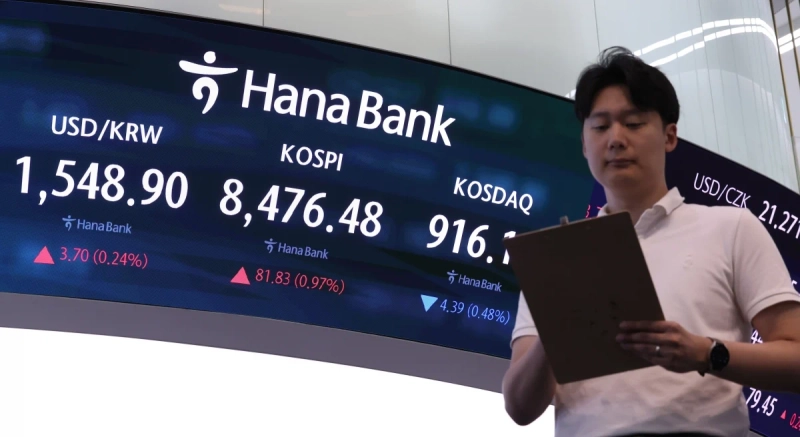
Foreign investors staged a record first-half 'Sell Korea' trade, dumping more than 148 trillion won ($106.8 billion) of Kospi shares on a net basis. Foreign ownership of Samsung Electronics Co. and SK Hynix Inc. fell below levels seen during the global financial crisis. Brokerages attributed the selling to profit-taking after a sharp rally in domestic stocks and pressure from the rising won-dollar exchange rate. They said the selling pressure may persist in the second half if dollar strength continues.
Data from the Korea Exchange showed foreigners sold a net 148.316 trillion won ($106.8 billion) of shares on the Kospi in the first half. That contrasted with net buying of 99.174 trillion won ($71.4 billion) by retail investors and 35.045 trillion won ($25.2 billion) by institutions over the same period. On June 29 alone, foreigners sold a net 7.756 trillion won ($5.6 billion) of shares, the biggest one-day net sale since the data series began in 1998.
The selling was concentrated in large-cap chip stocks. Foreign investors sold 3.8 trillion won ($2.7 billion) of Samsung Electronics and 3.2 trillion won ($2.3 billion) of SK Hynix. Together, the two names accounted for 7.1 trillion won ($5.1 billion), or 92% of total foreign net selling on the Kospi.
That drove foreign ownership in South Korea's two biggest chipmakers to multi-year lows. As of June 29, foreign ownership of Samsung Electronics stood at 47%, the lowest in 16 years and seven months. SK Hynix fell to 50%, the lowest in three years and one month. Both levels were below those seen during the global financial crisis and the Covid-19 pandemic. The 20 biggest daily foreign net-selling sessions on the Kospi have all occurred this year, with records being reset every month since May.
Brokerages said the selling was driven by profit-taking after a sharp rise in local equities and by portfolio rebalancing pressure. The Kospi has surged 101.14% in the first half alone, swelling the weight of Korean shares in portfolios and prompting investors to cut positions.
The sharp rise in the won-dollar exchange rate also fueled the selloff, according to brokerages. Foreign investors tend to sell Korean equities to avoid currency losses when the exchange rate rises. Since May, when the won's decline gathered pace, foreigners have sold a net 92.89 trillion won ($66.9 billion) of shares over two months. During that period, the exchange rate rose from 1,483.3 won per dollar to 1,549.4 won based on weekly trading closes.
On July 1, the won-dollar exchange rate climbed as high as 1,559.0 won intraday, briefly threatening the 1,560 level, before ending at 1,554.9 won, up 5.5 won on the day. The currency finished above 1,550 despite what the market viewed as intervention by foreign-exchange authorities. Even so, the close was the highest since March 6, 2009, when the won ended at 1,550.0 per dollar during the global financial crisis.
The won remains volatile as the dollar strengthens on expectations of higher US interest rates and foreign investors continue to sell Korean equities. A day earlier, authorities were seen stepping in to defend the 1,550 level, but the currency still finished at 1,549.4 per dollar, up 4.2 won. That was also the highest close since March 6, 2009.
Brokerages expect foreign selling to continue in the second half as the Kospi rises despite market volatility and the dollar stays strong. "It is difficult to expect foreigners to turn net buyers of domestic stocks in the second half," Moon Da-woon, an analyst at Korea Investment & Securities, said. "This is an unavoidable backlash that comes with the Kospi's sharp rally."
Moon added that expected inflows tied to SK Hynix's American depositary receipt listing and South Korea's inclusion in the World Government Bond Index may offer some support. Still, foreign equity selling is likely to remain dominant when timing and scale are taken into account.
Oh Jae-young, an analyst at KB Securities, said the remaining potential selling volume is estimated to exceed the amount already sold. He added that the won could weaken to 1,580 per dollar in the second half as dollar strength and foreign securities selling persist, before attempting a move back into the 1,400 range after the fourth quarter.
Kang Kyung-ju, Hankyung.com reporter qurasoha@hankyung.com

Korea Economic Daily
hankyung@bloomingbit.ioThe Korea Economic Daily Global is a digital media where latest news on Korean companies, industries, and financial markets.