PiCK
Dunamu CEO Says Blockchain Finance Is About Speed, Not Feasibility, at DAIF 2026
Summary
- Dunamu CEO Oh Kyung-seok said blockchain-based financial infrastructure is core infrastructure that can boost a country's financial competitiveness and lower transaction costs.
- He said stablecoins have provided a "stable benchmark of value for digital assets," driving rapid growth in payment volumes across remittances, payments and the on-chain issuance of financial products.
- He said countries including the US, the EU, Japan and Hong Kong are moving quickly to build regulatory frameworks for blockchain finance and stablecoins, while South Korea faces a challenge of speed rather than feasibility because of remaining institutional constraints.
Forecast Trend Report by Period


Digital Asset Investment Insight Forum 2026

Blockchain technology could sharply strengthen a country's financial competitiveness if it is applied to financial infrastructure, according to Oh Kyung-seok, chief executive officer of Dunamu.
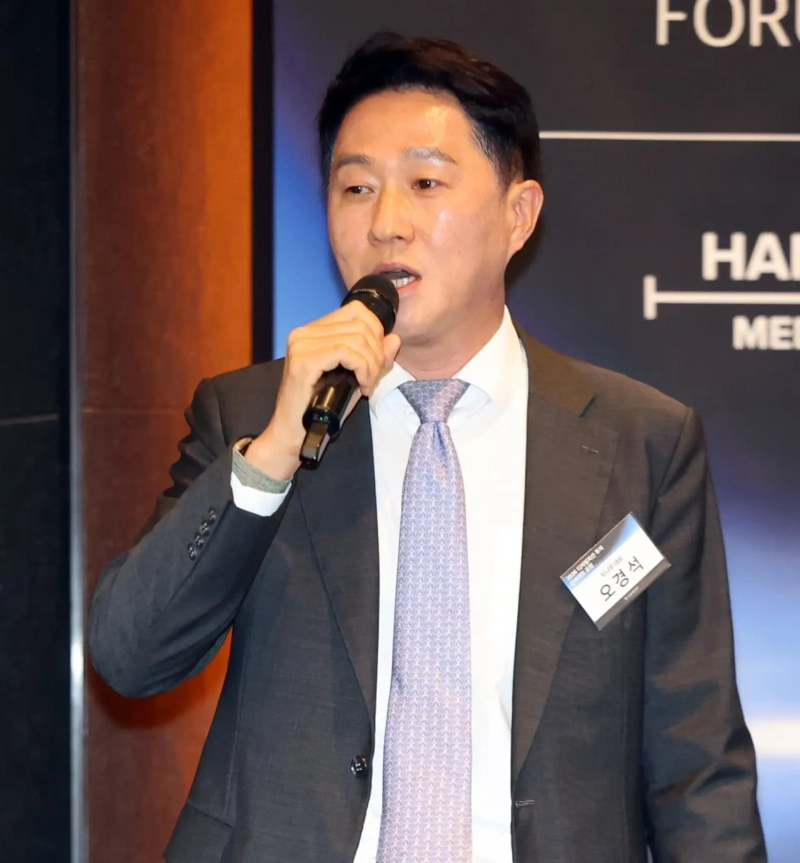
Speaking at the Digital Asset Investment Insight Forum 2026 hosted by the Korea Economic Daily at the Conrad Seoul in Yeouido on July 2, Oh said blockchain changes the way trust is guaranteed and could have a major impact on finance, an industry built on trust and the transfer of value. He added that while blockchain had not previously been used in financial technology in a meaningful way, stablecoins have changed the picture. Stablecoins, or digital assets pegged to fiat currencies, have given the financial industry a stable benchmark of value for digital assets.
Oh said that shift could bolster national competitiveness. Blockchain-based financial infrastructure is core infrastructure that can lower transaction costs not only for the financial industry but across the broader economy, he said. Major economies including the US, Europe and Japan are already putting related rules in place and fostering the industry. South Korea also has a world-leading digital asset user base and digital infrastructure, making this a matter of speed rather than feasibility. The country needs to respond quickly in the race to set standards for new financial infrastructure, he added.
Finance and Blockchain Move Closer Together
Oh said finance and blockchain are converging in four areas: remittances, payments and settlement, the on-chain issuance of financial products, and AI agents.
Stablecoins have played a major role in remittances, he said. As stablecoins gain acceptance as a means of transferring value, payment volumes are rising quickly. Remittances using stablecoins are already active in countries including Mexico and Argentina.
Global big tech and fintech companies have already begun building infrastructure for payments, settlement and the on-chain issuance of financial products, Oh said. Stripe and Circle have built their own blockchains, while Visa and Mastercard are expanding stablecoin payment infrastructure. PayPal is also supporting stablecoin payments through its consumer-facing platform. The market is now moving beyond remittances and payments to an era in which financial products themselves are issued and traded on blockchain networks. BlackRock, Robinhood and Coinbase have all launched their own products.
Oh also said AI agents will lead a new financial paradigm. In the future, humans will no longer carry out financial activity directly, with AI handling search, decision-making, payments and settlement, he said. That will require blockchain-based financial infrastructure capable of supporting cross-border payments and real-time automated settlement.
South Korea Needs to Move Faster on Rules
Oh said South Korea needs to accelerate work on digital-asset rules if it wants to avoid falling behind in global competition. The US is pushing ahead with legislation centered on the GENIUS Act and the CLARITY Act, while the European Union has implemented Markets in Crypto-Assets, or MiCA, he said. Japan and Hong Kong are also putting stablecoin-related frameworks in place as they join the race to build new financial infrastructure.
South Korea has one of the world's highest internet and smartphone penetration rates, Oh said. The country also has a strong digital-asset trading market and user base. That gives it the conditions for stablecoins and blockchain finance to spread quickly.
Still, institutional constraints remain on stablecoin issuance, payment and settlement experiments, and the expansion of on-chain financial services, he said. That is not a question of feasibility, but of speed.
Countries around the world are competing fiercely to set the standard for new financial infrastructure, Oh said. South Korean companies need to move quickly, test technology and services through trial and error, and secure their competitiveness. Dunamu will also work to contribute to the development of South Korea's financial industry and technology, he added.
Jinwook, Bloomingbit reporter / Kim Soo-hyun, Bloomingbit reporter

Korea Economic Daily
hankyung@bloomingbit.ioThe Korea Economic Daily Global is a digital media where latest news on Korean companies, industries, and financial markets.