Kim Seong-jin Says South Korea to Regulate Digital-Asset Industry by Function [DAIF 2026]
Summary
- The government said it will regulate the digital-asset industry by breaking it down by function — including exchange, custody, brokerage and management — and pursue second-phase legislation on a two-track basis.
- The government said it will assign centralized exchanges responsibility as market operators and raise user protection to a level closer to the investor protection mechanisms under the Capital Markets Act.
- The government said it will broaden market participation by corporations and financial companies to strengthen the foundation for the custody industry, stablecoins and tokenization, while expanding the market’s scale and credibility.
Forecast Trend Report by Period


Digital Asset Investment Insight Forum 2026
Kim Seong-jin, head of the Financial Services Commission's Virtual Asset Division

South Korea’s government will draw up a framework to regulate the digital-asset industry by function, separating activities such as exchange, custody, brokerage and asset management. It plans a two-track overhaul of the sector’s rules, dividing measures that can be pursued without legal amendments from those that require legislation.
Kim Seong-jin, head of the Virtual Asset Division at the Financial Services Commission, outlined the plan at the Digital Asset Investment Insight Forum 2026 held at the Conrad Seoul in Yeouido on July 2. Regulating digital-asset businesses simply by business type is not well suited to supporting diverse operations and innovative services, he said. A functional approach would let companies combine multiple roles and operate with greater flexibility.
Kim said the government’s second-phase legislative discussions center on three pillars: industry, market regulation and user protection. On the industry side, authorities are reviewing a framework that regulates digital-asset businesses according to their role rather than grouping them into a single category. The aim is to apply different entry requirements and conduct rules by function, as under the Capital Markets Act, while allowing new business models within the regulated system.
On market regulation, the government is discussing ways to give centralized exchanges responsibility as market operators. Digital-asset exchanges play a core role in the trading market. The industry is also structured around exchanges, with custody and related products and services expanding from that base. Because the legal concept of a digital-asset market remains unclear, authorities are considering how centralized exchanges could assume the responsibilities and role of entities that operate those markets.
The user-protection framework is also set to be strengthened. Regulation should move beyond the simple concept of a user and move closer to the level of protection applied to financial consumers or investors, Kim said. Investor safeguards under the Capital Markets Act, including contractual obligations and duties of explanation, should in principle apply to the digital-asset sector as well. He added that discussions also need to cover system security and disclosure rules in light of the characteristics of digital assets.
The government also sees broader participation by corporations and financial firms as a key task. Officials believe South Korea’s digital-asset market has been unusually reliant on spot trading by retail investors, contributing to volatility and leaving infrastructure businesses such as custody underdeveloped. Corporate participation is needed to ease volatility and improve market stability. It is also necessary to support the development of the custody industry and build a foundation for new businesses such as stablecoins, Kim said.
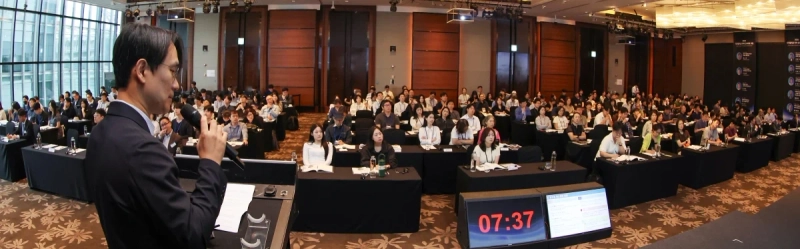
He said the global market is shifting away from simple virtual-asset trading toward tokenization tied to the real economy. Putting real-world assets on-chain offers advantages in speed and cost. In finance, the very concept of a ledger is shifting toward blockchain-based on-chain flows. Overseas, attempts to tokenize highly liquid traditional financial assets such as stablecoins, government bonds and money market funds are increasing, he added.
Broader participation by financial companies would also improve market credibility, Kim said. Their capital strength would help expand the market while reinforcing compliance and trust. Going forward, the digital-asset market is likely to be driven more by tokenization led by institutions and financial firms than by traditional virtual-asset trading.
The Financial Services Commission plans to first address matters that can be handled without revising the law through discussions at the Virtual Asset Committee. Stablecoins, regulation of digital-asset businesses, and rules on disclosure and business conduct will be handled as part of second-stage legislation, including a proposed Digital Asset Basic Act. On tokenized securities, the government is preparing subordinate rules such as enforcement decrees ahead of the system’s launch in June next year.
Hwang Du-hyeon, Bloomingbit reporter / Jo Mi-hyun, reporter

Korea Economic Daily
hankyung@bloomingbit.ioThe Korea Economic Daily Global is a digital media where latest news on Korean companies, industries, and financial markets.