Samsung, SK Unveil $174 Billion Chungcheong Investment as Lee Hails ‘Bold Decision’
Forecast Trend Report by Period


President Thanks Samsung and SK for Their Decision
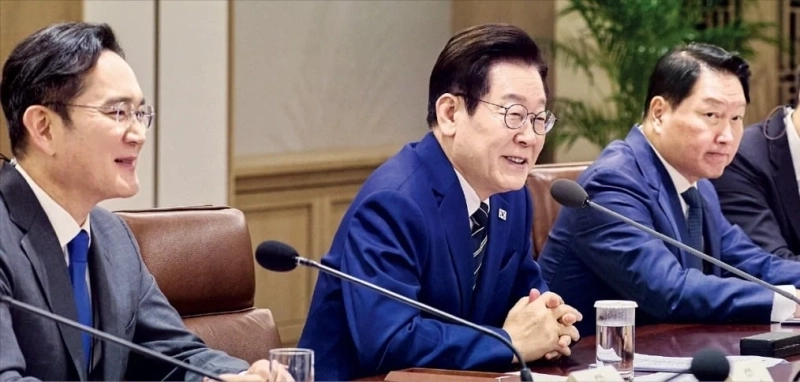
Samsung and SK unveiled new investment plans for South Korea’s Chungcheong region on July 2, underscoring the area’s rise as a production hub for advanced materials, components and AI semiconductors. Samsung said it will invest $101.4 billion in cutting-edge displays, high-bandwidth memory, next-generation batteries and package substrates for AI servers. SK hynix said it will invest $72.4 billion in Cheongju to expand NAND production fabs and advanced packaging facilities. The push comes as the spread of AI boosts demand for high-performance memory, displays and package substrates.
President Lee Jae-myung thanked the two groups for their Chungcheong investment plans. “On behalf of the people, I thank you for this bold decision,” Lee said. He added that hearing Samsung Electronics Chairman Jay Y. Lee speak reminded him of the historic moment when late Samsung founder Lee Byung-chul declared in Tokyo in 1983 that the group would enter the semiconductor business.
Samsung announced its $101.4 billion Chungcheong investment plan at a public briefing on a development vision for advanced industries in the region, held at Samsung Display’s Asan campus on July 2. The plan centers on turning Chungcheong into a base for ultra-competitive materials and components and creating 250,000 quality jobs.
The investment has four main pillars. Samsung Display will complete a cutting-edge display cluster in Asan. Samsung Electronics will build what it described as a next-generation HBM base through fab investment. Samsung SDI will establish a mother line to spread next-generation battery technology globally. Samsung Electro-Mechanics will pursue a global manufacturing hub for high-performance package substrates.
In Asan, Samsung Display will expand its organic light-emitting diode production base. The company plans to add high-value OLED lines for smartphones and IT devices, XR and automotive applications, and humanoid and wearable devices. The goal is to meet demand for next-generation displays as AI, XR, robots and wearables spread.
Samsung Electronics’ HBM investment will focus on Onyang and Cheonan. In Onyang, the company will invest in five HBM fab lines and turn the site into a state-of-the-art production base. In Cheonan, it will expand and modernize HBM-related equipment. The plan is to strengthen its HBM production base as the market for AI servers and accelerators grows.
Battery and package-substrate investment will proceed in parallel. Samsung SDI will build a mother line in Cheonan to verify next-generation battery technology. Samsung plans to use the site as a base to roll out validated technology globally. Samsung Electro-Mechanics will expand facilities in Sejong for AI server package substrates and invest in research and development and talent development for core technologies.
SK hynix announced its Cheongju investment plan the same day. Chief Executive Officer Kwak Noh-jung presented the chipmaker’s semiconductor and AI investment strategy for the Chungcheong region at the same event.
The centerpiece of the SK hynix plan is a $72.4 billion investment in Cheongju. The company will spend $57.9 billion on M17, a fab for NAND production, and $14.5 billion on facilities including P&T7 to strengthen advanced packaging. P&T7 is scheduled to be completed at the end of 2027 and will serve as SK hynix’s advanced packaging base. Construction of the M17 fab will begin in 2027, with operations targeted for the first half of 2029.
Kwak said NAND demand is rising rapidly while supply remains tight, making additional capacity necessary. He called Cheongju the fastest and most efficient base for building a NAND fab. SK hynix plans to invest $72.4 billion in the city, including $57.9 billion in M17 for NAND production and $14.5 billion in sites including P&T7 for advanced packaging.
SK hynix said it is focused on explosive growth in NAND demand as AI adoption widens. As AI services scale up, demand is increasing not only for HBM and server DRAM but also for enterprise SSDs and NAND. If agentic AI and physical AI spread further, NAND applications and demand will grow even more.
The company also cited Cheongju as a site ready for development. SK hynix said building a semiconductor fab requires not only a large site but also timing and secure infrastructure such as stable power and water. Cheongju is connected to existing fabs for efficient production, and much of the land, electricity and water infrastructure is already in place, allowing construction to begin immediately.
Kwak said he would reestablish Cheongju as a key base supporting the competitiveness of South Korea’s memory chip industry.
SK Group also outlined plans for AI data centers. Separate from SK hynix’s investment, the group will build a 1-gigawatt AI data center in the Chungcheong region. It plans to roll out AI data centers nationwide in stages, ultimately reaching 15 gigawatts, starting with a 5-gigawatt program. Under that plan, the Chungcheong facility would help create an AI industry ecosystem in which chip production and AI computing reinforce each other.
Kim Dae-young, Hankyung.com reporter kdy@hankyung.com

Korea Economic Daily
hankyung@bloomingbit.ioThe Korea Economic Daily Global is a digital media where latest news on Korean companies, industries, and financial markets.