Euro-Zone Inflation Slows to 2.8% in June, Giving ECB Scope to Slow Rate Hikes
Summary
- Euro-zone consumer prices and core consumer price inflation slowed, easing the pressure for rate hikes on major central banks.
- The ECB said it would respond to inflation risks less aggressively than in 2022-2023, while still leaving open the possibility of one additional 0.25 percentage point increase in the benchmark rate this year.
- Kevin Warsh's remarks on weaker inflation expectations pushed US Treasury yields down by 0.03 percentage point, while the interest-rate futures market continued to reflect a hawkish stance with a 50.7% probability of a September rate hike.
Forecast Trend Report by Period


June Inflation Falls Back Into the 2% Range
Warsh Says Inflation Expectations Declined Last Month
Inflation pressures in Europe and the US eased as global oil prices stabilized following a ceasefire agreement in the Iran war. That has somewhat reduced the pressure on major central banks to keep raising interest rates.
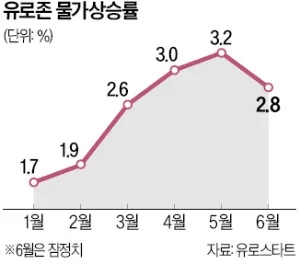
Eurostat, the European Union's statistics agency, said on July 1 consumer prices in the euro zone rose 2.8% in June from a year earlier. The reading was below both May's 3.2% increase and the market forecast of 3.0%. Core consumer prices, which exclude volatile food and energy prices, also slowed to 2.4% from 2.6%.
The figures have strengthened the view that the European Central Bank will slow the pace of rate increases. ECB President Christine Lagarde said the response to inflation risks stemming from the Iran war would be less aggressive than it was during the 2022-2023 war in Ukraine.
The ECB last month became the first major central bank to raise rates after the outbreak of the Iran war, lifting its policy rate by 0.25 percentage point. Markets had expected as many as three rate increases from the ECB. Even with inflation easing, markets still left open the possibility of one additional 0.25 percentage point increase in the benchmark rate this year, citing the chance that inflation could remain in the 3% range throughout the year.
Kevin Warsh, chair of the Federal Reserve, also said on the same day that inflation risks had eased. Speaking at a central banking forum hosted by the ECB, he said inflation expectations had declined over the past month. Markets interpreted the remarks as dovish. The yield on the policy-sensitive two-year US Treasury fell 0.03 percentage point to 4.14% immediately after his comments.
Warsh stressed that the Fed's inflation target remains 2% a year. Anyone who thought the central bank would tolerate a target above 2% would probably be disappointed, he said, adding that price stability remains a key task. He also said prices are still too high across the economy.
The Financial Times said Warsh's remarks about easing inflation pressures were interpreted as dovish, even as broader market positioning remained tilted in a hawkish direction. According to CME FedWatch, the interest-rate futures market priced in a 50.7% chance that the Fed would raise rates by 0.25 percentage point in September.
Warsh also addressed the economic impact of artificial intelligence, calling it a major paradigm shift for both policymaking and the broader economy. He said it would create more jobs, citing Uber drivers as an example.
Han Myung-hyun, Hankyung.com reporter, wise@hankyung.com

Korea Economic Daily
hankyung@bloomingbit.ioThe Korea Economic Daily Global is a digital media where latest news on Korean companies, industries, and financial markets.