[Exclusive] South Korea to Deploy $3.6 Billion Semiconductor Tax Windfall for Sovereign AI
Summary
- The government said it will invest $3.6 billion in surplus tax revenue from the semiconductor boom to secure 10,000 Rubin GPUs and begin developing a world-class sovereign AI model.
- The Ministry of Science and ICT said it will stop spreading support across multiple teams and instead foster a frontier-class AI model through a selection and concentration strategy centered on 10,000 GPUs for a single team.
- Amid concern that South Korea could become dependent on foreign AI, the government said it will use the budget to secure an independent sovereign AI model and recruit top domestic AI talent to strengthen the country's AI competitiveness.
Forecast Trend Report by Period


Semiconductor tax windfall to fund future technology investment
Science ministry seeks 10,000 GPUs to build a U.S. Mithos-class model
Government shifts to concentrated support to accelerate AI sovereignty

South Korea plans to use a semiconductor-driven tax windfall to develop an independent artificial intelligence model on par with Mithos. The government aims to deploy about 5 trillion won, or $3.6 billion, in surplus tax revenue generated during the AI boom to buy large quantities of cutting-edge graphics processing units this year and build a world-class sovereign AI model. The move comes as concern grows over reliance on foreign AI after the U.S. tightened controls on access to advanced AI.
Government ministries said on July 2 that the Ministry of Science and ICT is discussing funding options with the presidential office and fiscal authorities for a frontier-class AI model. The ministry's internal estimate puts the required budget at about 5 trillion won, or $3.6 billion. That would cover the purchase of about 10,000 of Nvidia's latest Rubin GPU modules and the recruitment of top-tier talent.
The ministry concluded it cannot wait for next year's regular budget process and is pushing for a supplementary budget this year using excess tax revenue from semiconductors. President Lee Jae-myung said on June 26 that the extra budget should secure related funding, adding that demand for GPUs is rising rapidly while procurement remains too slow.
The push reflects concern inside government that the current sovereign AI policy will not narrow the gap with global frontier models. The science ministry is running a domestic competition for independent foundation models. But distributing 700 to 800 GPUs each to four teams, including LG AI Research and SK Telecom, is widely seen as insufficient to catch up with global frontier models trained with tens of thousands of GPUs. The ministry is now leaning toward concentrating support by giving 10,000 GPUs to a single team.
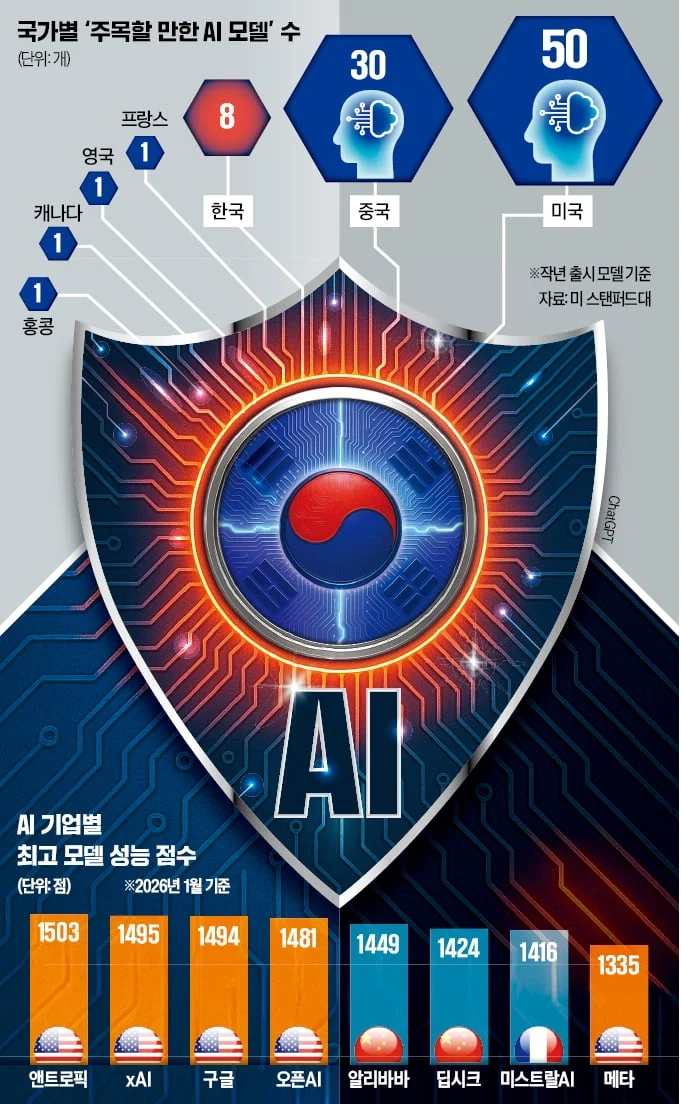
Time is running out: Fall further behind big tech and South Korea risks AI dependence
$3.6 billion semiconductor tax windfall to be deployed for sovereign AI
Anthropic unveiled its Mithos-based AI model Fable5 on June 9. Its performance prompted many South Korean companies to link their software to the model and build AI agents. Three days later, however, the U.S. government blocked overseas access to Fable5, citing national security. Companies that had been building systems around the model were forced to revise their plans. An executive at a large South Korean company said the concept of AI models as national strategic assets took hold after controls were also imposed soon after on OpenAI's GPT-5.6. The executive added that companies now expect such restrictions to become routine.
Shift toward a sovereign AI model
The U.S. action directly triggered the Ministry of Science and ICT's move to use 5 trillion won, or $3.6 billion, in surplus tax revenue to secure about 10,000 Rubin GPU modules and begin development of its own frontier AI model.
A frontier AI model is the kind of technology that can shape a country's standing in the AI era. Anthropic's Mithos and OpenAI's GPT-5.6 fall into that category. Such models can deliver a different level of capability across defense, industry, engineering, medicine and biology. That is why the U.S. government provides Mithos-class models only to approved institutions and blocked access to Fable5 despite its built-in safeguards.
South Korea launched a project last year to select a domestic independent foundation model developer. After the first round of screening, four teams -- LG AI Research, SK Telecom, Upstage and Motif Technologies -- were chosen and are developing AI models with GPU support from the science ministry. Critics say the project's structure makes it difficult to catch up with global leaders. Each of the four teams received only 700 to 800 GPUs. Even if the field is narrowed to two teams, support would rise only to about 2,000 GPUs each. That compares with roughly 10,000 A100 GPUs used for OpenAI's GPT-4 and about 21,000 for GPT-5.
From broad support to selection and concentration
While South Korea targets the first half of next year for its independent foundation model project, Anthropic and OpenAI are releasing upgraded models every week after pouring in massive resources. Chinese AI companies including DeepSeek and Zhipu AI are also trying to capture markets outside the U.S. by open-sourcing their models while Washington tightens control over American AI systems.
Stanford University earlier this year selected eight South Korean models for its "AI to Watch in 2025" list. But experts say the quality gap with frontier models is widening quickly because resources are spread too thin. France, by contrast, had only one model on the list, yet Mistral AI ranked seventh in frontier-model performance, ahead of Meta.
One South Korean AI specialist said the top models from leading AI companies such as Anthropic are overwhelmingly ahead and South Korea has little time left. If it fails to catch up quickly, the country could become dependent on foreign AI, the person said.
Reflecting that reality, the science ministry plans to provide all 10,000 Rubin GPU modules to one elite team if the supplementary budget is secured. That would mark a shift in sovereign AI policy away from internal competition and toward a selection-and-concentration strategy focused on global competitiveness. The ministry is expected to weigh project scores, AI capabilities and each company's willingness to co-invest. The supplementary budget will also include funding to recruit top South Korean AI talent now working overseas.
The government's plan to use surplus tax revenue from the semiconductor boom to strengthen AI competitiveness has drawn positive reviews. A professor in a South Korean semiconductor department said using dollars earned from hardware during the AI boom to strengthen software competitiveness amounts to an investment in the country's future.
Park Han-shin / Lee Young-ae, Hankyung.com reporters phs@hankyung.com

Korea Economic Daily
hankyung@bloomingbit.ioThe Korea Economic Daily Global is a digital media where latest news on Korean companies, industries, and financial markets.