Hanwha’s Kim Dong-kwan Says Group to Invest $39.7 Billion in Space, AI by 2040
Summary
- Hanwha Group said it will invest a total of $39.7 billion in the aerospace and artificial intelligence (AI) industries by 2040.
- The group said Hanwha Aerospace will invest about $16.6 billion in its space launch vehicle business, while Hanwha Systems will invest about $14.4 billion in SAR satellites, a space AI data center and a low-Earth-orbit satellite communications network.
- Hanwha Group said it will help build an aerospace ecosystem and promote balanced regional development through projects including a defense AI data center, Defense OS and a manned-unmanned teaming (MUM-T) system.
Forecast Trend Report by Period


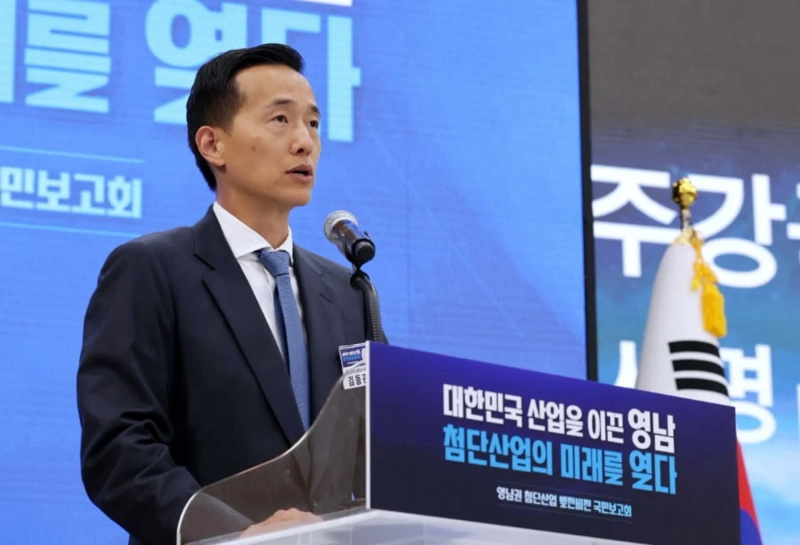
Hanwha Group said it will invest 55 trillion won ($39.7 billion) in the aerospace and artificial intelligence industries by 2040.
The South Korean conglomerate aims to build an aerospace industry ecosystem centered on the Yeongnam region, secure an independent space launch capability and establish defense infrastructure linking land, sea and air forces.
Kim Dong-kwan, vice chairman of Hanwha Group, unveiled the plan on July 3 at a public briefing on advanced-industry development in the Yeongnam region held at Gyeongsang National University in Jinju, South Gyeongsang Province.
Hanwha said the investment will fund integrated space infrastructure based on its own launch vehicle and satellite technologies.
Under the plan, data collected by observation satellites would be analyzed at a space AI data center, then sent to the ground through a low-Earth-orbit satellite communications network for military operations.
Hanwha Aerospace Co. will invest about 23 trillion won ($16.6 billion) in its space launch vehicle business.
The company plans to build an assembly plant and launch vehicle development and testing facilities, with the goal of shifting to commercial launches and securing an independent space transportation capability.
Hanwha Systems Co. will invest about 20 trillion won ($14.4 billion) in very-low-Earth-orbit synthetic aperture radar, or SAR, satellites, a space AI data center and a low-Earth-orbit satellite communications network.
Hanwha Systems plans to launch and operate 64 SAR satellites by 2031. It will begin services through a 192-satellite low-Earth-orbit communications constellation and add satellites in stages.
Kim said South Korea cannot secure space sovereignty or achieve self-reliant national defense as long as its space industry depends on overseas providers for satellite manufacturing and launches. Hanwha will develop its own launch vehicle so the country can reach space whenever needed, he added.
Hanwha Aerospace and Hanwha Systems also plan to invest more than 10 trillion won ($7.2 billion) in Changwon, South Gyeongsang Province, to build a defense AI data center.
The center will integrate and manage data from space, land and sea. It will operate as a closed, high-security system that does not rely on external providers.
Construction will begin this year with capacity of 45 megawatts and expand in stages to 135 megawatts by 2032. Power will be supplied through links to generating assets owned by Hanwha Energy. The facility will operate in a mutual backup system with the space data center so operations can continue even if one side is disabled.
Hanwha also plans to invest about 2 trillion won ($1.44 billion) by 2040 to develop Defense OS, a defense AI model tailored for battlefield use.
The system will learn from and infer using battlefield data from the Korean Peninsula. Hanwha plans to use it to upgrade existing weapons systems, including the K9 self-propelled howitzer, unmanned surface and underwater vessels, and autonomous drones, into intelligent weapons systems and complete a manned-unmanned teaming, or MUM-T, system.
Hanwha said its large-scale investment centered on Yeongnam cities including Changwon will help foster an aerospace ecosystem and support more balanced regional development.
The group aims to create a virtuous cycle in which local talent studies in the region, local companies compete in global markets and the regional ecosystem supports South Korea’s future, Kim said. He added that Hanwha will expand industry-academia cooperation, including by setting up contract-based academic departments at regional universities.
Park Sang-kyung, Hankyung.com reporter highseoul@hankyung.com

Korea Economic Daily
hankyung@bloomingbit.ioThe Korea Economic Daily Global is a digital media where latest news on Korean companies, industries, and financial markets.