Six in 10 Americans Say US Golden Age Is Over as Trust in Politics, Economy Erodes
Forecast Trend Report by Period


A Nation Split at 250
Americans expect political violence to rise as polarization deepens
Organizers of the anniversary celebration have split into rival camps
Doubts are growing about US competitiveness, including in manufacturing
America’s global leadership has come under strain after the Middle East war
On July 4, 1776, Thomas Jefferson, John Adams and other American leaders issued the Declaration of Independence, declaring the 13 colonies’ independence from Britain. The document emphasized equal rights and natural rights, and said government derives its power from the consent of the governed. It remains the foundation of the American creed.
A major celebration will be held in Washington on July 4 to mark the 250th anniversary. President Donald Trump’s administration has said it will set off 850,000 fireworks, four times the usual number for Independence Day. Even so, many Americans are in no festive mood.
‘Best Days Are Behind Us’
Americans increasingly see the country as worse off than it once was. Gallup asks each year how the signers of the Declaration of Independence would view the US today. In 2001, 54% said they would be pleased and 42% said they would be disappointed. In a survey released in June, 77% said the founders would be disappointed, while 19% said they would be pleased. Gallup said the pattern held across race, gender, age and income.
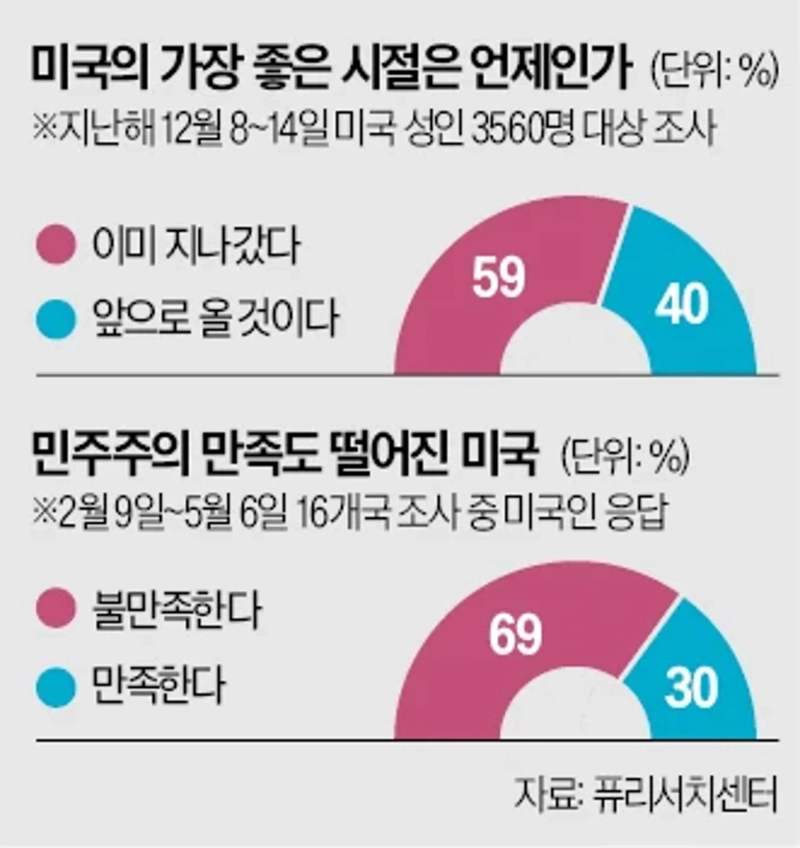
Many Americans also believe the country’s peak has already passed. In a Pew Research Center survey, 59% said America’s best days are behind it, compared with 40% who said they are still ahead. The share of Americans who said they were proud to be American fell to 58% in Gallup’s June survey, the lowest in 25 years.
Political polarization is one reason for the growing pessimism. A June Reuters/Ipsos poll found 77% of Americans think political violence will increase over the next five years. As hostility between Democratic and Republican supporters deepens, more Americans also believe US democracy is no longer functioning properly.
That divide is also apparent in the planning of the 250th anniversary events. The Trump administration pushed aside America250, a bipartisan commission created a decade ago, and instead set up Freedom 250, a Republican-led group staging events including combat sports matches. CNN said the celebration had become less a national birthday party than a festival for one political party. Trump has described the event as a “Trump rally” and said he intends to deliver “a very long speech” despite extreme heat.
Confidence in the Economy Is Fading
Checks and balances among branches of government, a principle deeply embedded in the nation’s founding ideals, are also weakening. According to the Federal Register, Trump had signed 268 executive orders in his second term as of July 3. That is far above the 162 issued during former President Joe Biden’s administration and nearly matches the 277 former President Barack Obama signed over eight years, even though Trump has done so in only a year and a half.
The flood of executive orders is shifting authority traditionally held by Congress and the courts toward the executive branch. The increasingly conservative Supreme Court has ruled that Trump’s orders on tariffs and birthright citizenship were unconstitutional. In other areas, however, the court has increasingly recognized broader executive authority than in the past.
Confidence in the economy has also weakened. By standard economic measures, the US economy is not in poor shape. Stocks have rallied, and the unemployment rate remained relatively low at 4.2% in June. Inflation has been rising because of the war with Iran and other factors, but conditions remain far better than during the pandemic. Even so, Americans remain doubtful about the outlook. Consumer sentiment fell to 44.8 in May, the lowest since 1978, and only 35% said they were optimistic about the economy in McKinsey’s second-quarter survey. The view that the US abandoned manufacturing, lost competitiveness, and has China and even its allies to blame has also gained force, particularly within the Trump administration.
America’s global leadership, which it has maintained since World War II, is also under strain. The recent war with Iran exposed how difficult it is for the US to decide on deploying ground troops and suggested its ability to protect allies has weakened. Favorability toward the US, long supported by liberal democracy and soft power such as popular culture, has also fallen sharply. In a Pew Research Center survey covering 36 countries, 57% viewed the US unfavorably, compared with 37% who viewed it favorably. The share of respondents who said the US is an unreliable partner also rose sharply.
Lee Sang-eun, Washington correspondent, Korea Economic Daily, selee@hankyung.com

Korea Economic Daily
hankyung@bloomingbit.ioThe Korea Economic Daily Global is a digital media where latest news on Korean companies, industries, and financial markets.