PiCK
Record Yen Short Bets Stoke Fears of Another Global Stock Shock
Summary
- CME data showed short yen positions hit a record high, indicating the potential scale of position unwinds tied to the yen carry trade is large.
- Fears of a yen carry unwind and concern over volatility in global equities are growing as the Bank of Japan’s rate hikes coincide with rising Japanese 10-year government bond yields.
- Some analysts say the odds of a yen carry unwind remain low because of the interest-rate gap between the US and Japan and the Japanese government’s fiscal expansion policies.
Forecast Trend Report by Period


Japanese bond yields surge
Fears of a yen carry-trade unwind resurface
Concern grows over large-scale position liquidation
Markets and investors grow more cautious
Takaichi puts economic recovery first
Odds of a carry-trade unwind remain low
On Aug. 5, 2024, Japan’s Nikkei 225 tumbled 12.4% in a single day. South Korea’s Kospi dropped 8.8% the same day, marking its biggest one-day decline on record at the time. The Nasdaq Composite also fell more than 6% intraday. The rout was a “Black Monday” that shook global equities on fears of a yen carry-trade unwind. Wall Street is again on alert, seeing similar structural strains emerge in Japan.
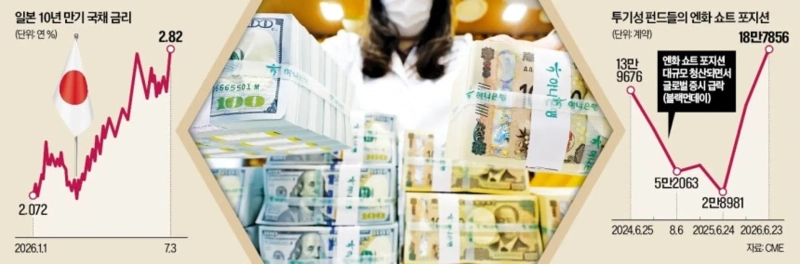
Record bets against the yen
A carry trade involves borrowing in a low-interest-rate currency and investing in assets with higher returns. Because Japan kept rates ultra-low for years, the yen has long been a key funding currency in global markets. But the currency’s steep recent weakness has fueled concern that any sharp rebound could trigger large-scale position unwinds.
According to the Chicago Mercantile Exchange, leveraged funds’ short yen positions reached a record 187,856 contracts as of July 23. That was more than six times the level a year earlier. It was also about double the 98,058 contracts on July 30, 2024, just before Black Monday.
The buildup in bets on further yen weakness suggests the potential size of any carry-trade unwind is large. In July 2024, after the Bank of Japan raised its policy rate to 0.25%, speculative funds rapidly sold risky assets financed in yen, helping spark a global equity selloff. At the time, the dollar-yen exchange rate fell to 142 from 161, reflecting a sharp rise in the yen.
The yen’s unusually deep slide is adding to market unease. The Wall Street Journal reported that yen weakness would add inflation pressure to Japan’s economy, which relies heavily on energy imports priced in dollars. It also said the Bank of Japan, after raising rates to 1% last month, could lift them further. The newspaper added that any unwinding of yen carry trades could hit US technology stocks, where such funding is believed to be concentrated.
Japan Finance Minister Satsuki Katayama also signaled a willingness to intervene after the dollar-yen rate rose above 162 on July 30. “We will respond appropriately at any time if necessary. That includes decisive measures,” she said.
Another warning sign is Japan’s 10-year government bond yield, which has climbed to its highest level in 30 years. Concern over higher bond yields had been one of the main reasons the Bank of Japan delayed raising rates. With borrowing costs still low and yields rising largely on concern over confidence in Japan’s public finances, the central bank has less reason to hesitate over further rate increases.
Takaichi’s fiscal expansion is a variable
Even so, many argue the concern is overdone. One major difference from 2024 is that the US is still maintaining high interest rates. Japan’s policy rate has risen to 1%, but the gap with the US still stands at 2.75 percentage points. That means the basic logic of borrowing cheaply and investing in higher-yielding markets remains intact, limiting the incentive to unwind carry trades even if the yen strengthens.
In Japan, the outlook for additional rate hikes is also fading. Sanae Takaichi’s government is pushing aggressive fiscal expansion while making economic recovery its top priority. The government also asked the Bank of Japan on July 30 to conduct monetary policy appropriately in line with economic conditions, prices and financial conditions.
Governor Kazuo Ueda’s hospitalization and absence from last month’s monetary policy meeting was also interpreted by markets as a sign that the central bank’s ability to make policy independently of the government has weakened.
Japan’s fiscal position is another factor that could deter further rate hikes. Government debt stands at 1,340 trillion yen, or about $9.1 trillion, equal to roughly 250% of gross domestic product. As rates rise, the interest burden increases.
Some analysts also say markets are better prepared because they already experienced a yen carry-trade unwind two years ago. MarketWatch said that even if a trigger emerges, a repeat of the abrupt position clearing seen before is unlikely.
Choi Man-su, Tokyo correspondent, Korea Economic Daily, bebop@hankyung.com

Korea Economic Daily
hankyung@bloomingbit.ioThe Korea Economic Daily Global is a digital media where latest news on Korean companies, industries, and financial markets.