Korean Pension, Mutual Aid Funds Tighten Fair-Value Reviews of Alternative Assets
Forecast Trend Report by Period



South Korea’s major pension funds and mutual aid associations are tightening fair-value reviews of alternative investments after criticism from the Board of Audit and Inspection. Failing to fully reflect declines in asset values caused by higher interest rates and other factors can overstate returns and hurt members.
Fair value is the price an asset would fetch if sold in the market today. For listed stocks, the share price is the fair value. But alternative assets such as unlisted shares and overseas real estate require estimation.
Nine of 10 major pension and mutual aid funds, including the National Pension Service and the Teachers’ Pension, strengthened the valuation and verification of alternative-investment assets starting last year, according to documents obtained by the Korea Economic Daily on July 6. The main step was to broaden the assets subject to valuation and verification by outside specialist firms.
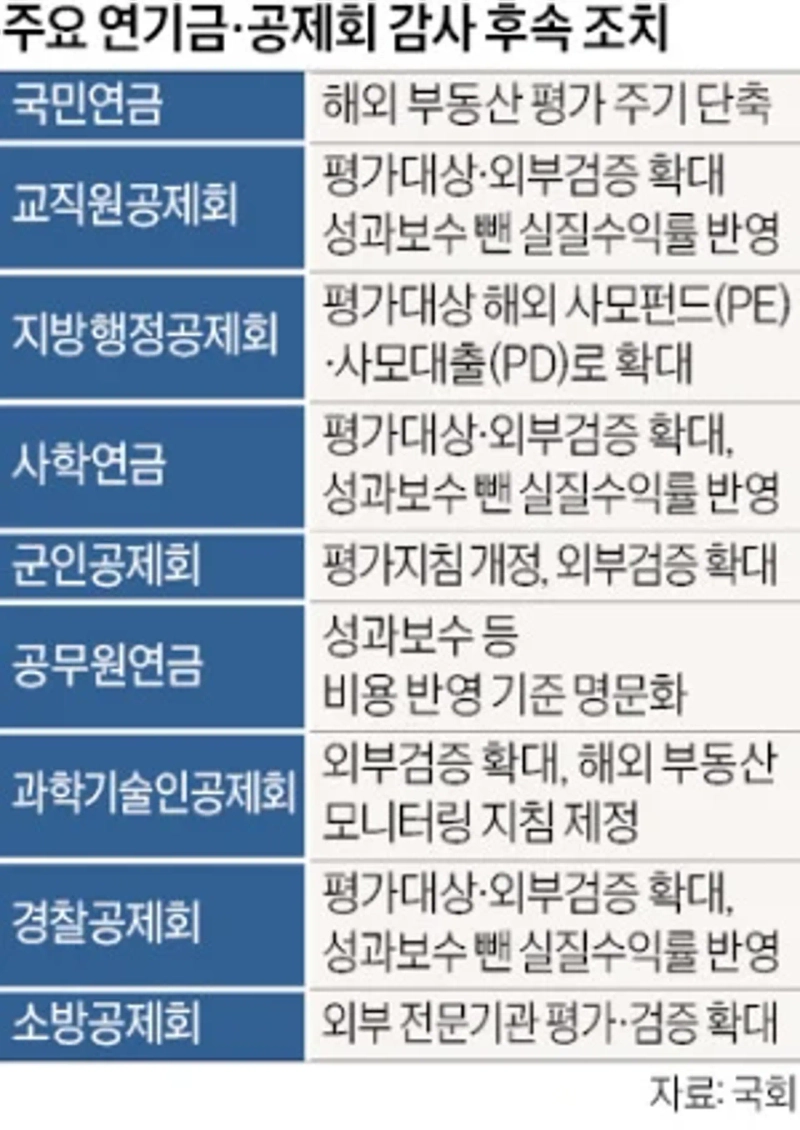
The Board of Audit and Inspection audited alternative-investment management and oversight at major pension and mutual aid funds in 2024. As concerns about weak valuations mounted, the agency in May 2025 ordered institutions to improve their fair-value assessment practices.
The Teachers’ Pension was told it needed to improve how it values alternative assets. It expanded the assets subject to review and completed valuation and verification through outside institutions. The Military Mutual Aid Association revised its valuation guidelines and completed external verification. The Police Mutual Aid Association and the Korean Teachers’ Credit Union also widened the scope of assets under review and introduced external verification. They also decided to deduct asset managers’ performance fees in advance when calculating returns so reported performance would reflect actual results.
The audit findings particularly affected valuations of overseas real estate. Asset values were falling as market rates rose, but those declines were not being reflected promptly. The National Pension Service shortened its valuation cycle to quarterly from annually and added post-review monitoring procedures. The Korea Scientists and Engineers Mutual-Aid Association established guidelines for monitoring overseas real-estate investments. The Korea Local Finance Association expanded its valuation scope to include overseas private equity and private debt assets.
Fair-value assessment matters in alternative investments because the current value of those assets directly affects institutional returns. Mutual aid associations classify most alternative-investment holdings as available-for-sale securities and reflect valuation gains and losses in annual net income. Inaccurate valuations can therefore distort the returns reported to members.
South Korea’s Capital Markets Act has required assets without market prices to be valued at fair value set by a valuation committee organized by the asset manager. But the committee was not required to accept prices provided by outside specialist firms. There was also no rule governing valuation frequency, leaving room for managers to keep using acquisition costs or prior valuations that were more favorable after review by internal committees. To address that, the Financial Services Commission revised an enforcement decree in September 2025 to require at least one annual valuation for fund assets that are difficult to mark to market. It also required alternative-investment funds holding real estate or infrastructure to give priority to prices provided by outside specialist firms.
Experts say the growing share of alternative investments in pension and mutual aid portfolios is increasing the importance of valuation. Jeong Do-jin, a business professor at Chung-Ang University, said alternative investments had long been viewed as assets that could simply be held through price declines because they were largely unlisted and not subject to external audits. But risk-management committees now demand that information and use it as a benchmark for performance evaluation. Proper valuations therefore need to be carried out by asset managers regardless of outside regulation, he said. The key question, he added, is whether decision-making bodies such as investment committees and risk-management committees are functioning and whether there are mechanisms to hold them accountable when problems arise.
Choi Da-eun and Ahn Dae-kyu, Korea Economic Daily reporters max@hankyung.com

Korea Economic Daily
hankyung@bloomingbit.ioThe Korea Economic Daily Global is a digital media where latest news on Korean companies, industries, and financial markets.