Semiconductor Shock Rocks Kospi, Prompting Calls to Split Pension Portfolios
Summary
- Experts said retirement pension investing should focus on diversification across Korea and the US, as well as growth and defensive stocks, alongside a core-satellite strategy.
- Core holdings can consist of major US index ETFs and Korean index ETFs, or TDFs, while satellite holdings can include semiconductor ETFs. Investors should avoid concentrating too heavily on any single theme.
- Brokerages say bond-mixed ETFs and qualified TDFs can lift equity exposure in pension portfolios to as much as 94%, while maintaining a balance between offense and defense.
Forecast Trend Report by Period


Volatility in South Korea’s stock market is adding to the concerns of retirement pension investors. Wider swings in semiconductor and artificial intelligence-related shares, which led the market in the first half, have made it harder to decide whether to increase exposure to domestic equities or shift back to exchange-traded funds tracking major US indexes. Market experts advise pension investors to maintain diversification across Korea and the US, as well as growth and defensive stocks, rather than overhaul portfolios in response to short-term market moves.
Core-Satellite Strategy Is the Foundation of Pension Investing
Retirement pensions are long-term assets designed to build compound returns over decades, not vehicles for chasing short-term performance. In periods of heightened market volatility, that argues for managing assets mainly through index-based investments that capture the broader market rather than betting on a single theme. ETF investments in retirement pension accounts totaled 50 trillion won, or about $36.2 billion, at the end of last year.
That is also why investors need exposure to both Korean and US equities. South Korea’s stock market is heavily weighted toward semiconductors and manufacturing, while the US market has larger allocations to big tech, platform and healthcare companies. When one market weakens, the other can help offset the downturn.
One representative approach is the core-satellite strategy. Under that framework, 60% to 70% of assets are placed in core holdings, with the rest invested in satellite assets tied to growth industries. US benchmark-index ETFs and Korean index ETFs are commonly used as core holdings. Examples include TIGER US S&P500, KODEX US Nasdaq 100 and KODEX 200.
For investors who find it burdensome to adjust asset weightings themselves, target-date funds, or TDFs, can also serve as core holdings. These products automatically adjust the mix of stocks and bonds based on the investor’s retirement date, removing the need for direct rebalancing.
Among satellite holdings, semiconductors are attracting a large share of inflows. Representative products include TIGER Semiconductor TOP10, KODEX Semiconductor and HANARO Fn K-Semiconductor, which include Samsung Electronics, SK Hynix and major materials, parts and equipment companies.
Still, the asset-management industry advises against excessive bets on a single theme. “Pensions are assets invested over a long horizon, so if a portfolio is concentrated in one theme, investors could end up bearing losses near retirement if that theme loses momentum,” an industry official said.
Balance Offense and Defense
Brokerages are emphasizing a balance between offense and defense in second-half pension investment strategies. The medium- to long-term outlook for growth industries such as AI and semiconductors remains positive, but heightened volatility means defensive assets should also be included. Investors can maintain exposure to growth themes such as the AI value chain and key exporters while using mixed-asset ETFs, asset-allocation products and covered-call ETFs to respond to the market.
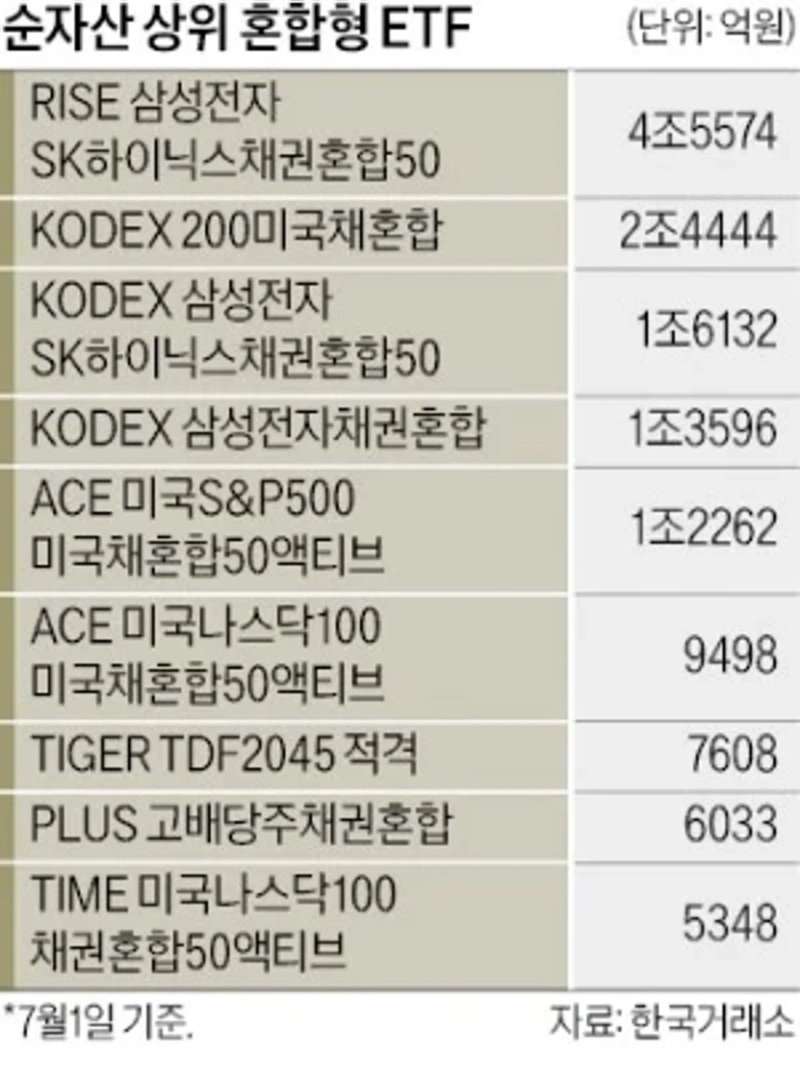
Bond-mixed ETFs have also drawn steady interest. In defined-contribution pension plans and individual retirement pension accounts, or IRPs, 30% of assets must be allocated to safe assets such as deposits or bonds, and bond-mixed ETFs are classified as safe assets. If investors fill the full risk-asset limit with equity ETFs and put the remaining portion into bond-mixed products holding half stocks and half bonds, equity exposure can be raised to as much as 85%.
Products that have drawn the most attention this year include RISE Samsung Electronics SK Hynix Bond Mixed 50 and KODEX Samsung Electronics SK Hynix Bond Mixed 50. More recently, products combining other blue-chip stocks have also been launched, including WON Samsung Electronics Hyundai Motor Bond Mixed 50 and 1Q Hyundai Motor Kia Bond Mixed 50.
Qualified TDFs with equity allocations of up to 80% can raise stock exposure within a pension portfolio to as much as 94%. Some TDFs targeting retirement around 2060 carry equity weightings of 80%.
Yang Ji-yoon, Korea Economic Daily reporter yang@hankyung.com

Korea Economic Daily
hankyung@bloomingbit.ioThe Korea Economic Daily Global is a digital media where latest news on Korean companies, industries, and financial markets.