Naver Plans First Logistics Centers, Direct Delivery Push to Challenge Coupang
Forecast Trend Report by Period


Naver Moves Into Standalone Logistics, Prepares Direct Delivery
Distribution Centers Planned in the Seoul Area
Partnership Model Seen Hitting Cost Limits
Nationwide Expansion Aims to Build a Coupang-Style Ecosystem
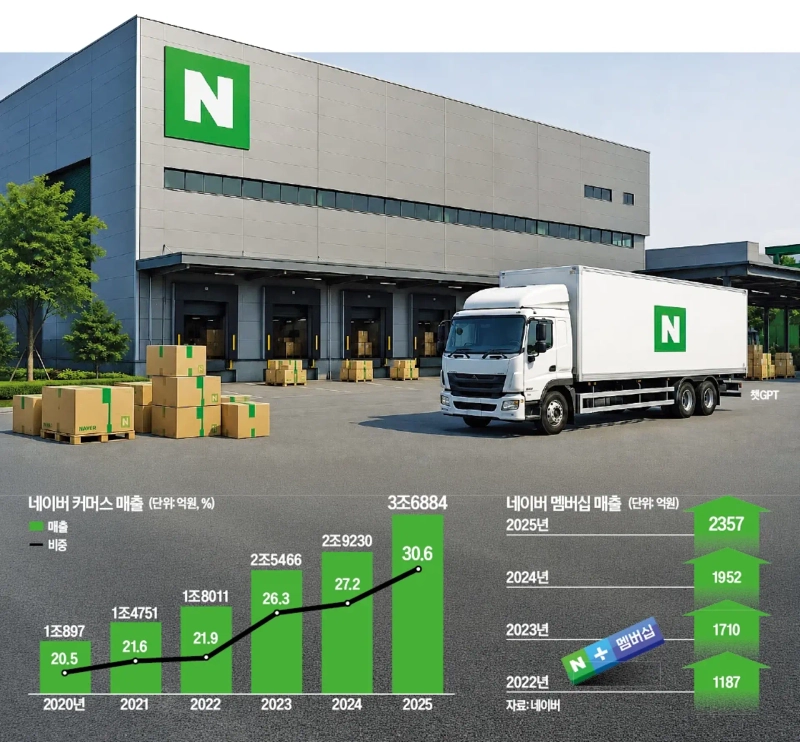
Naver Corp. is preparing to secure its first logistics centers and launch direct delivery, overhauling a strategy that had long outsourced shipping as its shopping business expanded. The company is also pushing a plan to build logistics hubs nationwide, starting in the greater Seoul area.
Industry officials said on July 6 that Naver is reviewing candidate sites north and south of the Han River for logistics centers. The company is weighing options including buying land and building facilities, acquiring existing centers, or signing long-term leases.
Naver, which began its shopping business in 2001, stayed out of delivery operations through 2019 and let sellers choose their own logistics providers. It partnered with CJ Logistics in 2020, and startups including FASSTO and Poomgo later joined Naver's logistics network. Sellers can choose among those companies.
That outside-partner model helped keep costs down because Naver did not need to own warehouses and could instead rely on logistics operators for storage, packing and delivery. Using those partners, Naver countered Coupang's Rocket Delivery with services branded as Guaranteed Arrival and N Delivery.
Naver has concluded that the outside model is no longer enough as competition in delivery intensifies, according to industry officials. One e-commerce industry official said the partnership approach has strengths but leaves shopping platforms with limited control over shipping cut-off times, inventory placement, delivery quality and logistics costs. Coupang, by contrast, has built a nationwide logistics network with more than 10 trillion won ($7.2 billion) in investment and improved efficiency through automation and data-driven operations.
Naver plans to begin by establishing its own logistics bases in the greater Seoul area and then expand logistics centers nationwide. The company is also set to secure last-mile delivery workers in addition to storage, packing and outbound shipping operations. Industry officials say Naver could eventually consider a dedicated in-house courier model similar to Coupang Friends, formerly known as Coupang Man.
Logistics Centers in Capital Region Signal Direct Delivery Push
Commerce Revenue Reaches 30% of Sales as Naver Takes On Coupang With Its Own Infrastructure
Naver's move to secure its own logistics centers 25 years after launching its shopping business reflects a judgment that alliances with outside logistics operators alone are no longer enough to sustain the business. As artificial intelligence ushers in a so-called zero-click era, Naver's decision to name shopping, alongside cloud, as a future growth engine is being viewed as a high-stakes bet against dominant rival Coupang.
Logistics Expansion to Go Nationwide
Naver has chosen the greater Seoul area as the first base for its logistics push. The company is looking at sites in Seoul and logistics clusters in Gyeonggi Province, including Yongin, Icheon and Yangju. The strategy is to first test the business case for a Naver version of Rocket Delivery in the region with the highest concentration of consumers, order density and demand for fast shipping. That follows comments by Chief Executive Officer Choi Soo-yeon on Naver's first-quarter conference call on April 30 that delivery was the top priority in the company's commerce strategy and that direct investment in logistics was under consideration.
Behind the strategic overhaul is Naver's assessment that its partnership-based logistics model has clear limits. The company built the Naver Fulfillment Alliance, or NFA, after teaming up with CJ Logistics in 2020. The model allowed Naver to expand its delivery network quickly by linking outside operators. It also gave sellers access to fast-delivery services without requiring Naver to build logistics centers or hire couriers directly, reducing warehouse rent, equipment spending and inventory-management burdens.
Limits of External Dependence Become Clear
As delivery has emerged as the key factor in e-commerce competition, those advantages have turned into weaknesses. Shipping cut-off times, inventory allocation, returns processing and delivery quality all depend on site-level operations. When partner logistics companies push for higher shipping fees, free-delivery and free-return strategies also come under pressure.
Coupang has invested about 10 trillion won ($7.2 billion) to build nine large logistics centers and 227 camps, or small delivery outposts, across the country. It has used that network to further raise delivery efficiency through logistics automation and data-based operations.
Coupang's expansion of Rocket Growth is also adding pressure on Naver. The service lets sellers send goods to Coupang warehouses, after which Coupang handles storage, packing, delivery and returns. That means Coupang, long centered on direct purchasing, is also drawing in small and midsize merchants that form the backbone of Naver Smart Store.
A logistics industry official said Naver's commerce base could quickly weaken if sellers move into the Coupang ecosystem for convenience.
A High-Stakes Bet at 1 Times Book Value
For Naver, investment in logistics centers has become essential as commerce emerges as a core source of revenue. Revenue from the company's commerce division rose about 3.4 times to 3.6884 trillion won ($2.66 billion) in 2025 from 1.0897 trillion won ($786 million) in 2020. Its share of total revenue climbed to 30.6% from 20.5% over the same period.
The market, however, still favors Coupang. After a major personal data leak in November last year, many expected usage to fall. Instead, estimated credit-card spending on Coupang rose to 4.8337 trillion won ($3.49 billion) last month from 4.4735 trillion won ($3.23 billion) in November, an increase of 360.1 billion won ($260 million). Monthly active users also rose by about 670,000 to 35.09 million from 34.42 million over the same period.
An e-commerce industry official said that suggests consumers have few viable alternatives to Coupang. The person added that the result reflects how accustomed users have become to Rocket Delivery, which is built on Coupang's own logistics centers.
For Naver, the move amounts to an all-in push on shopping. The company's price-to-book ratio stood at about 1 as of July 6, reflecting investor criticism that it has yet to present a compelling future beyond search. For a technology company, that is a low valuation, effectively implying that Naver's market value is little different from the combined value of its headquarters and data centers.
Ahn Jung-hoon and Oh Hyung-joo, Korea Economic Daily reporters, ajh6321@hankyung.com

Korea Economic Daily
hankyung@bloomingbit.ioThe Korea Economic Daily Global is a digital media where latest news on Korean companies, industries, and financial markets.