AI Rally Cools as Nearly 70% of US Tech Stocks Drop 20% From Highs
Forecast Trend Report by Period


Wall Street Split Between a Pause and a Bear Market
'Big Short' Investor Burry Reveals Short Positions
Slower Memory-Price Gains Add Pressure
Earnings Alone May Not Be Enough to Restart the Rally
Data-Center Expansion Supports Structural Growth
Sector Still Attractive Despite Near-Term Volatility

Artificial intelligence-related stocks that had driven the recent advance in US equities have begun to lose momentum. About 69% of companies in the S&P 500 information technology sector have fallen at least 20% from their most recent 52-week intraday highs, MarketWatch reported on July 8.
Market analyst Mike Zaccardi first highlighted the figure on X, formerly Twitter. The selling has been concentrated in semiconductor shares as investors take profits, sharpening debate over whether the AI trade is simply pausing or entering a deeper bear market.
Rebound Expected After a Temporary Pullback
Chip stocks, widely viewed as the biggest beneficiaries of the AI boom, have posted some of the sharpest declines. Micron Technology has fallen 25% from its recent peak, Broadcom is down 21%, and Marvell Technology has slid 30%.
Most of Wall Street views the retreat as a natural round of profit-taking after a strong second-quarter rally. William Kerwin, an analyst at Morningstar, said broad-based profit-taking has spread across tech infrastructure this month. Selling has been particularly heavy in semiconductor equipment stocks.
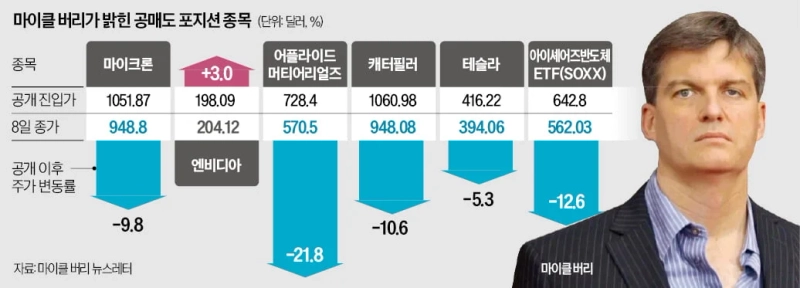
Some on Wall Street have also raised the possibility of a "Burry effect" after a series of sharp declines in stocks linked to positions recently disclosed by Michael Burry, the investor made famous by "The Big Short." Burry wrote on Substack on June 30 that he had opened new short positions in Micron, Nvidia, Applied Materials, Caterpillar, Tesla and the iShares Semiconductor ETF, known by its ticker SOXX.
Susannah Streeter, chief investment strategist at investment platform Hargreaves Lansdown, said Burry has a track record of identifying overheated markets and is also known for moving early. That may be contributing to a short-term "Burry effect."
Wall Street bulls also point to a pattern that has emerged over the past several quarters. Tech stocks have often pulled back after earnings before rebounding ahead of the next reporting season. This correction may be another extension of that trend.
Some analysts say the memory-chip industry's growth pattern is changing. The sector had long been treated as a classic cyclical business. But AI adoption is structurally increasing data-center investment and demand for high-bandwidth memory, DRAM and NAND flash, fueling expectations that the industry may be entering a longer-term growth phase unlike past cycles.
Goldman Says AI-Driven Earnings Bonanza Is Nearing an End
Others worry the memory boom could cool again as supply expands. Samsung Electronics' preliminary earnings, released recently, were also cited as a factor weighing on memory shares.
Samsung said operating profit rose about 19-fold from a year earlier. Even so, some investors viewed the result as falling short of expectations. Kerwin said the market may have interpreted Samsung's earnings as a sign that the steep rise in memory prices enjoyed by companies such as Micron could begin to slow.
Amit Daryanani, an analyst at Evercore ISI, said investors should focus less on spot prices and more on long-term supply contracts. Agreements with hyperscalers and the pricing in those contracts offer a more accurate gauge of memory-market conditions.
In a report, Daryanani said the memory sector remains one of the most attractive areas in the technology ecosystem despite short-term volatility. He added that it is reasonable for investors to trim positions in stocks that have risen sharply as they reassess the durability of memory pricing and the pace of AI spending by hyperscalers ahead of the next earnings season.
Goldman Sachs also said on July 8 that the string of AI-driven earnings surprises is unlikely to be repeated during second-quarter earnings season.
Christian Mueller-Glissmann, the firm's head of portfolio strategy and asset-allocation research, told Bloomberg TV that the wave of outsized AI-led earnings surprises appears to be nearing its final stage. Companies are still likely to top market estimates, he said, but expectations have risen so much that earnings alone may not be enough to reignite the rally.
Park Shin-young, New York correspondent / Kim Dong-hyun, reporter, Hankyung.com nyusos@hankyung.com

Korea Economic Daily
hankyung@bloomingbit.ioThe Korea Economic Daily Global is a digital media where latest news on Korean companies, industries, and financial markets.