Dollar’s Safe-Haven Status Fades as Shift to Return-Seeking Asset Jolts Economists
Forecast Trend Report by Period


From Reserve Currency to Return-Seeking Asset
The Dollar’s 80-Year Transformation
Treasuries, Stocks Draw Inflows
Pension Funds and Retail Investors Replace Central Banks
The US dollar is taking on a different role as America’s dominance of the global economy and stock markets stretches on. Analysts say it is becoming less of a reserve currency accumulated by central banks and more of a return-seeking currency held to access US capital markets. The change comes about 80 years after the 1944 Bretton Woods system established the dollar as the world’s reserve currency.
The US economy is projected to grow 2.3% this year, according to the International Monetary Fund’s World Economic Outlook released on July 8. That is well above growth forecasts of 0.9% for the euro area, 1.0% for the UK and 0.6% for Japan. The 10-year US Treasury yield is in the 4.5% range, higher than South Korea’s comparable yield in the 4.2% range. US stocks have set record highs 23 times this year, helping explain why more investors are holding dollars as a gateway to US assets.
That has shifted dollar demand away from central banks and toward pension funds, hedge funds and retail investors. Private investors now hold 58.1% of foreign-owned US Treasuries, more than the 41.9% held by central banks and other public-sector institutions.
Adam Tooze, a Columbia University professor, wrote in a recent Financial Times column that the US currency has become both “a promise of liquidity” and “a vehicle for capital accumulation.” He labeled it the era of the “profit dollar.” The shift stands to increase volatility in asset markets. Barry Eichengreen, a University of California, Berkeley professor, told the Korea Economic Daily that bigger swings in cross-border capital flows could make US interest rates far more volatile than in the past.
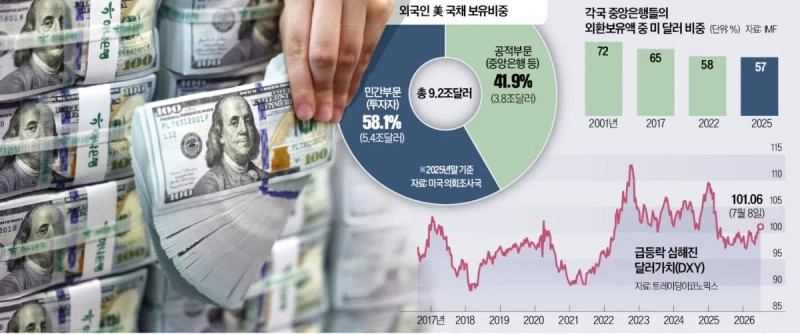
Private Investors Hold 58% of US Treasuries as Dollar’s Role Shifts, Volatility Builds
Dollar’s Move Toward Return-Seeking Role Weakens Its Hedging Power
Economists were shocked for reasons beyond the market selloff when President Donald Trump announced reciprocal tariffs from the White House in April last year on what he called “Liberation Day.” US stocks, the dollar and Treasury prices all fell together. That broke with the usual pattern in which investors flee to safe-haven assets during a market rout. The decline in Treasuries, long viewed as a classic refuge, set off active debate among economists. Their conclusion was that the character of the dollar itself has begun to change fundamentally.
Safe-Haven Role Weakens
Brad Setser, a senior fellow at the Council on Foreign Relations, said in a phone interview on July 8 that demand for dollars has changed structurally. “Over the last decade, most of the money flowing into the US has come not from investors seeking safety, but from investors seeking above-average returns, or alpha,” he said.
That does not mean the dollar is no longer a safe-haven asset, he said. But the nature of capital flowing into the US has changed. As the dollar takes on more characteristics of a risk asset, the risk is rising that stock selloffs and dollar weakness will occur at the same time.
Jakob Adolfsen and other former European Central Bank economists recently published an article arguing that the correlation between the US dollar and safe-haven assets has weakened in recent years. They wrote that a deterioration in the US net international investment position, defined as the difference between Americans’ overseas investments and foreigners’ investments in the US, has undermined the dollar’s status as a safe-haven currency. They also said the hedging benefits of dollar-denominated assets have become less effective than in the past.
Private Investors Take Over as Main Buyers
The decline in central bank dollar holdings also points to a fundamental shift in the currency’s role. As China’s public sector has slowed its dollar purchases, the combined foreign-exchange reserves of central banks worldwide have stagnated over the past decade. Over the same period, the US current-account deficit has expanded rapidly. Because the balance of payments consists of the current account and the financial account, someone has had to buy US Treasuries and other American assets to finance that deficit.
Private investors have increasingly taken over the role once played by foreign central banks. Foreigners held a total of $9.2 trillion in US Treasuries at the end of last year, according to a Congressional Research Service report. Private investors accounted for $5.4 trillion of that total, or 58.1%.
Demand to invest in US stocks was particularly strong. According to the Treasury Department, equities made up 56.2% of dollar-denominated US assets held by foreigners at the end of June last year, up from 51.1% a year earlier. Over the same period, the share of long-term bonds fell to 39.2% from 44.5%, while short-term debt rose to 4.7% from 4.4%. Given that short-term debt can eventually be redirected into equities, the data suggest the AI- and Big Tech-led boom in US stocks has been driving demand for dollars.
South Korean retail investors buying overseas stocks offer another example of the dollar’s role as a return-seeking currency. Overseas stock holdings in custody at the Korea Securities Depository surged to $180 billion at the end of May from $67.8 billion in 2021. That is the backdrop to Tooze’s argument that countries such as South Korea are helping finance US deficits.
Exposed to Bigger Swings
The shift could increase volatility across dollar-denominated assets, including Treasuries. Eichengreen said foreign investors looking to put money into the US often first buy short-term Treasury bills to park funds, then move into AI-related stocks and other assets when the timing is right.
He said it is positive that the US is viewed as an attractive place to invest. But private foreign investors such as hedge funds are far more fickle than conservative central bank reserve managers, and even a small adverse development can cause them to reverse their bets.
Lee Sang-eun, Washington correspondent / Kim Ju-wan, reporter, Korea Economic Daily selee@hankyung.com

Korea Economic Daily
hankyung@bloomingbit.ioThe Korea Economic Daily Global is a digital media where latest news on Korean companies, industries, and financial markets.