Power-Grid Stocks Surge on AI Data Center Demand; Gaon Cable Jumps 9.46%, Taihan Cable Gains 8.81%
Summary
- Power infrastructure stocks surged across the board on expectations that expanding AI data centers will sharply increase electricity demand.
- Investor sentiment is being lifted by the government’s three mega projects initiative, policy support tied to the power grid, and major orders announced by HD Hyundai Electric and LS Electric.
- Cable makers including Taihan Cable and Gaon Cable are expanding orders for ultra-high-voltage grids and AI data center power equipment, along with investment in production facilities.
Forecast Trend Report by Period


AI data center power demand surges, lifting electricity infrastructure stocks
Power-grid stocks rally across the board
Gaon Cable jumps 9.46%, Taihan Cable gains 8.81%
HD Hyundai Electric, LS Electric seen benefiting from major orders
Government’s "three mega projects" plan boosts outlook for transmission and distribution networks
Power infrastructure stocks surged on July 10 on expectations that the expansion of artificial intelligence data centers will drive a sharp increase in electricity demand. Rising global investment in AI data centers is fueling demand across the grid supply chain, from transformers and distribution equipment to cables, while a string of large order announcements from major companies has added to investor enthusiasm.
According to the Korea Exchange, Gaon Cable closed at 254,500 won on July 10, up 22,000 won, or 9.46%. Other major power infrastructure stocks also climbed, with Taihan Cable & Solution up 8.81%, LS Electric gaining 6.92%, LS rising 4.94% and HD Hyundai Electric advancing 4.42%.
The rally reflects growing concern over power-grid shortages. As the AI investment cycle spreads beyond semiconductors to power-generation equipment and transmission and distribution networks, worries are rising that power-supply bottlenecks could delay data center construction.
"Cable stocks are rising because grid shortages are becoming more pronounced as AI data centers expand," said Seo Sang-young, an analyst at Mirae Asset Securities. Building a data center is only part of the process, he said, as a massive power supply is also needed. That requires not only generation facilities but grid infrastructure to be built first.
Concerns about delays in data center construction also stem in part from grid shortages, Seo added. Demand tied to that trend is bound to increase, while government support for grid-related policies is helping revive investor sentiment.
The government on June 29 announced its "three mega projects" initiative, centered on semiconductors, AI data centers and physical AI. Large-scale data centers and advanced manufacturing plants will need not only more generation capacity but also expanded transmission and distribution networks to deliver electricity to end users.
This month has also brought a series of announcements on supply contracts for power equipment used in AI data centers, ultra-high-voltage grid orders and investment in production facilities.
HD Hyundai Electric said on July 2 that it signed a long-term supply agreement worth about 1 trillion won with a global big-tech company for data center power infrastructure. Four days later, it raised its order outlook for this year by about 24% to $5.2 billion from $4.2 billion.
"HD Hyundai Electric’s higher guidance and large data center orders show the strength of demand," said Na Min-sik, an analyst at SK Securities. Growth in Quanta Services’ order backlog is also accelerating, he said. For AI data center construction, power equipment — especially transformers — is the biggest bottleneck.
LS Electric is also seeing rising data center demand translate into more orders. The company booked 1.1 trillion won in orders in the first quarter, and cumulative first-half orders are estimated at nearly 3 trillion won. Analysts say that puts it on track to exceed its previous annual target of 4 trillion won in new orders.
"Contracts with big-tech companies for data centers are evolving beyond one-off deals into medium-term fixed contracts and package agreements," said Lee Sang-hyun, an analyst at BNK Investment & Securities. Because distribution products have short replacement cycles, the structure offers an attractive source of recurring, high-margin revenue that can feed directly into same-year sales, he said.
Demand for grid expansion is also spreading to cable makers. Taihan Cable said on July 8 that it won a 45 billion won order for a 330-kilovolt ultra-high-voltage grid project to supply power to a large AI data center in Australia. Last month, it also won the second section of the East Coast-Dong Seoul 500-kilovolt high-voltage direct current project, marking its first entry into South Korea’s domestic HVDC market.
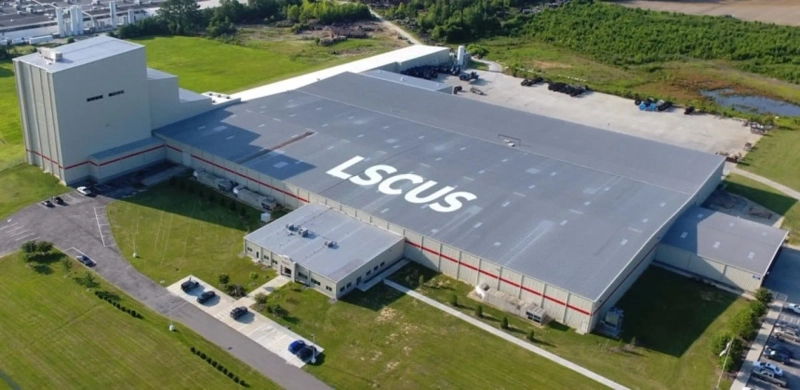
Gaon Cable last month won a 35 billion won order for medium-voltage cables for the power grid of a U.S. AI data center. Through its U.S. subsidiary LSCUS, it also signed a contract to supply 60 billion won of bus ducts, or large-capacity power distribution equipment, to a data center operated by a generative AI company. On July 8, the company said it would expand investment in production facilities and begin full-scale supply next year of 2,500-square-millimeter ultra-high-voltage cables built to Korea Electric Power Corp. standards.
Kim Yeon-ji, Hankyung.com reporter kongzi@hankyung.com

Korea Economic Daily
hankyung@bloomingbit.ioThe Korea Economic Daily Global is a digital media where latest news on Korean companies, industries, and financial markets.