South Korea to Invest $1 Billion in Physical AI, Build Robot Training Center
Summary
- The government said it will build infrastructure for physical AI, including a robot training center, behavioral data, and synthetic data.
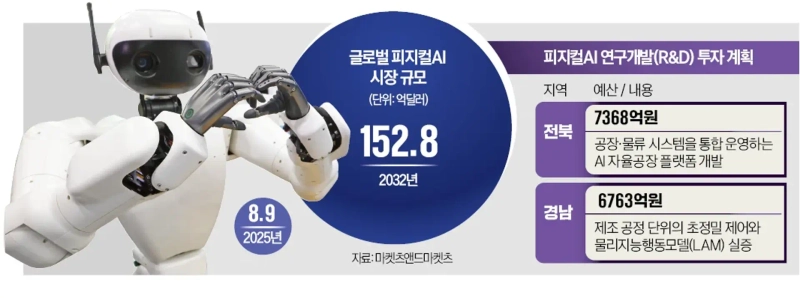
- It said it will pursue an AX research and development project worth 1.4131 trillion won from 2026 through 2030, including 676.3 billion won for South Gyeongsang and 736.8 billion won for North Jeolla.
- The government said it aims to strengthen manufacturing processes, autonomous factories, a K-physical AI-based manufacturing innovation model, and export competitiveness through physical AI.
Forecast Trend Report by Period


The South Korean government plans to build a "robot training center" to collect real-world data needed for physical artificial intelligence. The facility will gather and process the behavioral data robots need to reach, grasp objects and control equipment, while using synthetic data to fill gaps.
The Ministry of Science and ICT is moving to establish a facility to build training data for physical AI, industry officials said on July 13. The government believes competitiveness in the physical AI era will depend on who secures and trains models on real-world data first. Generative AI learned from text, images and code accumulated on the internet. Physical AI, by contrast, requires behavioral data generated as robots and equipment operate in real-world environments. The facility will serve as a hub for producing and processing basic motion data and synthetic data needed to run robots.
The government is pursuing the project because data shortages are viewed as the biggest bottleneck to deploying physical AI. For robots to pick up objects, hold tools, turn screws and work with production equipment, image recognition alone is insufficient. They need extensive training on unit-level physical actions such as reaching, gripping, twisting and pulling.
Fruit picking, for example, is a composite task from a robot's perspective. It combines object recognition, arm movement, finger-force control, twisting and pulling. The government plans to begin by securing low-sensitivity basic behavioral data from small and midsize business sites, regional demonstration projects and data held by startups.
Missing data will be supplemented with synthetic data. The technology creates large volumes of virtual training data by changing lighting, angles, object placement and work environments based on real data. Because data from industrial sites cannot be collected without limit, the government plans to use synthetic data to accelerate robot training.
The Ministry of Science and ICT and the National IT Industry Promotion Agency are also accepting applications through July 28 for the 2026 South Gyeongsang-North Jeolla AX research and development project. The program is part of the government's "three mega-projects for Korea's great leap forward" and will receive a total of 1.4131 trillion won, or about $1.02 billion, over five years from 2026 to 2030. Of that, 676.3 billion won, about $489 million, is allocated to South Gyeongsang Province and 736.8 billion won, about $533 million, to North Jeolla Province.
The 1.4131 trillion won AX research and development project for South Gyeongsang and North Jeolla is centered on applying physical AI technology to manufacturing sites using that data infrastructure. The government's view is that physical AI must integrate perception, judgment and control in the real world, limiting the industrial use of models developed only at the laboratory level.
In South Gyeongsang, the government will pursue a project called "Global Demonstration of a Human-AI Collaborative Physical Intelligence Action Model," or LAM. The goal is to secure ultra-precise control technology at the manufacturing-process level. The South Gyeongsang project will also develop physics-informed neural network, or PINN, technology that embeds physical laws such as thermodynamics and fluid mechanics into AI models. It will combine process, equipment and sensor data from factory floors to create data for precise prediction and control, and demonstrate models that allow humans and AI to collaborate safely.
In North Jeolla, the government will develop a physical AI software platform that connects and operates entire factories and logistics systems. The ministry plans to link South Gyeongsang's ultra-precise manufacturing control technology with North Jeolla's autonomous factory operations technology and develop them into a single physical AI platform.
Park Tae-wan, director-general for information and communications industry policy at the Ministry of Science and ICT, said physical AI is a core technology that will redefine the competitiveness of South Korea's manufacturing sector. The government aims to build a K-physical AI-based manufacturing innovation model led by AI, spanning production processes to factory operations, and expand it into global markets as a new source of export competitiveness.
Lee Young-ae, Korea Economic Daily reporter, 0ae@hankyung.com

Korea Economic Daily
hankyung@bloomingbit.ioThe Korea Economic Daily Global is a digital media where latest news on Korean companies, industries, and financial markets.