Kospi Nears Historic Valuation Low as US Big Tech Earnings Loom as Turning Point
Summary
- Analysts said the Kospi’s drop into the 6,000 range reflected worsening investor sentiment, calling it an excessive decline, an oversold zone, and a market trading at about 6 times PER.
- Several research chiefs said the Kospi below 7,000 represents a zone for buying the dip, valuation appeal, and a process of moving through the bottom, while some also mentioned the possibility of a historical floor at 6,500.
- Most strategists said the Kospi could regain 9,000, with US Big Tech earnings, AI investment capex, and ASML and TSMC earnings as the key variables for a rebound.
Forecast Trend Report by Period


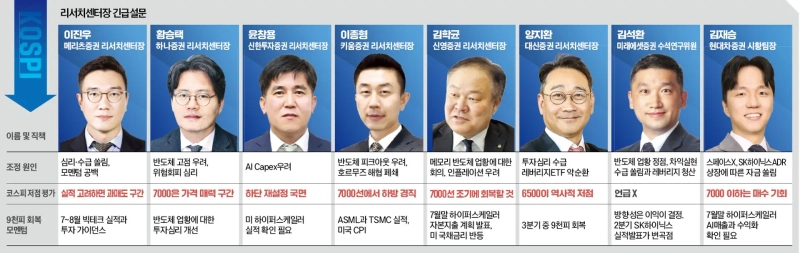
Analysts called the Kospi’s retreat to the 6,000 range for the first time in two months an excessive selloff. Fears of a peak in the semiconductor cycle, distorted trading flows tied to leveraged exchange-traded funds and the war in the Middle East combined to leave the market oversold, they said. Many also cited earnings from major US technology companies due later this month as the biggest variable in any recovery toward 9,000.
◇Kospi Sinks on Semiconductor Peak Fears
A Korea Economic Daily survey conducted on July 13 of research heads and market strategy chiefs at major local brokerages found broad agreement that the Kospi’s drop into the 6,000s was overdone. Lee Jin-woo, head of research at Meritz Securities, said the market had entered oversold territory relative to earnings. A price-to-earnings ratio of about six times is highly unusual. Kim Seok-hwan, senior research fellow at Mirae Asset Securities, said fear had been priced in more aggressively than any deterioration in earnings forecasts.
Respondents commonly pointed to worries over a semiconductor peak as the main reason for the correction. Hwang Seung-taek, head of research at Hana Securities, said concerns about a top in the memory-chip cycle and worsening investor sentiment were the main drivers. Samsung Electronics posted solid earnings, but they missed market expectations, he added.
Investor sentiment was also hit by a Korea Investment & Securities report forecasting SK Hynix operating profit would fall 8% short of market consensus. Chae Min-sook, an analyst at Korea Investment & Securities, said the firm lowered its operating profit estimates for this year and next by 9% and 11%, respectively, after incorporating price assumptions based on long-term supply agreements.
Global conditions and trading flows were also cited as sources of strain. Lee Jong-hyung, head of research at Kiwoom Securities, said renewed US-Iran tensions over a possible closure of the Strait of Hormuz had lifted both oil prices and US Treasury yields, adding to macroeconomic pressure. Lee Jin-woo said extreme concentration in the two largest semiconductor names had already left the market vulnerable, with leveraged ETFs acting as an amplifier. Retail fund inflows have weakened, while foreign investors have yet to return, leaving the market with a thinner demand cushion.
◇Below 7,000 Seen as a Buy-the-Dip Zone
After the Kospi fell as low as 6,806.93 on July 13, several strategists said the market had entered a range where bargain buying was possible. Kim Jae-seung, market strategy chief at Hyundai Motor Securities, said volatility remained high, but anything below 7,000 looked like an excessive short-term decline and a buying opportunity. Hwang said the market appeared to be entering a process of moving through its sentiment bottom. The area around 7,000 is where valuation appeal becomes more pronounced, he said.
Some, however, said investors should leave room for further downside. Yang Ji-hwan, head of research at Daishin Securities, said the selloff had been driven not by earnings but by worsening sentiment and weaker trading flows, making it difficult to identify a support level. Based on valuations seen during the 2003-2004 credit-card crisis, a historical floor would be around 6,500, he said. Yoon Chang-yong, head of research at Shinhan Investment & Securities, said that with 7,000 already broken, the market had entered a phase of resetting its lower range rather than defending the downside.
◇Big Tech Earnings to Decide Rebound
Most respondents said the Kospi had a strong chance of regaining 9,000. Yang said the uptrend could resume at any time because fundamentals, including earnings and the economy, remained solid. He expects a high probability of the index reclaiming 9,000 in the third quarter.
Several also said the key test would be earnings from major US technology companies. Strong profits and confirmation of continued artificial intelligence capital spending later this month would be critical to any recovery in share prices.
Hwang said that if US hyperscalers confirm an expanding AI investment trend in their results, concerns about a peak in the memory-chip cycle would ease. That could pave the way for a move back toward 9,000 after earnings season. Lee Jong-hyung said second-quarter earnings due this week from ASML and TSMC could become the catalyst for a turn in sentiment.
Kang Jin-kyu, Oh Hyun-ah and Ko Song-hee, Korea Economic Daily reporters josep@hankyung.com

Korea Economic Daily
hankyung@bloomingbit.ioThe Korea Economic Daily Global is a digital media where latest news on Korean companies, industries, and financial markets.