SK Hynix May Tap Joint-Venture Funding for Honam Fab Under Proposed Law
Summary
- The amendment would allow SK Hynix to secure outside investment through non-capital-region joint ventures and split roughly half of its plant construction investment costs.
- The government and the Democratic Party plan to pass a special law during the regular National Assembly session to relax the 100% ownership rule for holding-company great-grandchild companies to 50% in support of non-capital-region semiconductor clusters.
- The government set next year’s total spending growth target at “10%+α” and plans a record budget of more than 800 trillion won, premised on a tax revenue increase from the semiconductor boom.
Forecast Trend Report by Period


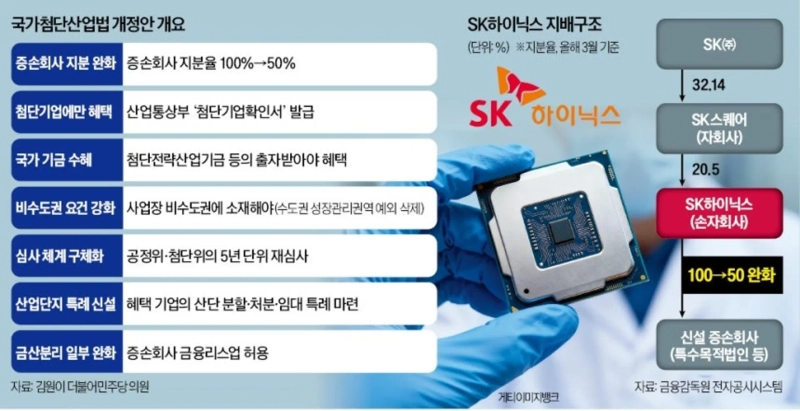
SK Hynix would be able to bring in outside capital for a fabrication plant in the Honam region under a proposed legal revision. Until now, holding-company rules have made it difficult for the chipmaker to raise external funding. The government and the Democratic Party plan to ease those restrictions through a special law aimed at supporting a semiconductor cluster in southwestern South Korea. The change could also help other advanced manufacturers attract external capital more aggressively and bolster the country’s lead in artificial-intelligence chips.
A draft amendment to the Act on Special Measures for Strengthening and Protecting the Competitiveness of National Advanced Strategic Industries, obtained by the Korea Economic Daily on July 13, sets out the deregulation plan. It comes about seven months after the government announced its intention to ease holding-company rules during the president’s year-end policy briefing. Democratic Party lawmaker Kim Won-i, a lawmaker from Mokpo in South Jeolla Province who served as the ruling party’s senior member on the National Assembly’s Trade, Industry, Energy, SMEs and Startups Committee in the first half of the 22nd Assembly, prepared the bill in consultation with the Ministry of Trade, Industry and Energy and other agencies. The government and the party aim to pass it during the regular National Assembly session that begins in September.
Under the current Monopoly Regulation and Fair Trade Act, a holding company’s great-grandchild company must be wholly owned by its grandchild unit. SK Hynix is a grandchild company of SK Inc. Critics say that rule has slowed efforts to build new semiconductor plants with outside capital. The amendment would add Article 34-2 to allow a holding company’s grandchild unit to own as little as 50% of a jointly funded corporation, or great-grandchild company, if the industry minister recognizes it as an advanced-technology company. The joint venture would also have to maintain its head office outside the Seoul capital region. Kim said the bill is intended to preserve South Korea’s lead in AI semiconductors and expand advanced industries beyond the capital area under the government’s “five growth poles and three special zones” strategy. He added that the government and the party would make an all-out effort to pass the bill in the regular session so the Lee Jae-myung administration’s southwestern semiconductor cluster does not remain only a declaration.
Separately, the government held a national fiscal strategy meeting on July 13 and set next year’s total spending growth target at “10% plus alpha.” It plans to draw up the biggest budget in the country’s history, with total spending exceeding 800 trillion won ($579.7 billion), on expectations that tax revenue will rise sharply amid a semiconductor boom.
Hynix Could Split About Half of Fab Costs With Strategic and Financial Investors
Easier M&A for Advanced Smaller Companies; LG Energy Solution Also May Benefit From Non-Capital-Region Investment
SK Hynix has been unable to bring in outside money for semiconductor fabs that cost trillions of won to build. Even as planned investment in the Yongin semiconductor cluster in Gyeonggi Province expanded from 120 trillion won ($86.9 billion) in 2019 to 600 trillion won ($434.8 billion) over six years, the company had to shoulder the burden alone. The obstacle was the Fair Trade Act’s requirement that a holding company’s grandchild own 100% of a great-grandchild subsidiary.
According to the National Assembly and industry officials on July 13, the government and the party decided to sharply ease the great-grandchild rule as they push three mega projects. The move reflects a practical judgment that South Korea can no longer rely on regulation alone if it wants to maintain leadership in AI and semiconductors while advancing regional decentralization. The two sides have spelled out conditions including a non-capital-region requirement and a dual review process, and are targeting passage during this year’s regular session.
Capital-Region Exception Dropped
Kim prepared the amendment in consultation with the industry ministry and other agencies. It gives concrete form to a policy announced about seven months ago at the president’s year-end policy briefing. The proposal would relax the Fair Trade Act by allowing a holding company’s grandchild to own 50% of a great-grandchild company, down from the current 100%, under Article 34-2 and related provisions.
The bill imposes conditions. The great-grandchild company must keep its principal office outside Seoul, Gyeonggi and Incheon. A provision the government considered last year that would have created an exception for growth-management zones in the capital region, including the southern Gyeonggi semiconductor belt, was removed. To qualify, a company would need approval not only from the Fair Trade Commission but also from the National Advanced Strategic Industry Committee under the Prime Minister’s Office. Cases would be reviewed again every five years after approval. Additional requirements include an advanced-company certification from the industry minister and investment from the advanced strategic industry fund within the National Growth Fund. The proposal also creates special provisions for industrial complexes under Article 34-3 and related clauses. While industrial land and factories can normally be leased or sold only after construction is complete, companies with national strategic technologies would be allowed to secure leases before completion.
The government and the party plan to pass the bill during the regular National Assembly session that begins in September. Kwon Jae-yeol, a professor at Kyung Hee University Law School, said the Fair Trade Commission’s rationale for regulating holding-company stakes — curbing the concentration of economic power — is a concept found only in South Korea among OECD members. An exception through the advanced industries law would fit global trends and help speed legislation, he said.
Joint Investment Gains Traction in Semiconductors
SK Hynix stands to be one of the biggest beneficiaries. As memory chip production has moved into the low-10-nanometer range, equipment costs have climbed. The industry’s cyclicality has also added pressure. SK Hynix posted record earnings in the first quarter of this year, but reported an operating loss three years ago.
For companies such as SK Hynix, the change would sharply reduce upfront cash needs and borrowing pressure. They would be able to bring strategic investors into special-purpose companies set up to build fabs, alongside financial investors such as the National Pension Service, Korea Investment Corporation and Korea Development Bank, and split roughly half of the investment cost. One industry official said that would allow companies to spread risk with outside partners and preserve room for capital spending even if business conditions worsen. It could also make mergers and acquisitions of smaller advanced-technology companies easier.
Global companies are already using joint-investment structures to reduce those risks. Intel adopted a “smart capital” strategy by forming joint ventures with asset manager Brookfield in 2022 and Apollo in 2024 to share factory investment costs. The measure could also apply to other Korean holding-company groups. LG Group may benefit if LG Energy Solution, a subsidiary of LG Chem, proceeds with large production facilities outside the capital region.
Lee Si-eun, Korea Economic Daily reporter, see@hankyung.com
Kang Hae-ryeong, Korea Economic Daily reporter, hr.kang@hankyung.com
Han Jae-young, Korea Economic Daily reporter, jyhan@hankyung.com

Korea Economic Daily
hankyung@bloomingbit.ioThe Korea Economic Daily Global is a digital media where latest news on Korean companies, industries, and financial markets.