South Korea Plans Spot Bitcoin ETFs in Second Half Through Law Revision
Forecast Trend Report by Period


Capital Markets Act revision planned for the second half of this year
Virtual assets to be included as eligible ETF underlying assets
Move would open crypto investing through brokerage accounts
"Crypto investment demand may rise again"
South Korea’s government will push to introduce spot Bitcoin exchange-traded funds in the domestic market by revising the law in the second half of this year. The move would come about two years after the first spot Bitcoin ETFs began trading in the US. At the center of the plan is bringing virtual assets into the legal framework by recognizing them as eligible ETF underlying assets under the Capital Markets Act.
◇ Lower Legal Hurdles
Under the “2026 Second-Half Economic Growth Strategy” unveiled on July 14, the Financial Services Commission plans to revise the Capital Markets Act in the second half of this year to allow spot Bitcoin ETFs. The most likely approach is to create a legal basis for including virtual assets in the range of eligible ETF underlying assets.
The current Capital Markets Act defines underlying assets for financial investment products as financial instruments, currencies and general commodities such as agricultural, livestock and fishery products, minerals and energy. Financial authorities have so far interpreted Bitcoin and other virtual assets as falling outside those categories. ETFs are collective investment products designed to track the price of a specific asset or index.
To launch a spot Bitcoin ETF, an asset manager must hold Bitcoin directly and set up and manage the fund on that basis. Because virtual assets are not recognized as underlying assets under the Capital Markets Act, there has been no legal basis for listing on South Korean exchanges a spot ETF that tracks Bitcoin prices.
Even after US regulators approved spot Bitcoin ETFs in 2024, South Korean financial authorities determined that domestic brokerages could risk violating the Capital Markets Act by intermediating overseas-listed spot Bitcoin ETFs. Local securities firms therefore halted new purchases of related products one after another. At the time, the Financial Services Commission said it would review whether to allow such trading in light of the implementation of the Virtual Asset User Protection Act and overseas cases. President Lee Jae-myung also pledged during his presidential campaign to introduce spot Bitcoin ETFs in South Korea.
Once the legal revision is completed, domestic investors will be able to buy Bitcoin exposure through spot ETFs in existing brokerage accounts rather than directly trading the token on crypto exchanges.
◇ New Variable for a Cooling Crypto Market
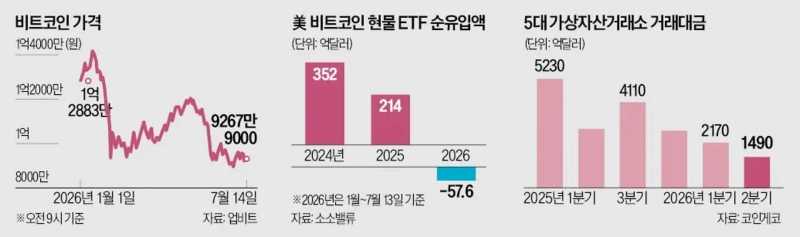
The US Securities and Exchange Commission approved the listing and trading of 11 spot Bitcoin ETFs in January 2024. Those funds drew more than $35 billion of net inflows in their first year. Spot Ethereum ETFs later came to market as well, extending the shift toward bringing crypto into mainstream financial products.
The industry says spot ETFs could reshape South Korea’s virtual-asset investment market. They would create a new investment channel through brokerages and asset managers alongside retail-led direct trading on crypto exchanges. An industry official said the products would also improve institutional investors’ access to crypto investments.
The move could also become a new factor in South Korea’s cooling virtual-asset market. According to CoinGecko, trading volume at the country’s five largest won-based exchanges — Upbit, Bithumb, Coinone, Korbit and Gopax — totaled $366.5846 billion in the first half, down 54.6% from a year earlier. Analysts attribute the decline to Bitcoin’s correction and rangebound trading after reaching a peak in the second half of last year, as well as strong gains in the domestic stock market that diverted investor attention. Kim Min-seung, head of the research center at Korbit, said spot ETFs could help draw investment demand back into South Korea’s crypto market. He added that while the move may come somewhat late, it remains significant because it would bring virtual assets into the institutional investment universe.
Cho Mi-hyun, Korea Economic Daily reporter mwise@hankyung.com

Korea Economic Daily
hankyung@bloomingbit.ioThe Korea Economic Daily Global is a digital media where latest news on Korean companies, industries, and financial markets.