Min Byung-deok Urges Faster Push for Won Stablecoins Before US GENIUS Act Takes Effect
Summary
- Rep. Min Byung-deok said won stablecoins would be central to financial sovereignty that protects Korea’s industrial competitiveness.
- Min said Korea should move quickly on regulatory reform as the US GENIUS Act is set to take effect in 2027 and more than 200 stablecoins are being prepared.
- Min said the spread of dollar stablecoins is expanding the payments market and the digital dollar market, and argued that Korea must preserve its domestic payments and settlement infrastructure in won.
Forecast Trend Report by Period


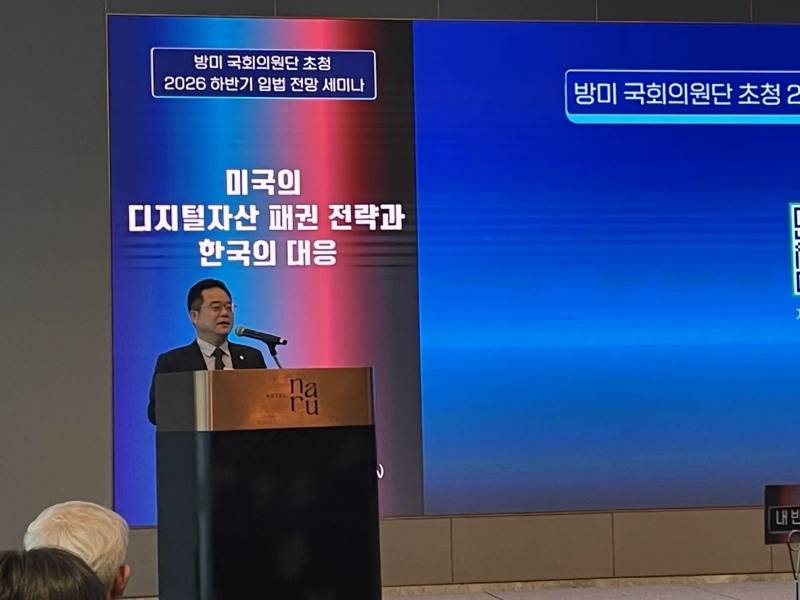
Min Byung-deok, a lawmaker from South Korea’s Democratic Party, urged Korea to speed up the introduction of won-backed stablecoins to counter the spread of dollar stablecoins. As the US moves to foster digital assets as national financial infrastructure linking payments, the Treasury market and capital markets, Korea must respond to protect its financial sovereignty and industrial competitiveness, he said.
Min made the remarks in a welcoming address at a seminar held July 15 at Hotel Naru Seoul MGallery in Seoul titled “The US Strategy for Digital Asset Dominance and Korea’s Response.” He said won stablecoins would be a key pillar of financial sovereignty needed to safeguard Korea’s industrial competitiveness.
What looks on the surface like regulatory reform for digital assets is, in essence, a digital expansion of the financial order, Min said. The US is treating digital assets as a matter of national strategy.
Min, Park Min-kyu and Kang Min-kook visited Washington and New York last month, where they met with the US Congress, the White House, regulators, exchanges, custodians and stablecoin operators.
Based on that trip, Min said the US is integrating payments, the Treasury market, capital markets, custody, cross-border settlement and industrial policy into a single financial infrastructure.
He also stressed that Korea needs to step up its response before the GENIUS Act, a US stablecoin regulatory bill, takes effect on Jan. 18, 2027.
More than 200 stablecoins are now being prepared, Min said. He expects at least dozens of them to win approval and enter global markets.
Korea has the technology, but if rules are delayed and infrastructure is lacking despite demand, the opportunity will move overseas, he said, calling for a swift regulatory overhaul.
Min also raised concerns about the effect of dollar stablecoins on Korea’s domestic payments market. The global stablecoin market has already exceeded $300 billion, he said, while Tether’s USDT and Circle’s USDC together make up a digital dollar market worth more than $250 billion.
The rise of dollar stablecoins signals that dollar-based payment networks are becoming the core infrastructure of the digital economy, he said. Once a payments market is lost, it is difficult to reclaim.
Korea needs won stablecoins so it can connect to a dollar-based digital order while preserving the foundations of domestic payments, settlement, data and industry in won, Min added. A realistic response starts with a clear reading of the US digital-asset strategy.
The seminar was organized to discuss the outlook for digital-asset legislation in the second half of 2026 and invited lawmakers who visited the US last month. Min and Park attended the event.

Minseung Kang
minriver@bloomingbit.ioBlockchain journalist | Writer of Trade Now & Altcoin Now, must-read content for investors.