Trump Drops 20% Hormuz Transit Fee After One Day, Seeks Gulf Trade and Investment Deals
Summary
- Trump said he would replace his plan to impose a 20% transit fee on the Strait of Hormuz with trade and investment agreements.
- The shipping industry said the transit-fee proposal could raise global transportation costs and add to inflationary pressure.
- It said US Central Command’s resumption of blockade measures against Iran and continued mutual airstrikes pushed oil prices higher, with crude trading around $80 to $85 a barrel.
Forecast Trend Report by Period


President Donald Trump said he would replace a proposed 20% fee on cargo moving through the Strait of Hormuz with trade and investment agreements, reversing course a day after announcing the plan.
Trump wrote on social media on July 14 that he had held “very productive talks with Middle Eastern leaders” and that Gulf states had decided to replace the 20% Strait of Hormuz transit fee with trade and investment agreements with the US.
Reversal After One Day
A day earlier, Trump wrote on social media that the US would “occupy” and control the Strait of Hormuz and “make a lot of money” in return for protecting the region. He said ships passing through the waterway would be charged 20% of the value of their cargo.
That is roughly comparable to wartime insurance costs. In early July, before fighting between the US and Iran intensified, insurance premiums stood at 1% to 2%. A 20% charge would be more than 10 times higher. Reuters estimated that, assuming traffic remained steady, the US could collect $240 million a day from the fee.
Trump later told reporters he reversed course after leaders in the Middle East called and asked him to “solve” the issue. Many viewed the 20% charge as high enough to wipe out the economic benefit of using the strait, making it difficult for Gulf oil producers to accept. He also said that “nobody should be charging a fee on this strait.”
The shipping industry has expressed concern that the US proposal could prompt similar attempts elsewhere. Jakob Larsen, chief safety and security officer at BIMCO, the world’s largest shipping association, told the New York Times that Trump’s plan would “drive up transportation costs globally and create inflationary pressure.” Comments by national leaders that undermine international norms on freedom of navigation also weaken those norms, he added.
Will the US Expand Its Military Presence?
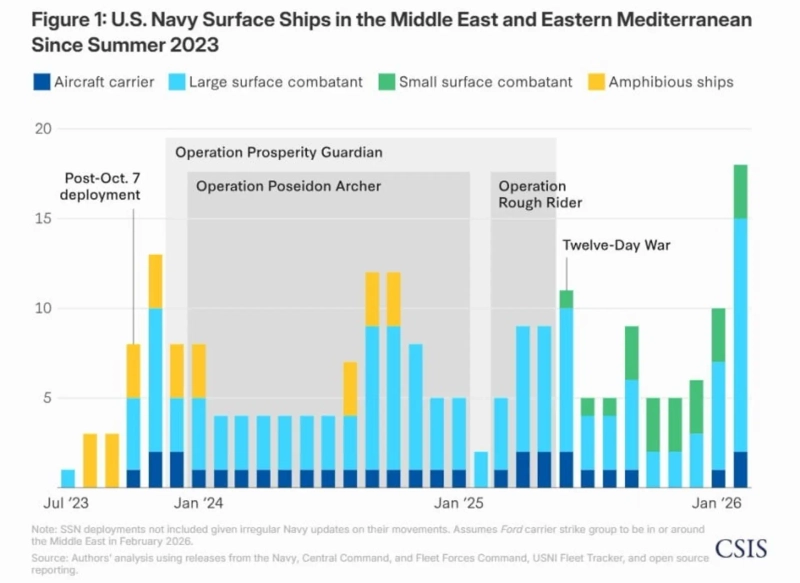
Trump said Gulf states would compensate the US through investment in exchange for protecting freedom of navigation in the Strait of Hormuz. It remains unclear whether Washington can sustain a defense posture above current levels.
The US deployed one or more aircraft carriers to the Europe-Middle East theater after Hamas attacked Israel in October 2023. A gap emerged in October 2025, when the USS Gerald R. Ford was redeployed to Central and South America. The move was in line with the Trump administration’s foreign-policy emphasis on the Western Hemisphere. After the war with Iran began, however, the US again concentrated carrier forces in the Middle East. At one point, the USS Gerald R. Ford, USS Abraham Lincoln and USS George H.W. Bush were all in the region. The Ford has since left.
The war with Iran has shown that aircraft carriers alone are not enough to fully deter Iran’s asymmetric threats. Carrier deployments are costly and can leave gaps in other theaters. The US also promised last month, in a memorandum of understanding with Iran, that it would withdraw troops from areas near Iran in the future. That underscores Washington’s reluctance to further expand its military presence in the region. The US may stop short of a buildup and instead seek to share part of the cost while maintaining its current posture.
Iran Blockade Resumes
US Central Command resumed blockade measures against Iran at 4 p.m. Eastern time on July 14, deploying more than 20 warships. Military operations have intensified further.
The US has continued airstrikes on major facilities inside Iran. Iran has also fired missiles and other weapons at US facilities in Bahrain, Kuwait and Jordan.
Iran’s Islamic Revolutionary Guard Corps said the US and its allies “should be prepared for other oil and gas exports that benefit them to also be blocked.” That has raised the possibility that Iran could use Yemen’s Houthi forces to disrupt the Bab el-Mandeb Strait.
Oil prices remained elevated. Brent crude for September traded at about $85 a barrel, while West Texas Intermediate for August remained above $80 a barrel. Both were up an additional 1% to 2% from a day earlier.
Lee Sang-eun, Washington correspondent, Hankyung.com, selee@hankyung.com

Korea Economic Daily
hankyung@bloomingbit.ioThe Korea Economic Daily Global is a digital media where latest news on Korean companies, industries, and financial markets.