TSMC Posts Record 2Q Profit of NT$706.6 Billion, Easing AI Peak-Out Fears
Summary
- TSMC said its second-quarter revenue, net income, and operating margin all exceeded market expectations.
- TSMC said it will invest $100 billion to build four additional fabs in Arizona and also raised its capital spending and revenue growth guidance for this year.
- The market said optimism over expanding AI infrastructure demand is coexisting with concerns about a semiconductor bubble, overinvestment by memory makers, and a potential surge in DRAM supply if CXMT goes public.
Forecast Trend Report by Period


Second-quarter net income reaches NT$706.6 billion
Up 77% from a year earlier
Advanced nodes below 7nm drive revenue
TSMC says it will build four more fabs in the US
CXMT IPO raises fresh oversupply concerns
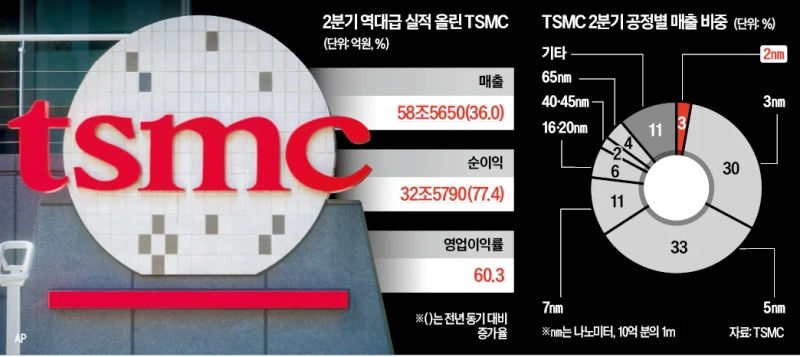
Taiwan Semiconductor Manufacturing Co., the world’s largest contract chipmaker, posted another record quarter as surging artificial intelligence demand drove an earnings surprise. A wave of AI chip orders from Nvidia, Apple and Broadcom helped lift revenue and profit to all-time highs. The results eased some market concerns that the AI boom may be nearing a peak.
Operating margin reaches 60.3%
TSMC said on July 16 that second-quarter revenue totaled NT$1.27 trillion and net income came to NT$706.56 billion. That easily beat market forecasts of NT$1.264 trillion in revenue and NT$632.64 billion in net income. TSMC shares closed 1.23% higher at NT$2,470, even as Asian chip stocks including Samsung Electronics and SK Hynix tumbled.
Second-quarter net income surged 77.4% from a year earlier, marking a ninth straight quarter of double-digit profit growth. Revenue rose 36% from NT$933.79 billion in the same period last year. Operating margin increased 10.7 percentage points to 60.3%. Gross margin came in at 67.7% and net margin was 55.6%.
Advanced manufacturing processes drove the strong performance. Chips made on 7-nanometer or smaller nodes accounted for 77% of total revenue. TSMC also recognized revenue from its 2-nanometer process for the first time, with that node contributing 2% of sales. Its main 3-nanometer process accounted for 30% of revenue, while 5-nanometer chips made up 33%. Smaller nodes generally deliver better chip performance and higher profitability. By business segment, high-performance computing, which includes AI chips, accounted for 66% of revenue.
TSMC also said it will invest $100 billion to build more than four additional fabs in Arizona. That would bring its cumulative investment in the US to $265 billion.
Capital spending and sales growth guidance raised
The strong results prompted the market to reassess fears of an AI peak-out. TSMC raised its 2026 capital expenditure plan to $60 billion to $64 billion from a previous range of $52 billion to $56 billion. It also lifted its annual revenue growth guidance for this year to 40% from 30%.
Bloomberg described the sharp upward revision as reflecting TSMC’s confidence in global demand for AI infrastructure. ASML Holding NV, the Dutch semiconductor equipment maker, also raised its full-year revenue guidance to 43 billion euros to 45 billion euros from 36 billion euros to 40 billion euros in its second-quarter earnings report.
The technology industry expects AI companies to keep spending on infrastructure. Even after the rise of assistant-style agentic AI, the shift to “physical AI,” in which more advanced AI is embedded across devices, will still require massive investment. Morgan Stanley Chief Executive Officer Ted Pick said at the firm’s second-quarter earnings presentation on July 15 that annual global data-center capital spending is projected at $850 billion this year and could reach $1.5 trillion by 2028.
That has reinforced expectations that chipmakers producing core components for AI data centers will see even steeper growth. Still, some investors continue to warn of a semiconductor bubble. Concerns are also growing over excessive investment by memory makers. In particular, there are worries that DRAM supply could jump if Chinese memory producer CXMT launches an initial public offering and secures significant funding.
Bae Seong-su, Kang Hae-ryeong and Son Ju-hyung, Korea Economic Daily reporters baebae@hankyung.com

Korea Economic Daily
hankyung@bloomingbit.ioThe Korea Economic Daily Global is a digital media where latest news on Korean companies, industries, and financial markets.