PiCK
Coinbase Says Stablecoins Could Sharpen US Regional Banks’ Competitive Edge
Forecast Trend Report by Period


The growth of the stablecoin industry could help strengthen the competitiveness of US regional banks, countering long-held concerns that the sector would undermine them.
Coinbase Institute, the research arm of US cryptocurrency exchange Coinbase, said in a report released July 15 that there is little evidence to support fears that stablecoins will erode regional banks’ deposit bases. The report was titled "Regional Banks and Stablecoins: Nothing to Fear, Much to Gain."
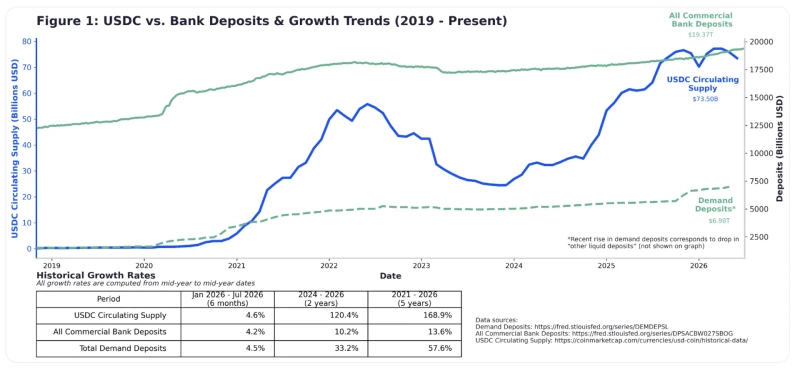
The institute said it found no statistically significant correlation between stablecoin growth and deposit outflows at US regional banks. During a period when Circle’s USDC market capitalization increased by about $75 billion, deposits at US regional banks also rose. Coinbase has offered rewards on Circle for more than four years, and no decline in bank deposits has been observed, it added.
The report also cited a 2024 UCLA study. It said 70% to 80% of US bank deposits are insensitive to changes in interest rates. Even when money-market fund yields climbed to about 5% in 2022, there was no large-scale shift in deposits.
Coinbase concluded that US regional banks could be among the biggest beneficiaries of the stablecoin industry’s expansion. In the past, global systemically important banks such as JPMorgan benefited from economies of scale because building payment systems, cross-border remittance networks and treasury-management infrastructure required heavy investment. Stablecoin networks built on public blockchains are significantly lowering those barriers to entry.
Regional banks could use stablecoins to offer 24-hour real-time payments, lower-cost cross-border remittances and settlement for tokenized securities on par with larger banks, Coinbase said. It also said stablecoins allow banks to provide those services without building their own systems.
"Stablecoins can strengthen, not replace, the role of traditional banks," Coinbase Institute said. As payment and treasury capabilities once dominated by large banks shift to shared infrastructure, regional banks stand to benefit the most, it said.

JOON HYOUNG LEE
gilson@bloomingbit.ioCrypto Journalist based in Seoul